The phone in my scrub pocket buzzed around eleven, just as I was trying to guide Mr. Albright’s shoulder into the MRI coil. My mother’s voice came through like she was sitting in the cab of her Silverado.
“I done sold the hens. And the bee boxes. You got room for my dresser with the mirror?”
I thumbed the volume down and stepped into the hall.
“What are you talking about?”
“I’m coming to live with you,” she said. “Friday.”
My name is Dani. I live in a two-bedroom shotgun house on Oak Street in Germantown, Louisville, with my husband Chris and our daughter Millie. My mother, Patsy, is sixty-seven and lives outside Hazard, in a house with a tin roof and a half-acre garden. My father died four years ago. She handled the grief by planting more tomatoes, not fewer.
So when she said she was moving in, I thought she was kidding. She drove that truck to church every Sunday, sold brown eggs at the farmers market, and told me more than once that city traffic made her want to throw up.
But she did not let up. Each night at nine-ten my phone rang. She had it planned. She would sleep on a cot in the kitchen. She would mind Millie after school. She would find a job at the Kroger on Goss Avenue.
“I’m not coming to sit on my hands,” she said. “I want a lighter life. Why can’t you understand that?”
I tried to explain. Our house has two bedrooms. Millie’s room used to be a pantry. Chris and I share one bathroom with a clawfoot tub that backs up when you flush twice. There is no dining room, no den, no spare room. You can stand in the middle of the living room and see every door.
“You have a floor,” she said. “I can put a cot next to the refrigerator.”
I did not know what to say. Her neighbor Geraldine is seventy-eight. She still mows her own yard and drives herself to church in Jenkins. Geraldine told me Mama had been giving away canning jars and washing her own curtains in the middle of the week. That was when I knew something had shifted.
Chris came home from his shift at UPS with a smear of sweat across his shirt and a gas-station coffee in one hand. I told him about the cot.
“Not happening,” he said. He set the coffee on the counter with a thump. “Your mother is not sleeping between my refrigerator and the back door.”
I agreed. But I also felt like a traitor for agreeing.
Then Mama called from the bank in Harlan County.
“I sold the house,” she said. “Ninety-one thousand. A man from Lexington is coming to change the locks on Friday.”
I was sitting on our front steps. The air smelled like fried baloney from the diner on Shelbyville Road.
“Mama. You didn’t ask.”
“I’m not asking. I’m telling you.”
“Where are you going to put your things?”
“I sold the chickens to a man in Jackson. Gave the rooster to the children’s center in Hazard. The dog went to your cousin Beth. I reserved a U-Haul.”
The bottom dropped out of my stomach. She had done all of it without one real conversation.
Millie asked if Grandma could sleep in her room. She even dragged out the Paw Patrol sleeping bag and unzipped it across the foot of her bed.
“No, baby,” I said. “Grandma is not coming for a sleepover.”
But I did not know what Grandma was coming for.
I tried one more time on Thursday night.
“Mama, if you need help, I can come down there. We can find you a place here, but not in my house.”
“I’m not paying rent,” she said. “Family does not charge family.”
“Then what do you call what you’re asking from me?”
She hung up. I stood in the kitchen and poured a glass of iced tea. The lemon had gone soft in the crisper, so I poured the tea down the sink and went to bed.
Friday came. A twenty-foot U-Haul rumbled up our street at six-forty in the evening, half on the curb, orange lights blinking. The neighbor’s coonhound, Biscuit, went crazy at the chain-link fence.
Mama climbed out with a lemon meringue pie in one hand and a blue vinyl zipper bag in the other. She had on her red slip-on shoes and the pearl earrings she wore to Daddy’s funeral.
“Traffic was terrible around Berea,” she said. “But I made it. Get Chris. There’s a dresser in the back.”
I did not move toward the U-Haul.
I walked down the steps and opened the passenger door again.
“Get back in, Mama. We have one stop before you unload.”
Her jaw tightened. “I’m not going to a motel.”
“Not a motel,” I said.
I drove her fourteen minutes to a brick building off Taylorsville Road. The sign read The Landings at Meadowbrook. The parking lot had fresh blacktop. I had been there the day before. In my purse was a manila folder with a signed lease.
We climbed to apartment 219. I unlocked the door. One bedroom, a kitchenette, new beige carpet, a small balcony over a retention pond. The place smelled like fresh paint and the inside of a new sedan.
Mama stood in the doorway.
“Whose place is this?”
“Yours,” I said. “As of this morning. The lease is in my name. You can live here.”
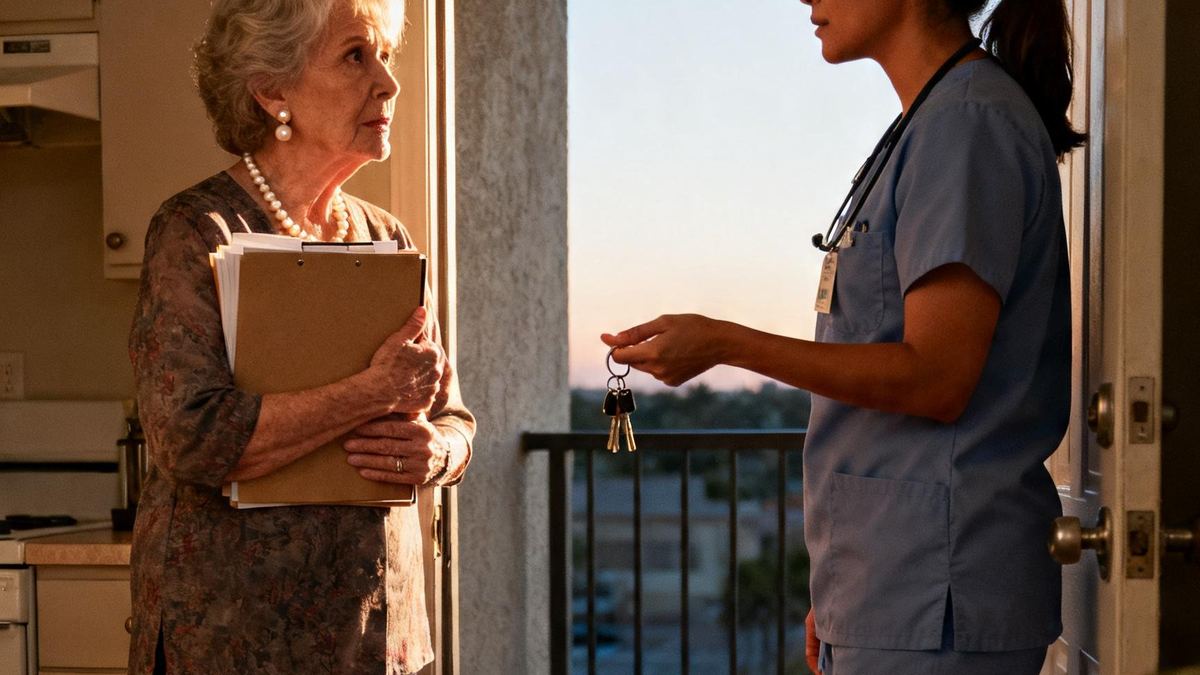
She opened her mouth, then closed it. I handed her the folder.
“First month and security deposit,” I said. “Two thousand three hundred dollars. I took it from the account I opened for Millie’s braces.”
She turned the pages like they might bite her.
“You spent two thousand three hundred dollars to keep me out of your house?”
“I spent two thousand three hundred dollars to keep you fourteen minutes from my kitchen. I love you. But you are not sleeping on my floor.”
Chris arrived a few minutes later with a hand truck and a box of trash bags. Mama looked at the keys in her palm, then at the U-Haul still parked down the block from our house with its lights on.
She said, “That pie’s going to melt if we don’t get it in a fridge.”
I said, “Then that’s the first thing we carry up.”
The three of us walked toward the truck. My mother walked in front, the lease folder clutched against her chest like a hymnal. I did not know if she was mad or heartbroken. But her feet were moving toward the back of that U-Haul, not toward my front door.