I was twenty-five minutes late because a fuel tanker had flipped near the Cullman exit of I-65, and by the time I reached the farm the red bedsheet was already tied to the mailbox. It wasn't a real flag. It was the sheet from the spare bed in the back bedroom, the one with the faded blue flowers.
Mama stood by the fence with a pair of bolt cutters. A coffee can of loose screws rested in her other hand. She set the can on the post and pointed the bolt cutters at the leaning chicken wire.
"You missed the trailer," she said. "It came at six-thirty for the goats."
"I didn't know there was a trailer."
"Because you didn't pick up."
"I was on the road. I called you at noon."
"I was at the auction lot with the rooster. Nobody wanted him. I left him behind the garage."
My mother is sixty-seven. She has a small farm outside Hanceville, Alabama, about forty minutes north of Madison. Four years ago, when my father died, she told everyone she would stay until the last possum moved out. That spring she painted the barn herself, up on an extension ladder, in a blazer and an old pair of work boots.
Now she had plastic totes lined up on the porch, each one labeled with blue painter's tape. One said "socks," another said "Christmas," another said "stuff for Ava."
I stood with my car keys digging into my palm. "Mama, I have a two-bedroom apartment off Wall Triana Highway. Tyler and Ava share the second room. You can't live with us."
She didn't look at me. She crimped a piece of wire over the latch and said, "I'll take the recliner."
"The recliner doesn't fit in the living room. We tried it when Marcus hurt his back."
"Then the couch."
"The couch sags. I put a folded moving blanket under the cushion. It's not for sleeping."
"Then I'll sleep on the floor." She said it the same way she used to tell me to go outside and pick the rocks out of the garden. No question mark anywhere.
I followed her into the house. The kitchen table was covered with brown paper. Half the dishes were in a copy-paper box. The radio on the windowsill was tuned to a classic country station, and the announcer's voice was rattling off a furnace tune-up special. On the counter sat a stack of mail with a canning jar anchoring it. I saw a cancellation notice from the propane company.
"You canceled the propane?" I said.
"I'm not going to need it."
"Mama. You can't just decide to move into my apartment."
She opened the refrigerator and handed me a cup of sweet tea. It had the same chip on the handle from when I dropped it as a kid. "I already sold the hens to the girl at the Dollar General on Highway 31. The goats are gone. I gave the milking stand to Cecil across the road. I listed the hay spear on Facebook Marketplace for two hundred dollars."
I took the tea because I didn't know what else to do with my hands. I was seeing the same woman who, three weeks earlier, had called me to say she'd killed a copperhead with a garden hoe. Now she was packing her good spoons.
Marcus called while I was sitting in the car in her driveway. I told him. He was at the plant, and I could hear a forklift backing up in the background.
"She's just bored. She'll get over it by Thanksgiving," he said.
"She canceled the propane, Marcus."
"Then she'll turn the heat back on when she gets cold."
I wanted to throw the phone at the mailbox. But I didn't. I said goodbye and drove back to Madison, past the shack on the corner that sells boiled peanuts out of a trailer, past the billboard with the missing dog from Decatur. The whole way I kept going over the same sentence: she is not asking.
The next week, she called every day at four. Not to talk. To report what she'd sold.
"I sold the pressure canner."
"I gave the old barn cat to the vet's office."
"I put the bedroom set on consignment at the furniture place on Highway 31."
I stopped answering after Thursday because I couldn't find a reply that wasn't a yell.
On Saturday I went to the bank, then to a property management office on Hughes Road in Madison. I didn't tell Marcus. I didn't tell my mother. I asked to see a one-bedroom they had in a 55-and-over building called Autumn Trails. It was beige, with a little patio, no steps, a washer-dryer hookup. I paid first month's rent and a cleaning deposit—$1,495 on a Visa card—and got a receipt. The unit wouldn't be ready until the first. The manager handed me a six-page lease with a sticky note on the front: "Sign at move-in."
Then I called a real estate agent in Cullman. Her name was Tracy Boykin. She had a voice like she'd been smoking since the Carter administration. I said, "My mother has a farm outside Hanceville. She wants to sell it. I need you to come look at it Monday."
"My sister covers the western part of the county. I'll give you her number," she said.
"No, I want you. Somebody local, not a stranger."
I could hear her tapping a pen against a coffee mug. "You know the farm isn't going to buy your relationship back, right?"
I didn't answer that. I wrote down her number and hung up.
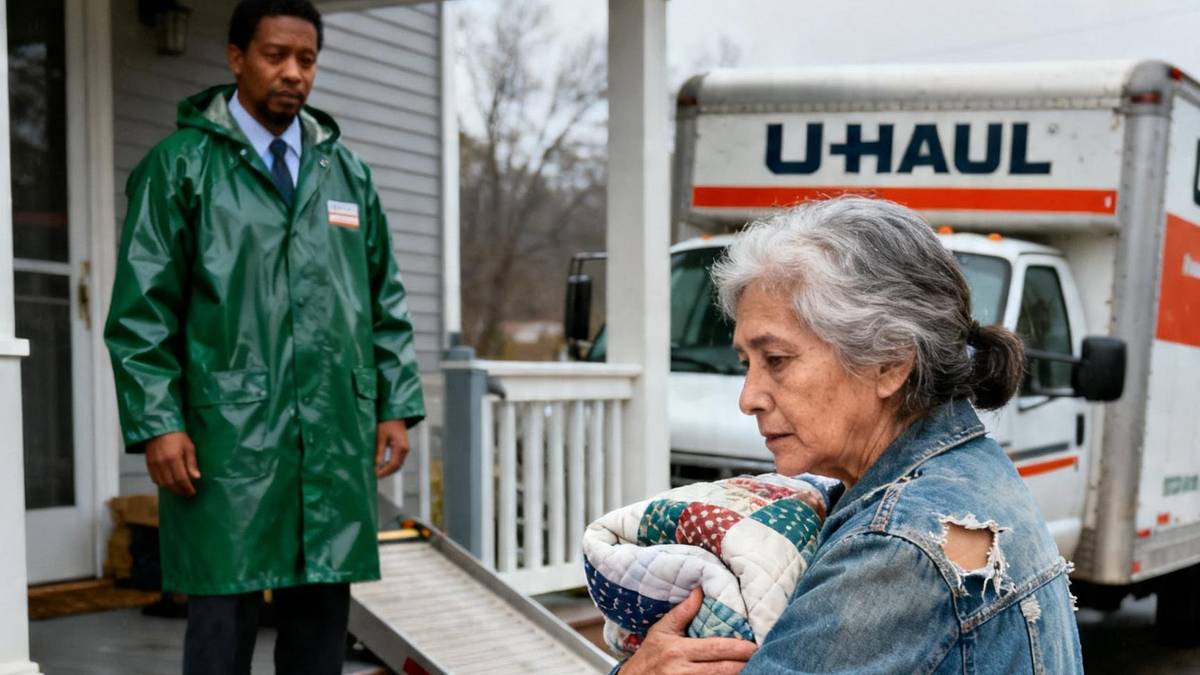
The following Monday, I drove north again. This time there was no wreck on I-65. The sky was that thick gray that comes before a hard rain. When I turned onto the farm road, the U-Haul was already there, backed up to the garage with the ramp down. Mama was standing on the porch with a stack of quilts in her arms. She had on my dead father's denim jacket, the one with the torn pocket he never would let her sew.
I parked behind the U-Haul and got out. I didn't slam the door. I walked over and set a folder on the hood of the truck.
"Are you happy now?" she said. "I found a man to buy the hay trailer for four hundred dollars."
"I brought you something."
"I don't want anything from you except a key to your building."
"That's not happening," I said. "But I put a deposit down on a place."
She stopped. The quilts slid off her shoulder and caught on the porch rail. She didn't pick them up.
I opened the folder. The receipt from the property management office was on top, with the dollar amount and the unit number. Under it was the lease. Under that was a printout of a listing agreement with the real estate office's name at the top.
"You sold the goats," I said. "You canceled the propane. You put the rooster behind the garage. You did everything but sell the house."
"I don't want to live by myself anymore."
"Then don't. But you made a choice to leave. I'm making sure you don't end up on my floor."
I took the receipt out of the folder. "Autumn Trails. One bedroom, no steps, twelve minutes from my apartment. First month's rent and deposit are paid. The unit opens Saturday. You can bring the quilts. You can't bring the rooster."
She looked at the paper. Her hands were red and cracked from the cold. "You think I want to sit in a beige apartment and watch a parking lot?"
"I think you want somebody to notice you're scared," I said. "You've been giving this place away piece by piece for two weeks and calling it moving. That's not moving. That's waiting for one of us to catch you."
She didn't answer right away. She reached down, picked up the quilts, and pressed them against her chest like she was warming her hands on them.
"Your daddy died in that back bedroom," she said. "I've slept on the other side of the bed for four years so I wouldn't have to look at the empty half in the morning. I'm not scared of the farm, Erin. I'm scared of an apartment where there's nobody to hear if I fall."
Tracy's Buick came up the drive then, tires crunching gravel, a magnetic sign on the door. She got out in a green raincoat and waved like we were at a church picnic. "Dee? I'm Tracy. You must be Erin. Your daughter said you'd be expecting me."
Mama looked at me. "You already called her."
"I told you I wasn't going to let you sleep on a broken couch. You wanted out of the farm. Fine. Let Tracy tell you what it's worth. Nobody's making you sign anything today."
Tracy set her folder on the porch steps and opened it. "I ran the county records this morning. A little over nine acres, two outbuildings, a three-bedroom built in 1978. If the well and septic check out, you're looking at two-eighty, maybe three hundred thousand."
Mama put her hand on the porch post, not for balance, just to touch something that was still hers for a few more minutes. Then she looked at me — really looked, the way she used to check a fever with the back of her hand.
"I don't want your apartment," she said. "And I don't want to sell the whole nine acres and go live in a box in Madison where I don't know a soul. Tracy, can you sell the back seven and the far outbuilding, and leave me the house and the barn?"
Tracy flipped a page. "Split like that? Sure. You'd clear less, but you'd keep your address."
"Then that's what we're doing," Mama said. She turned to me. "You can cancel your Autumn Trails. I'm not moving to a parking lot. But I'll take a phone with the big buttons, and I want you calling me every day at four instead of me calling you. And Cecil's boy is going to start coming by to check the propane, because yes, Erin, I'm turning it back on."
I laughed, and it came out messier than I meant it to. "I already paid the deposit. I'm not getting that back."
"Then give it to Tyler for college," she said. "I raised one daughter who throws away money worrying about her mother. I don't need to raise a second one."
We stood there while Tracy drew up a subdivision line on a legal pad, the rooster crowing from behind the garage like he had an opinion about the whole thing. Mama sent me home with the quilts and kept the recliner.
The U-Haul sat in that driveway until the following Saturday, but it never left the property. Cecil and his boy helped unload it back into the house — the good spoons, the pressure canner she bought back from the consignment shop for ten dollars more than she'd sold it for, the bedroom set. Autumn Trails kept my $1,495. I still think about asking for it back sometimes. Mostly I think about the four o'clock phone calls, how she answers now instead of reporting, and how last week she told me the rooster finally found a hen he liked over at Cecil's, and wasn't that something, at his age.