Walter opened his eyes at 5:58. The clock radio was set for 6:00, but he always beat it by two minutes. He’d lie there cataloging the day—coffee, black with two sugars. Oatmeal with raisins. The Wall Street Journal, sections A through C. Then the walk, exactly one hour, the same loop through the Arboretum, past the lilac bushes Eleanor had loved. After she died four years ago, the schedule became his spine. Without it, he’d just disintegrate.
One Tuesday in June, his granddaughter Maya showed up on his doorstep in Madison, sunburned across the nose, a duffel bag in one hand and a pet carrier in the other.
“Pops! I have a favor that’s miniscule but huge.”
She was twenty-two, a theatre major at UW, and always running from one catastrophe to the next. She set the carrier down and threw her arms around him before he could sidestep. Through the mesh door, a black nose twitched.
“What is that?” Walter asked.
“A dog. A dachshund, actually. His name’s Benny. Very chill, very low-maintenance. I swear.”
“I can see he’s not a badger. But why is he in my hallway?”
She launched into the whole saga: her roommate’s dog, a summer internship in New York starting Monday, the sublet that forbade pets like it was a maximum-security prison. “Just for three weeks, Pops. He’ll stay outside. You won’t even know he’s here.”
Walter looked at the screened porch off the kitchen. He hadn’t stepped foot on it since Eleanor’s last summer, when she’d sit out there with a book and a glass of lemonade. “The porch. He stays on the porch. That’s the rule.”
Maya’s face cracked into a smile. “Deal. Porch rule. Absolutely.”
She unzipped the carrier. Benny emerged slowly, like a small, sleek submarine surfacing. Long and low, brown with a darker saddle on his back, and his eyes didn’t just look at things—they calculated them. He sniffed the entryway rug, then trotted into the living room, walked to the exact center of Eleanor’s Persian rug—the one she’d bought in Istanbul back in ’78—and sat down. He looked up at Walter as if to say, *I’m here. Now what?*
“The porch,” Walter said, pointing toward the kitchen door.
Benny yawned. A long, luxurious yawn that showed off a pink tongue and a full set of teeth.
Walter took a step forward. Benny didn’t bolt. He just slid under the sofa until only the tip of his tail was visible.
Walter stood there, frozen. He’d faced down planning commissions, contractors who stole copper wire, and once, a mob of parents so furious they’d threatened to tar and feather him after he cut the middle school play. This dog—this tube-shaped creature with legs too stubby for any practical purpose—had completely ignored his authority.
From the kitchen doorway, Maya whispered, “He really, really likes rugs, Pops. It’s his thing.”
“He stays on the porch,” Walter repeated, but it sounded hollow even to him.
By nightfall, the porch rule was in tatters. Walter sat in his recliner with the evening news on, and Benny was curled into a tight circle at his feet. Walter’s left hand rested on the dog’s flank, the way it used to rest on Eleanor’s knee.
About a week in, Walter stopped noticing the inconvenience and started noticing the rhythm. Benny woke with him at 5:58, ears perking before the radio even clicked on. He’d sit by the coffee maker, watching the drip. On their walks, he matched Walter’s pace, not pulling, just a steady, quiet presence—a heartbeat with four paws.
One morning, Walter read aloud from the paper. “The school board wants to slash the arts budget again. A disgrace.” From the floor came a sharp bark. Benny had stood up, head canted, eyes locked on Walter. “You think so too?” Another bark. Walter nodded. “Good dog. At least someone around here has some common sense.”
That was their first real conversation. There were many more after that.
The next week, he stopped at the pet store on Monroe Street to grab more biscuits. He’d reached for the economy bag off the bottom shelf—the same one Maya had left—when his eye snagged on a smaller bag above. It said, “Grain-free, with wild-caught salmon and sweet potato. For active small breeds.” He held it, put it back. Then he thought about Benny tearing around the backyard, chasing squirrels like a tiny lunatic. The dog was very active. He bought the salmon formula.
At home, he poured a scoop into the bowl. Benny sniffed once, then dug in, tail swishing like a metronome. Walter stood there, watching him eat, and felt a quiet, unfamiliar warmth. It wasn’t joy, exactly. More like the satisfaction of tightening a screw that had been loose for years.
On a Thursday morning, their walk took them past the bench where Mrs. Chen always sat, her two canes propped beside her. She was eighty-two, sharp as a tack, and knew everyone’s business on the block. “Mr. Adler! You’ve gone and gotten yourself a dog!”
“It’s my granddaughter’s,” Walter said. “She picks him up tomorrow.”
“A shame. That’s a handsome animal. My Harold loved dachshunds. Said they were smarter than half the lawyers he worked with.” She leaned forward on her canes. “You’ll miss him.”
“I won’t. I’ll have my order back.”
But that night, he lay in bed and imagined the house without Benny. The coffee maker would still gurgle at 6:00, but no small body would be there to supervise. The walk would happen alone, the same path, no soft toenail clicks beside him. He’d have his order, yes. He’d have the silence. He’d have the empty rug and the spotless floor and the whole, wide, desperate loneliness he’d spent four years trying to ignore.
He didn’t sleep well.
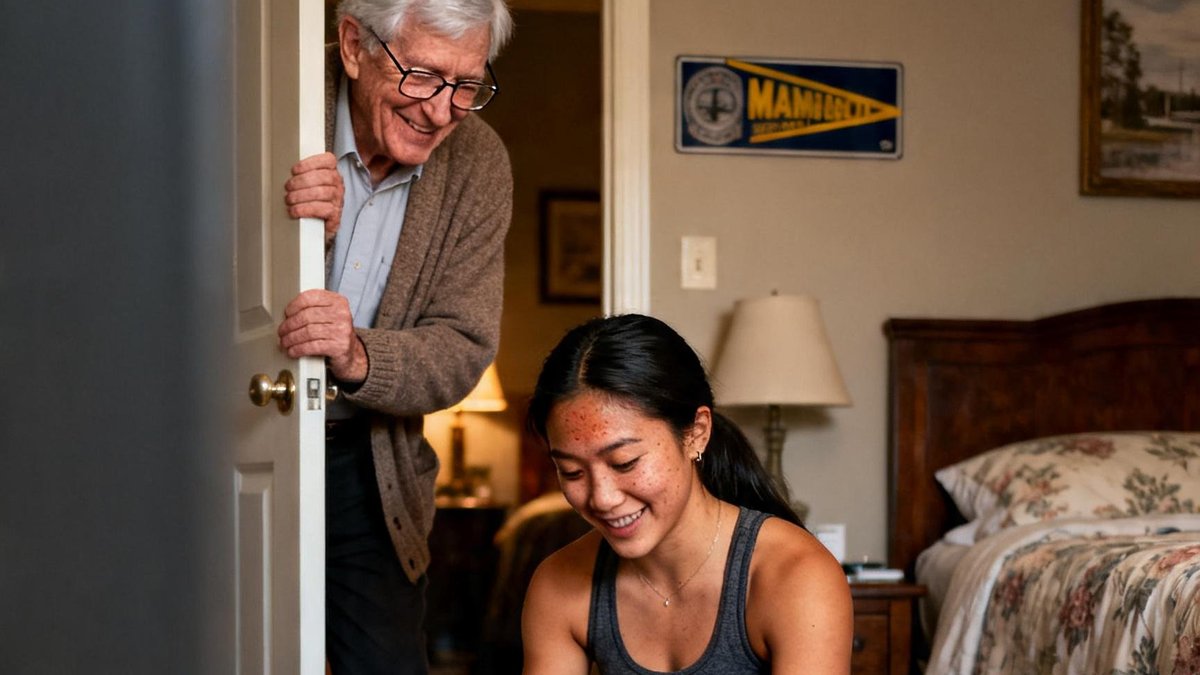
Friday evening, Maya was packing her duffel bag in the guest room. Benny sat an inch from her feet, his gaze locked on her hands as she folded a tank top. A thin, anxious whine leaked from his throat.
Walter leaned against the doorframe and cleared his throat. “Leave him.”
Maya froze, the shirt halfway into the bag. “Sorry, come again?”
“The dog. Leave him. I’ll keep him.”
She stared at him, then a grin spread across her face—the kind of grin that happens when something you’d hoped for but never expected suddenly goes real. “Are you serious, Pops?”
Benny barked once. Short, crisp, like a gavel coming down.
The next morning, Walter insisted on carrying Maya’s bag to the car. At the curb, she hugged him hard enough to make his spine pop. “Call me,” she said.
“I will. And you call me.”
“I don’t call just to chat.”
“Call anyway.”
She laughed, blinked rapidly, and climbed into the driver’s seat. As the car pulled away, she stuck her arm out the window, waving until she disappeared around the corner.
Walter stood in the driveway until the breeze turned cool. Then he walked back inside. Benny was waiting at the front door, tail swinging in a slow, hopeful rhythm.
Walter hung up his jacket. He unlaced his shoes, set them on the mat. “All right,” he said. “It’s just you and me now.”
Benny yipped once. They understood each other.
The schedule held. Up at 5:58, coffee at 6:05, walk at 7:00. But now there were three walks a day, and a weekly run to the pet store for the grain-free salmon. Every morning, Walter read the news aloud, and Benny sat beside him on the rug, ears tilted right, an audience of one. Every evening, the dog climbed onto the ottoman and rested his chin on Walter’s shins. When the lights went out at 9:30, Walter lay listening to the dog’s breath—soft, steady, a small engine of warmth in the dark.
The silence was still there. But it wasn’t hollow anymore. It had weight and shape and company.