— Renata, be honest with me — has your father ever helped anyone without expecting something back? — Marisol Castillo set two plates of pancakes on the kitchen table in her mother's condo in Scottsdale, Arizona, and sat down across from her. — Not a loan with interest, not a thirty-minute lecture about responsibility. Just: here, take it, you need it.
Her mother, Renata Alvarado, adjusted the napkin next to her coffee cup and shrugged.
— Your father's counted every dollar his whole life. That's why we have what we have.
— I'm not asking how he made his money. I'm asking if he's ever once helped me since I graduated.
— Marisol, are you starting this again?
— No. I just want to understand.
From the next room came her father's voice.
— What's there to understand? Grown kids build their own lives.
Héctor Alvarado walked into the kitchen in his undershirt, dropped his keys on the counter, and looked at his daughter.
— You always said you wanted to be independent. So be independent.
— I am independent, Dad.
— Then why are we having this conversation?
Marisol's mouth twisted into something that wasn't quite a smile.
— I was just remembering how you bought Diego a truck the week he turned twenty.
— He worked for me.
— Two afternoons a week.
— He was learning the business.
— And the condo you two put in his name after the wedding?
Héctor pushed his chair back.
— Did you come here to audit our finances?
— No. I came for pancakes with Mom.
— Then eat your pancakes.
Marisol picked up her fork, held it a moment, set it back down.
Now — I'm Diego. My sister tells this story like I got handed a life on a silver platter and never once had to sweat for it. That's not how it looked from where I was standing.
Our dad built a cabinet and countertop shop outside Tucson back in the late nineties, working with two guys in a rented warehouse off Valencia Road. By the time I was old enough to remember anything, he had three retail locations, a warehouse, and a couple of rental properties he never talked about at dinner. And yeah, I got a truck. A used F-150, not new, with 60,000 miles already on it, because he said a man who drives something too nice gets lazy. I got a laptop because I asked for the cheapest model on the list and he doubled the budget without me asking twice — that part's true, and I never really understood why it was different for me than for Marisol, except that I never pushed back on him the way she did. Maybe that's the whole answer right there. He gave to the kid who didn't argue.
What Marisol doesn't know — because she never asked — is that "working for him" two afternoons a week also meant six a.m. Saturdays doing inventory in a warehouse that smelled like sawdust and machine oil, freezing in January because he wouldn't run the space heater near the finished wood. She remembers the reward. I remember standing there at seventeen while he pointed at a stack of mismeasured cabinet doors and said my name wasn't going on the business until I stopped making mistakes like that.
The condo after the wedding — true. Two bedrooms, off Speedway Boulevard, a twenty-minute drive from the shop. What she doesn't mention is that it came with an unspoken condition nobody wrote down: I showed up to every family dinner, every Sunday, no exceptions, for six years. Bianca used to joke that the condo's real monthly payment was our social calendar. I used to laugh about it. I don't laugh about it anymore, honestly, not since Dad started acting like that arrangement bought him a say in everything else — including, later, a much bigger blowup than pancakes at a kitchen table.
Our older sister Lucía waved it all off whenever Marisol brought it up.
— Marisol, stop keeping score on what Diego got. You're not going to change anything.
— Doesn't it bother you?
— I've had my own life for years. My husband does well, we've got a house, the kids are growing up. Why would I pick a fight with Dad?
— Because it's not fair.
— Fair is different for everybody.
Lucía spent a couple of years trying to set Marisol up with men she considered suitable.
— This is Rob. Owns a construction company, house out near Oro Valley, very calm guy.
— I don't like him.
— You talked to him for ten minutes.
— That was enough.
— Then there's Marco. Runs a dental practice.
— No.
— What do you want?
— Someone I actually feel good around.
— And will feeling good pay your bills?
Marisol laughed it off.
— Lucía, I'm not merchandise at a swap meet.
At twenty-seven, she met Danny Reyes. He worked as an engineer at a manufacturing plant near Rita Ranch, had a small two-bedroom apartment, an old Civic with a cracked bumper, and a habit of making pancakes every Saturday — the same recipe Marisol later made for her mother, which tells you something about who she picked to build a life with. They married a year later.
At the wedding dinner, Héctor studied his new son-in-law for a long moment.
— So what's your five-year plan?
Danny answered evenly.
— Work, grow into the role, fix up the apartment, eventually get something bigger.
— And your salary supports that?
— Not all at once.
Héctor's face soured.
— You should aim higher.
Danny just said:
— As long as the goals are mine.
Under the table, Marisol touched his hand.
A few years passed. They had two daughters, Camila and Rosa. The two-bedroom apartment got small fast — kids' clothes crammed into every closet, a fold-out art table wedged into the living room, a bike barely fitting on the balcony between moving boxes.
One evening Danny came home from work, set the grocery bags on the counter, and said:
— I looked at some listings today.
— And?
— There's a good one in a new building off Wilmot. Three bedrooms, real kitchen, two kids' rooms.
— How much?
He told her.
Marisol laughed.
— Then we'd need to sell this place, take out a massive loan, and get the cat a job.
— Leave the cat out of this. He provides emotional support around here.
— I'm serious, Danny. We're short by a lot.
He sat next to her.
— Would you talk to your dad?
She shook her head immediately.
— No.
— Why not?
— Because I already know the answer.
— He's got a couple of rental properties. One's occupied, the other one's sat empty for months.
— Which means it'll stay empty another ten years.
— Marisol, we're not asking him to hand us a house. We could ask to borrow part of it. We'd pay it back.
She sat with that a while, then sighed.
— Fine. I'll ask once. And we never bring it up again.
That Saturday she drove out to her parents' place alone. Héctor was in the garage when he spotted her.
— Where are the girls?
— With Danny.
— Come in. Your mother made tamales.
At the table, she couldn't get to the point right away. Renata talked about a neighbor's hip surgery. Héctor showed her new photos of the shop floor. Finally Marisol set down her cup.
— Dad, I want to talk to you about something.
— Go ahead.
— We're looking for a bigger place.
— Good. You've been cramped for a while.
She felt herself relax a little.
— We found a three-bedroom. Even if we sell ours, we'll still be short a significant amount. I wanted to ask if you'd loan us part of it. We'd set up a payment schedule and pay you back gradually.
Héctor's expression went flat.
— How much?
She named the figure.
— No.
She waited for more.
— That's it?
— What else is there?
— I hadn't even finished explaining.
— What's left to explain? It's a lot of money. I'm not pulling cash out of the business.
— I wasn't asking you to touch the business. You've got savings.
His eyes snapped up.
— How do you know what I've got?
— Dad, you own several properties.
— That's my business.
— Fine. Then would you at least let us stay in the empty one near the park for a while? We'd rent ours out and save up faster.
— No.
— Why not?
— Because today you stay there, tomorrow you're renovating, and the day after you've decided it's yours.
Marisol just looked at him.
Renata tried.
— Héctor, maybe just for a year?
— No. Let them handle their own situation.
— Dad, you have two granddaughters.
— And?
— Nothing.
Héctor pushed his cup away.
— You chose Danny with your eyes open. I never told you not to. Now go build your life with him.
She stood up slowly.
— Okay.
— Don't be upset.
— I'm not going to argue.
— Good.
At home, Danny read it off her face before she said a word.
— He said no?
— To the money and the apartment both.
— Figures.
— Told us to handle it ourselves.
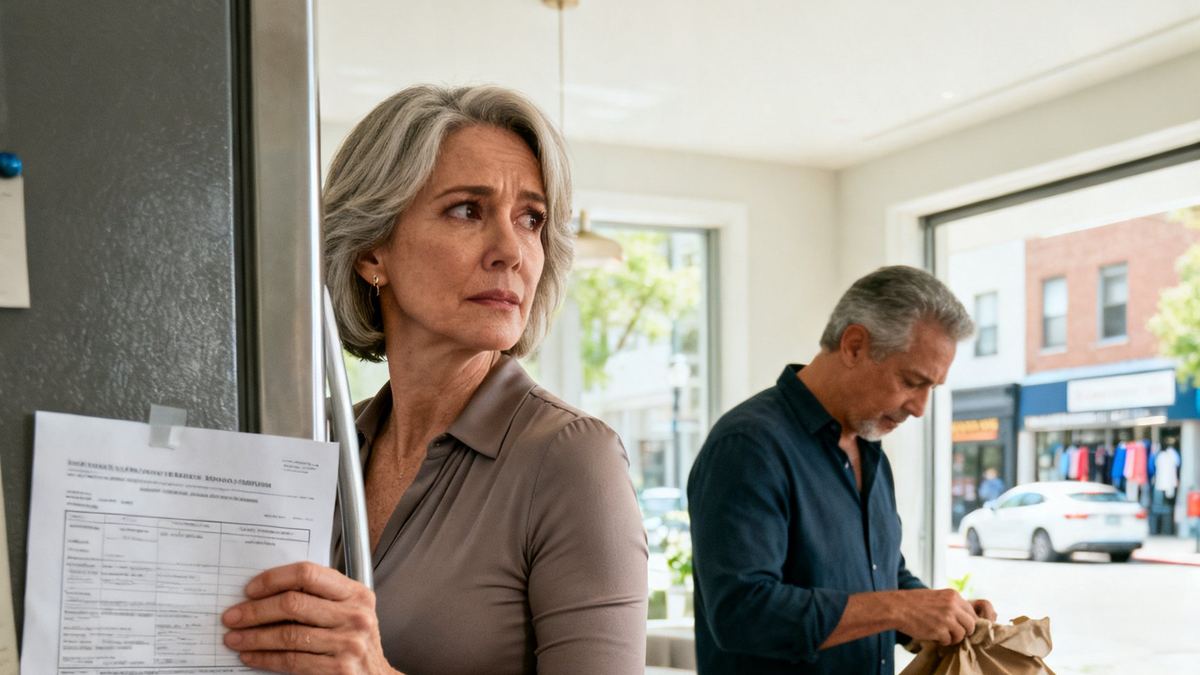
Danny walked to the fridge and pulled a sheet of paper off the door — the one where they tracked family expenses — and that's where things sat for the better part of a year. We kept the two-bedroom. The girls shared a room. Marisol picked up freelance bookkeeping work on the side, three clients, evenings after the girls went down.
Then, in March, our father had a minor stroke — minor in that he recovered, not minor in what it did to how he thought about the ledger he kept in his head. I found out about the empty property near the park during that hospital stretch, sitting with him at Tucson Medical Center, because he started talking, the way people do when a machine is beeping next to them and they're not sure for how long.
— That place near the park, he said, nobody's living in it. Feels stupid now.
I didn't say anything. I just sat there.
Three weeks after he was discharged, Héctor called Marisol himself — first time in years he'd called her instead of the other way around.
— Come by Saturday, he said. Bring Danny.
She almost didn't go. Danny convinced her it was worth an hour of her life.
At the kitchen table, Héctor slid a manila folder across the table without a word first, his hand flat on top of it for a second before he let go. Marisol didn't open it right away. She looked at him. He looked back, not at her face but at the folder, like he needed a second before he could meet her eyes.
— The property near the park, he said. It's yours. Not a loan. Deed's already redrawn — my lawyer handled it Thursday.
She opened it. The recorded quitclaim sat on top, her name and Danny's typed into the grantee line, no conditions stapled to the back, no repayment schedule. She ran her thumb along the edge of the page once and set it back down flat on the table.
— Why now?
— Because I almost went into a hospital room and left nothing settled between us but arguments over pancakes. That's a bad way to leave things.
He didn't apologize for Diego's truck, or the wedding condo, or the ten years he'd let that property sit empty out of stubbornness. He never did — that's not who he is. He just sat there with his hands around his coffee cup while she read the paper twice.
They sold the two-bedroom that spring. Danny hung the new house key on a nail by the door next to the old one, and never took the old one down.
She called me that night, the address still new in her mouth, and asked — actually asking, not accusing — if I thought it was fair.
I told her it was.