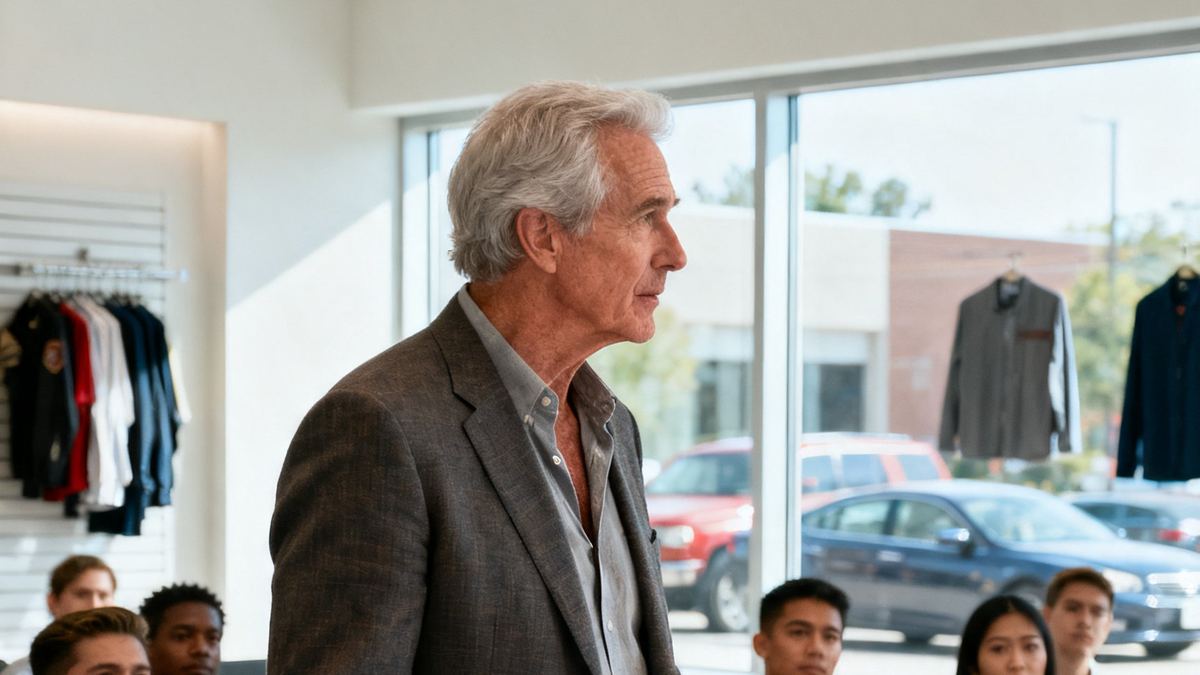
Dale Whitfield stands at the podium in the Founders Room of the Mayo Hotel in downtown Tulsa, seventy-six years old, a laminated one-page term sheet in his hand, and he cannot make the numbers hold still.
"Take your time, Mr. Whitfield," says one of the investors, a young man in a gray suit who has flown in from Dallas for this exact hour. There are five of them around the table, representatives of a private equity group weighing whether to put $40 million behind the Route 66 Reading Foundation's expansion into three more states. Dale had asked for this meeting himself. He'd insisted on reading the terms aloud, out of some old stubborn instinct he couldn't name, instead of letting his foundation's lawyer do it the way she always did.
The letters on the page are doing what they've always done. The 6 in $600,000 wants to be a 9. "Disbursement" wants to rearrange itself into something with no vowels at all. His hand, resting flat on the table, has gone damp enough that he can feel his palm sticking faintly to the wood veneer.
He'd told Carol Anne that morning, over coffee in her kitchen, that he wanted to do this one himself. She'd looked at him over her reading glasses and said, "Dale, I have read you every contract for forty-one years. Why start being brave about it now, in front of strangers with a checkbook?"
"Because it's my name on the building," he'd said. "Kids read out loud in front of people every day of their lives. Least I can do is once."
Now, standing here, the words swim, and for a second — just a second — he is sixteen again in Mr. Pruitt's office with a jar of butterscotch candies between them, waiting to be told what he already knows he is.
He sets the paper down. He looks up instead of down.
"I'm going to tell you something before I read this," he says. "I have dyslexia. Reading out loud takes me longer than it takes you. If I stumble on a word, it's not the number that's wrong. It's just me."
Nobody moves. The young man in the gray suit glances at the woman next to him, an older partner with silver hair who hasn't said a word since the meeting started.
Dale picks the paper back up. He goes word by word, sounding some of them out the way Carol Anne taught him decades ago, breaking "disbursement" into pieces like it's a part number he's never seen before. It takes him nearly four minutes to read what should take forty-five seconds. The room stays quiet, and that quiet is worse than laughter, worse than anything — until he gets to the number. Six hundred thousand dollars a year, for four years, contingent on matched fundraising.
He finishes. He sets the paper down a second time, and his hand isn't shaking anymore.
The silver-haired partner speaks first. "I run a literacy nonprofit's board in Fort Worth," she says. "I've sat through a hundred pitches. That's the first one anybody's ever told me the truth in the middle of."
They sign three weeks later.
—
Dale was nine years old the first time a teacher held up his spelling test in front of the class and asked him to read it out loud. He couldn't. The letters moved. B's became D's, "was" became "saw," and the harder he tried, the more the room seemed to close in around him. Someone laughed. He didn't remember who. He just remembered the heat that crawled up his neck and stayed there for years.
This was Tulsa, Oklahoma, in the early 1980s, and nobody in that classroom had ever heard the word "dyslexia." What they had heard was "lazy." "Slow." "Not trying hard enough." Dale's father, a machinist at the American Airlines maintenance base, sat across the kitchen table from him every night, a bowl of Wheaties going soft between them, drilling him on words he'd forget by morning. His mother worked the register at a Homeland grocery store. She came home smelling like deli meat and signed the failing report cards at the counter without reading them, the pen pressed so hard into the paper it left a groove.
By sixteen, Dale was failing three classes, and the assistant principal, a heavyset man named Mr. Pruitt who kept a jar of butterscotch candies on his desk, called him in. Pruitt leaned back in his chair, laced his fingers over his stomach, and said something Dale would carry with him for the next sixty years: "Son, way I see it, you're either gonna end up in the state pen or you're gonna end up owning half this town. I don't figure there's much room in between for a kid like you."
Dale dropped out that spring. He pumped gas at a Texaco off Route 66, then ran deliveries for a local auto parts warehouse, memorizing routes and part numbers by sound and shape because reading the invoices took him three times as long as everyone else. He was good with people. He noticed that every mechanic in every shop he delivered to complained about the same thing: parts took too long, suppliers didn't return calls, and nobody local carried what you actually needed.
At twenty-two, with $1,800 saved and a loan his father co-signed against his own better judgment, Dale rented a cinderblock garage bay on the east side of town and opened Whitfield Auto Supply. He couldn't read the supplier catalogs, so he hired a sharp-tongued widow named Carol Anne Sutter to read them to him out loud while he memorized every part number cold. Customers thought he had a photographic memory. He let them believe it, and some nights, driving home, he'd run through the day's part numbers in his head just to be sure they were still there.
Whitfield Auto Supply became three stores by the time Dale was thirty, then a chain of nine across eastern Oklahoma. In 1999, he sold a controlling stake to a regional distributor for $14 million and did something nobody expected: he bought a struggling regional airline out of bankruptcy, a puddle-jumper outfit flying prop planes between Tulsa, Oklahoma City, and Dallas. People said he was out of his mind. He didn't even like flying — turbulence made his stomach turn — and reading a boarding pass still took him a beat longer than it should have.
He ran it the way he'd run the auto parts counter: he walked the tarmac, talked to baggage handlers, sat next to mechanics during their lunch breaks, and asked what was broken. Ten years later, Heartland Regional Air was flying to fourteen cities, and Dale Whitfield was worth, on paper, just north of $600 million.
His father died in 2011. His mother had passed six years before that, in 2005, in the small house on Yale Avenue where she'd kept signing report cards long after there was nothing left to sign; Dale sold the house but kept her apron, folded in a drawer in his office, and never told anyone why.
He is seventy-six this year. He still can't spell "necessary" without spellcheck, and he still calls Carol Anne — who has run his foundation for going on twenty years now — when something longer than a page lands on his desk. Most mornings, though, he drives out to the Route 66 Reading Foundation himself, the learning center he built in north Tulsa with $40 million of his own money, and sits down across a small table from whichever kid is having the worst week of their life.
This morning it's a ten-year-old girl named Maribel, arms crossed, refusing to open her book.
"I can't read it," she says.
"I know," Dale says. "Took me till I was almost seventy to read a whole contract out loud without wanting to run out of the room. So we've got some time yet."
She almost smiles. He pulls his chair closer and opens the book to the first page.