I picked Leo up after school on a Tuesday that smelled like wet pavement and the last of the snow melting into the gutters. He came through the double doors with his backpack dragging on one shoulder, the way he always does, but he was chewing on the strap—the green canvas corner, gnawing it like a dog with a bone. He never used to do that.
Behind him, a boy with a Spider-Man lunchbox said something and Leo answered, too loud: “Nah, I’m not hungry. I had a big breakfast.”
It was four in the afternoon. The kid had been in the building since eight.
I didn’t say a word on the bus. Leo leaned against me and told me about the science project—volcano made of baking soda and vinegar. He was so proud. I had my arm around him and could feel every rib through his jacket. The bus rattled over a pothole on Washington Avenue and the driver, a woman with a neck tattoo, shouted something in Spanish at a guy who cut her off. I remember the fare machine beeping when I tapped my senior card. Eighty-five cents. Leo got on free because he’s under ten.
Back at my apartment, I made him a grilled cheese and watched him eat. He didn’t look up once. When he finished, he asked if he could have a second one, and he said it so softly I almost didn’t catch it.
The next morning, after I dropped him at school, I didn’t get on the bus to go home. I walked into the main office. The school, Lincoln Elementary off Central Avenue, has a smell I never got used to—pine cleaner and damp drywall—and there’s a crack in the floor tile shaped like a fish. I’d stared at it a dozen times picking up Leo over the years. This time I walked right past it to the secretary’s counter.
“I’d like to check on my grandson’s lunch account. Leo Simmons. Second grade, Mrs. Castillo’s class.”
The woman clacked at her keyboard. The pause that followed was long enough that I heard a kid crying somewhere down the hall and a janitor’s mop slapping the baseboards.
“The balance is negative one hundred eighty-two dollars and fifty cents,” she said. “Going back to January seventh.”
Three months. No hot lunch. No carton of milk. Just a boy sitting on the bench in the hallway with his backpack in his lap while everyone else queued up for chicken nuggets and tater tots.
I pulled out my debit card and paid it. One hundred eighty-two fifty. I told her to add another two hundred on top. The machine beeped and I walked out with the receipt folded into my pocket.
Mrs. Castillo found me in the yard at pickup. She came out from behind the fence where the dumpsters are and touched my sleeve—a light, quick thing, like a bird landing.
“Mrs. Cooper, can I talk to you?”
We stood beside a storm drain that smelled faintly of old leaves. Her name is Lucia Castillo; she’s forty maybe, with dark circles that told me she hadn’t slept much either.
“I’ve been calling Leo’s mom since February,” she said. “At first she said she’d pay online. Then the number stopped working. I sent letters home with Leo. They never came back signed.”
She paused and looked at the ground where some kid had drawn a hopscotch grid in chalk that was already fading.
“If this doesn’t change—and I mean the whole situation—I have to report it to CPS by Monday.”
Monday. Four days.
I took the bus to Jenna’s apartment that evening without calling first. She lives on the other side of town, past the Price Chopper, in a brick duplex where the stairwell light is always burned out. Somebody’s cat was sitting on the front porch, matted and orange, watching me like it knew something.
I knocked. The door opened six inches and I saw my daughter’s face—thirty-four years old, eyes rimmed red, hair in a knot that hadn’t been brushed in a while.
“Mom. What’re you doing here?”
“Let me in, Jen.”
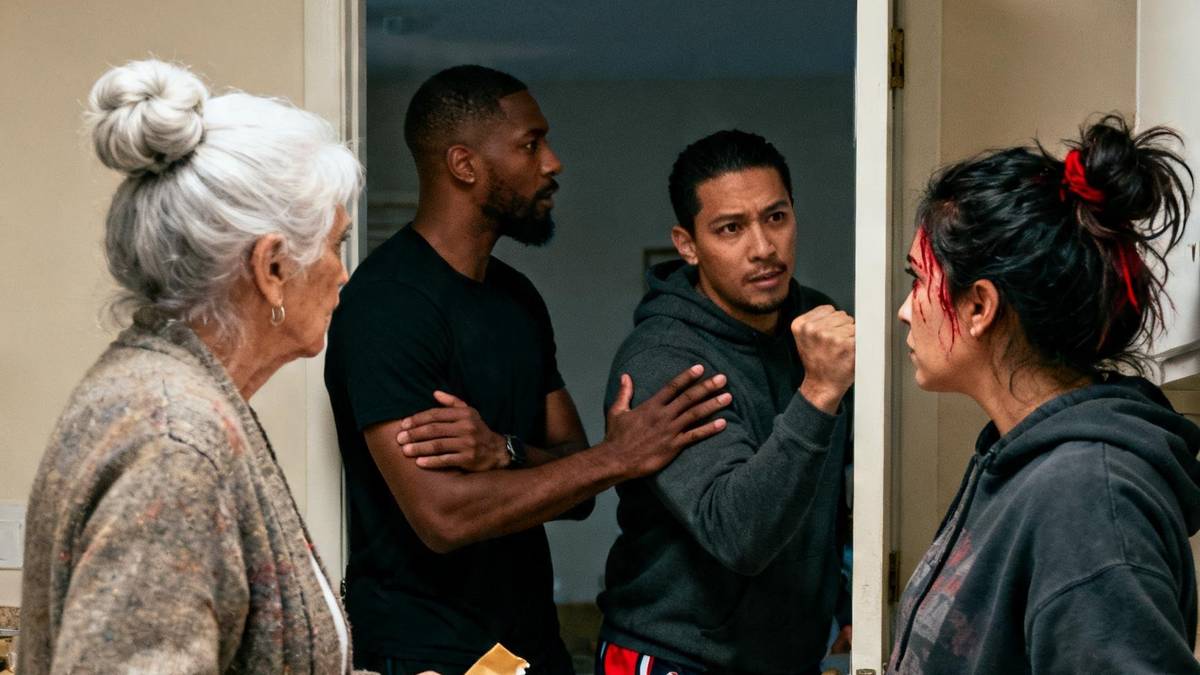
I pushed past her into a living room that stank of stale beer and a litter box that hadn’t been cleaned. A man I didn’t know was stretched on the couch in basketball shorts. He had a tattoo of a snake eating its own tail on his calf and a game controller balanced on his stomach.
“You must be Travis,” I said.
He grunted.
I walked into the kitchen. The fridge had a half-empty bottle of ketchup, a case of Miller Lite, and a bag of carrots that had gone soft. The freezer held a single frozen pizza. In the cupboard I found one can of SpaghettiOs and a box of saltines.
The wall above the sink had a hole in it, fist-sized.
“Where’s the money, Jenna? I just paid nearly two hundred dollars in school lunch debt because my grandson’s been sitting in the hallway at lunch for three months.”
She crossed her arms over her chest. “I told you, I got it handled.”
“Handled. He told his friend on the bus he wasn’t hungry. He gnawed through his backpack strap. When’s the last time you checked his grades? His clothes still fit?”
Travis spoke from the couch without sitting up. “Lady, she said she got it. You can go now.”
I didn’t look at him. I kept my eyes on my daughter.
“Monday the school files a report with Child Protective Services. Mrs. Castillo’s been trying to reach you since February. The letters came home in Leo’s backpack. What happened to them?”
Jenna’s face crumpled for just a second before she pulled it together. “I thought I’d catch up on the balance next paycheck. And then the car needed a new alternator, and Travis needed work boots, and I just—I thought it could wait.”
“Three months, Jenna.”
Travis sat up. “Yo, I said you can leave.”
I turned to him. “You don’t pay rent, you don’t work, and my grandson doesn’t eat because your boots were more important. You have five seconds to take yourself out of this conversation.”
He called me a name I won’t repeat and threw the controller onto the couch. Then he stood up—all six feet of him, with that snake staring at me from his leg—and took a step toward the kitchen.
But Jenna moved first. She stepped between us and put a hand flat on his chest.
“Stop. Just stop.”
He looked at her like he might say something else. Then he grabbed his keys off the side table and walked out. The front door slammed hard enough that the cat on the porch yowled and the window rattled.
Jenna sank onto a kitchen chair and put her head in her hands. I didn’t sit. I stood there in that dirty kitchen with the broken wall and let her cry for a minute.
Then I said, “Pack Leo’s things. He’s staying with me.”
She looked up. “You can’t just take him.”
“You just let a man put a hole in your wall and you’ve been letting your kid go hungry. Right now you can’t keep him safe. So yes, I can take him. I’m his grandmother. And unless you want CPS to take him farther than three bus stops away, you’ll let me.”
That night Leo slept in the pullout bed at my place. I made him pancakes with the little blueberries he likes, the kind that turn the batter purple. He ate six. Six pancakes, a glass of milk, and a banana. Then he fell asleep in under five minutes while the six o’clock news was still playing. I covered him with the quilt my own mother made and watched his chest rise and fall.
The next three days were a blur. I called a lawyer I found through the senior center—a woman named Ms. Owusu who charged me a hundred dollars for a consultation. She told me to document everything: the lunch debt, the letters, the state of the apartment, the hole in the wall. I wrote it all down in a notebook with a blue cover, the kind I used to use for ledger entries back when I worked for the DMV.
On Sunday, Jenna showed up at my door.
She looked different. Her hair was washed, pulled back with a clip. She was wearing a clean sweater. And behind her, parked at the curb, I saw a beat-up Honda with a cardboard box in the backseat and no Travis in the passenger seat.
“He’s gone,” she said. “I changed the locks. The landlord’s fixing the wall tomorrow.”
I didn’t open the screen door all the way.
“Good,” I said. “But that’s not enough.”
“I know.” She held out an envelope. Inside were two hundred dollars in cash, all twenties, a little crumpled. “It’s not the full amount yet. I’ll get the rest next week. I picked up extra shifts at the warehouse.”
I took the envelope. Then I stepped back and opened the door the rest of the way.
Leo was in the kitchen, coloring at the table. When he saw his mother, he jumped up so fast his chair tipped over backward and clattered on the linoleum. He ran to her and wrapped his arms around her waist, his face buried in her sweater.
I let them hug. Then I said, “Monday the teacher’s going to call you. Answer, Jenna. And you tell her the truth and you tell her what you’re doing to fix it.”
She nodded, but I didn’t need a nod. I’d see if she meant it.
Monday came. I kept Leo home from school just that one day—I called him in sick and spent the morning teaching him to make a proper pancake batter. He got flour on his pajamas and eggshell in the bowl, and we fished it out with a spoon. Around eleven, Jenna called my phone and said, “I spoke to Mrs. Castillo. She’s not filing the report. She said she’ll check the lunch account every Monday from now on, and if it’s in the black, the file stays closed.”
“And the other thing?” I asked.
A pause. “I have a meeting with a social worker on Wednesday. Voluntary. She’s going to help me find a parenting group.” Her voice cracked. “Mom, I didn’t know it was that bad. I didn’t see it.”
“I know, baby. That’s why I saw it for you.”
That Wednesday, I sat in the waiting area of the family resource center on Clinton Street while Jenna went in for her appointment. The room had a plastic plant in the corner and a stack of Highlights magazines on the table, the kind with the hidden pictures. I found the banana in the tree and the toothbrush in the gorilla’s hand. I still have a good eye.
In September, Leo started third grade. Same school, same teacher—Mrs. Castillo looped up with the class. The lunch account has been paid on time every week since, and Leo joined the after-school soccer club. He still gnaws on things when he’s thinking—pencils, his sleeve, the corner of his homework—but he doesn’t skip meals anymore.
Jenna and I trade off. She has him four nights, I have him three. On Fridays, we all eat dinner together at my place. I make a pot roast, or meatloaf, and she brings a salad from the Price Chopper. Sometimes, after Leo goes to bed on the pullout, she sits with me on the porch and we don’t talk about Travis or the hole in the wall or those three months. We just watch the orange cat that still lives next door, and listen to the city buses hiss by, and wait for the one streetlamp on the corner to flicker on at exactly eight-oh-seven.
Last week, Leo brought home a permission slip for a field trip to the science museum in Troy. Twenty-two dollars. He handed it to me with the envelope already licked shut, and inside was a twenty and two ones, in Jenna’s handwriting on the line where it said Parent/Guardian Signature.
I signed it underneath hers.