Jed came home that evening with blood up to his elbows and something enormous cradled against his chest. I was washing dishes in our little house twenty miles outside Bozeman when I heard his truck door slam a little too hard. I looked out the kitchen window and saw him staggering toward the porch, carrying what I first thought was a dead German shepherd. Then I saw the pale yellow eyes, half-closed, and the thick gray ruff matted with crimson.
I threw open the screen door. “What in God’s name is that?”
“A wolf,” he said, and his voice had that steady, stupid calm I’d learned to dread. “Found him up by the ridge. Someone peppered his hind leg with birdshot and left him to bleed out. I couldn’t just—”
“You brought a wolf into our house?” I was already backing into the hallway, one hand reaching for Lily’s bedroom door. Our daughter was eight. I could picture her tiny fingers and that animal’s jaw in the same thought. “Jed, so help me, you take that thing to a vet or I’m taking Lily and leaving.”
He didn’t argue. We laid the wolf on a moving blanket in the bed of the pickup, and I sat in the back with it, pressing a dish towel against the wound while Lily stared from the rear window of the cab. Her mouth was a perfect O, but she wasn’t scared. She looked at that bleeding, half-dead predator the way she looked at the ponies at the county fair.
The vet, Dr. Ames, didn’t ask questions. She just shaved the leg, dug out fourteen pellets, and pushed fluids while the wolf lay limp under sedation. The whole time, Jed kept one hand on the animal’s shoulder like it was a Labrador he’d raised from a pup. I stood in the corner of the exam room, arms crossed so tight my elbows ached.
For the first three days, I didn’t let Lily within twenty yards of the barn. Jed fixed up a stall with straw bales and a heat lamp, and I watched him through the kitchen window, changing bandages and murmuring nonsense to a creature that could crush his skull with one bite. The wolf refused to eat from a bowl. He’d only take scraps from Jed’s hand, trembling the whole time, his eyes squinting at close range like an old man who’d lost his glasses.
It was Lily who named him. She snuck out on the fourth morning while I was on a work call. By the time I noticed, she was already in the stall, cross-legged in the straw, and the wolf had his massive head in her lap. I screamed—I know I did—but before I could reach her, the wolf lifted his gaze to me. He didn’t growl. He just blinked those weak, nearsighted eyes and let out a low, pitiful whine.
Lily wrapped her arms around his neck. “My doggy Muffin,” she announced.
I was half-hysterical. “Lily, that’s not a dog. Why are you calling it Muffin?”
She looked at me as if I were the slowest person on earth. “Because.”
Jed pulled me back by the shoulders. The wolf licked Lily’s cheek with a tongue the size of my palm, and I swear something in that animal’s posture just melted. He’d chosen her. Or she’d chosen him. Either way, the decision was made.
Muffin healed in ways that made no sense. Within a month, he was padding through the house on paws that clicked against the hardwood like slow applause. He was afraid of everything—the vacuum, the doorbell, and especially the neighbor’s three orange tabbies who figured out in about five minutes that this towering gray monster was a pushover. They’d ambush him by the back steps, hissing and swatting, and he’d bolt behind me with his tail clamped between his legs, whimpering until I chased them off with a broom.
I grew to love that ridiculous, cowardly wolf. He’d rest his chin on my knee while I read, and his golden eyes would follow Lily everywhere she went. He never barked, never snarled, never even curled a lip at a stranger. He was just a giant, nearsighted, sweet-natured shadow with breath that smelled faintly of the raw chicken Jed insisted on feeding him.
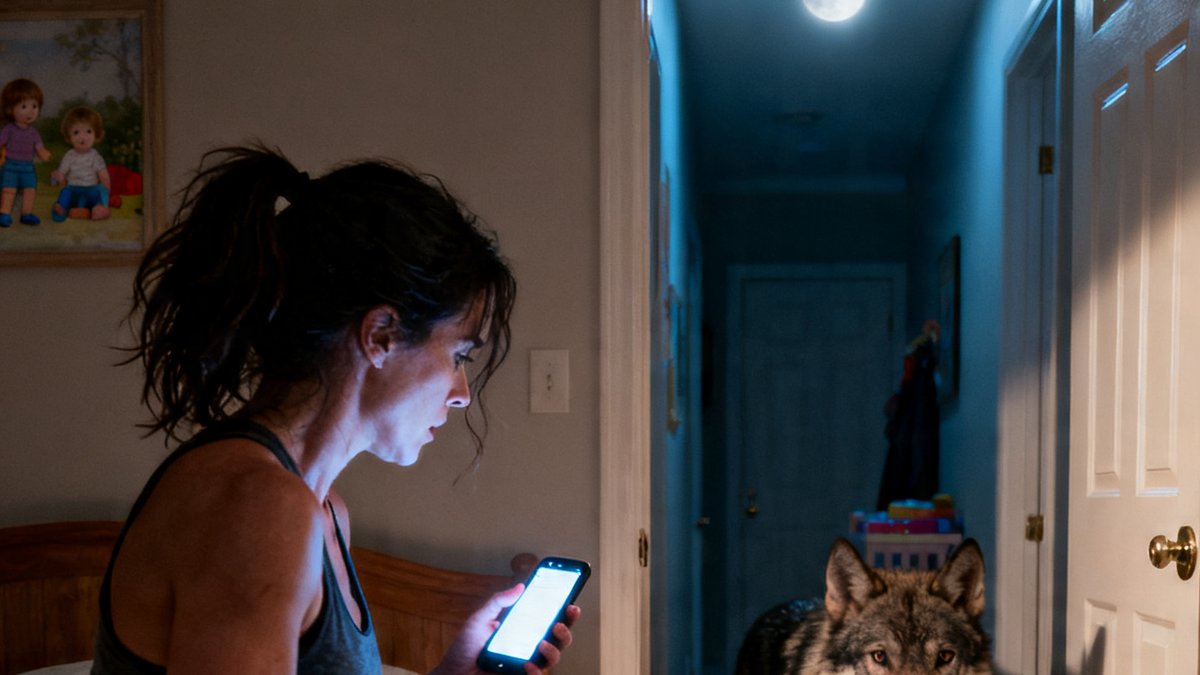
Jed left for a construction job in Billings that was supposed to last ten days. On the fifth night, I woke up at 2:07 a.m. to a sound I couldn’t place. A shift. A shoe on hardwood that shouldn’t have been there.
Lily was in her room at the end of the hall. I reached for my phone and saw the flashlight beam moving in the living room. Two voices, low and rough, not bothering to whisper.
My heart stopped when the bedroom door creaked. Not my door—Lily’s.
Then the hallway exploded.
Muffin hit the flimsy interior door like a battering ram. The wood splintered from the frame, and suddenly there was a sound I will never forget: a wet, tearing crunch, then a gurgle that cut off mid-breath. A man screamed—no, shrieked—and I heard the front door bang open, then the scramble of boots on gravel.
I grabbed the baseball bat from under the bed and ran. The hallway was dark, but the moonlight from Lily’s window showed me a shape on the floor that wasn’t moving, and another shape—gray, vast, and slick with something that glistened—already vanishing through the front doorway.
I dialed 911 with shaking fingers and pulled Lily from her bed. She was crying, but not from fear. “Where’s Muffin?” she kept saying. “Mommy, where’s Muffin?”
I found him in the yard, thirty yards from the house, standing over a second body. His muzzle was dark and dripping. He looked at me, and his eyes weren’t weak or nearsighted anymore. They were ancient and absolutely certain. Then he lay down beside the man he’d killed and waited.
The deputies arrived in four cruisers. One of them raised a rifle the second he saw Muffin, and I threw myself in front of that animal, screaming about what just happened, about my daughter, about how this wolf had saved us. The deputy didn’t lower his weapon.
Then a small, barefoot girl with tangled brown hair pushed past me and wrapped her body around Muffin’s head, pressing his bloody face to her chest. “You can’t shoot him! He’s our dog!”
The sergeant swore and barked into his radio. Twenty minutes later, a wildlife officer put a tranquilizer dart into Muffin’s shoulder, and they loaded his limp, enormous body into a steel crate.
They told me the next afternoon that Muffin would be euthanized. “He killed two people, ma’am. Doesn’t matter the circumstances. State law.”
I went home and sat at my kitchen table for an hour, not crying, not moving. Then I opened my laptop and typed out everything that had happened. Every detail. The birdshot, the barn, the tabbies, the way he whimpered when I pet his head, the sound of that door breaking. I posted it in a Montana wildlife forum and a few Facebook groups and asked if anyone knew a lawyer.
I didn’t expect anything. I really didn’t.
Two days later, my phone rang. A woman named Clara from an animal rights legal defense fund said they’d take the case pro bono. She told me the post had been shared over a million times. There were already people planning a rally outside the sheriff’s office in Helena.
The next week, ten thousand people filled the streets with signs. A blown-up photo of Muffin with Lily on his back was taped to every lamppost within three blocks of the courthouse. The sheriff’s department had to open three tip lines just to handle the media inquiries. Politicians I’d never heard of were promising to “review the case personally.”
The trial was set for Monday. By Saturday night, we’d raised enough for a real legal team, and the lawyers had prepared a defense that hinged on castle doctrine and the wolf’s documented non-aggressive history. I let myself hope. I let Lily choose what dress she’d wear to court.
Sunday morning, the sergeant called.
“Ma’am, there’s been… an incident at the kennel.”
Someone had cut through the chain-link fence in the dead of night. Three individuals in ski masks, according to the one deputy who’d been on duty and had mysteriously been taking a coffee break at the time. The crate was open. Muffin was gone.
I collapsed into a kitchen chair, my whole body shaking. I didn’t know if he’d been stolen to be killed or stolen to be freed, and the police wouldn’t tell me anything beyond “an investigation is ongoing.”
Three weeks passed. The story started to fade from the news. Lily stopped asking about Muffin, but she started leaving an extra portion of chicken on the edge of her plate every night, just in case.
Then Jed got a phone call from an old buddy of his, a forest ranger named Tom who worked a fire lookout deep in the Bitterroot National Forest. Tom’s voice was staticky and slow. “Jed, I think your wolf found me.”
He’d come across a set of tracks near his cabin one morning—huge, canine, with a slightly off-kilter hind print. That night, he’d set out some venison and waited. Around dusk, a massive gray wolf limped out of the tree line. He stopped ten feet from Tom’s porch, sat down, and just looked at him. Tom said the animal’s eyes were milky and soft, and they held a question rather than a threat.
“He’s been hanging around ever since,” Tom said. “He won’t come inside, but he lets me scratch his ears. Seems to like it.”
We drove up that weekend, all three of us, bumping along forest roads for four hours until we reached Tom’s cabin. The moment Lily opened the truck door, a gray blur shot out of the woods and skidded to a halt at her feet, tail wagging so hard his whole body shook. She buried her face in his ruff and laughed and cried all at once while I stood there, a hand clamped over my mouth, tears running straight into my collar.
Tom agreed to keep him. It was the safest place—no neighbors, no sheriff’s patrols, no questions. Jed found a small fixer-upper cabin thirty miles away, on the edge of the national forest, and we bought it with the last of our savings. Now we spend every other weekend there, and Lily rides Muffin through the meadows like he’s a pony from one of her storybooks.
The official report on the kennel break-in was quietly shelved. No one really wanted to prosecute the people who freed a wolf that had become a folk hero. The sheriff told me once, off the record, that he figured things had worked out about as well as they could.
Sometimes, when the light is low and Muffin rests his head on my knee, I think about how close I came to telling Jed to leave that bleeding animal in the woods. I think about all the ways I almost chose fear over this ridiculous, cowardly, magnificent creature who looks at us with those foggy yellow eyes and sees exactly who we are.
Some wolves don’t watch the forest. They watch your soul, and they know, before you do, what’s worth protecting.