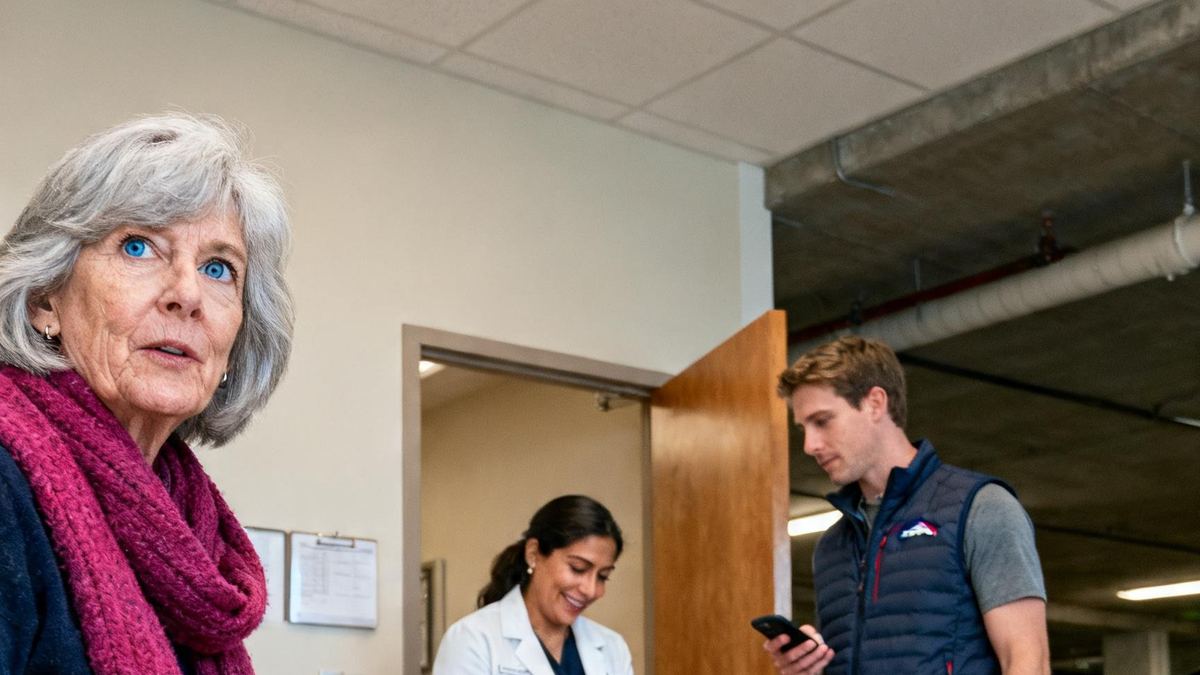
Dr. Alvarez asked how I’d been feeling. I got maybe four words out before my son cut across me from the chair by the door.
“Doctor, it’s better if you talk to me. My mom won’t keep the details straight.”
The nurse froze with the blood pressure cuff halfway up my arm. I stared at the poster on the wall — one of those anatomical hearts with arrows, the kind they hang so you have something to look at while your own kid tells a stranger you’re basically senile. My mouth was still open. I closed it.
David was already rattling off my symptoms: the dizzy spell last Tuesday, the skipped dose of metoprolol, the numbers from the Bluetooth monitor he’d installed in my kitchen. He had it all in a notes app. He even knew the brand of the generic I’d switched to because the copay on the name brand had gone up. Standing there in his Patagonia vest with his phone in one hand and a travel mug in the other, he could’ve been thirty years younger and I could’ve been somebody’s file folder.
I’m sixty-six. I taught high school math in Milwaukee for thirty-one years — algebra, geometry, the whole works. You don’t manage a classroom full of sophomores on a Friday afternoon without a memory like a steel trap. But that afternoon, in that exam room that smelled like rubbing alcohol and wet wool, I said nothing. I just watched David’s mouth move and heard the doctor’s pen scratch.
The thing is, he wasn’t wrong about the facts. He’s had my medication schedule in his phone ever since I mixed up the lisinopril and the baby aspirin last spring. One time. One time in half a dozen years of taking pills twice a day, and suddenly he was treating my entire life like a Google calendar he had editing rights to.
We left the clinic on Prospect Avenue. The wind off the lake was sharp enough to make my eyes water. David had parked his Subaru in the ramp across the street because he didn’t want me walking on the ice — Milwaukee in February, you get these patches of black ice that sneak up on you. He’d texted me that morning: *Appt 2:15. I’ll pick u up at 1:45. Eat lunch early so the reading isn’t off.* As if I needed a reminder to eat.
In the car, the heater was on full blast. I waited until we were on I-43 to speak.
“Why did you say that? That I wouldn’t remember.”
He changed lanes. “What?”
“At the doctor’s. You said I wouldn’t keep the details straight.”
A pause. A semi roared past us, spraying slush. “Mom, you forgot the eye doctor appointment last month. And the water bill sat on the counter for six weeks.”
“I thought I was on autopay. It expired.”
“That’s exactly what I mean.” He said it without heat — that’s what got me. Not angry, just matter-of-fact. Like he’d long ago accepted that I was a thing that needed managing.
I stared out the window at the frozen harbor. The breakwater was covered in snow. A couple of guys were ice fishing off McKinley Beach, tiny dots in orange parkas. I thought about the first apartment Pete and I had on the East Side, the one with the radiator that clanked all night. Pete died eight years ago — pancreatic cancer, four months from diagnosis to the funeral. David was twenty-eight then, just married, with a baby on the way. He stepped up. I’m not ungrateful. But somewhere between the casserole deliveries and the shared iPhone location, the man my son used to be got replaced by a project manager.
The project was me.
It started small. He’d pick up my groceries because “the parking lot at Pick ’n Save is a nightmare and the cart wheels stick.” Then he took over my taxes because “the new software is a pain.” Then the blood pressure cuff that sent him my readings in real time. Then the nightly check-in call at nine sharp, and if I didn’t pick up, he’d call twice more and then text my neighbor Deb to ask if my lights were on.
Deb mentioned it once over coffee. “Your David is so thoughtful,” she said, dunking a shortbread cookie. “My Jason hasn’t called in two weeks.” I nodded and changed the subject. I wasn’t ready to say what I was feeling, mostly because I didn’t know how to put it into words yet — this slow, creeping dread that I was being erased from my own life, one thoughtful gesture at a time.
Two Sundays after the cardiology appointment, David came over with his daughter, Lily. She’s seven, all elbows and missing front teeth, and she drew a rainbow unicorn on the back of an envelope while David unloaded a cooler bag full of Tupperware.
“I made a bunch of stuff — chili, roasted vegetables, that quinoa thing you like. Freeze what you don’t eat today.”
I looked at the containers lined up on my counter like evidence. Each one had a strip of blue painter’s tape with the contents written in Sharpie: *Butternut squash soup 3/2. Chicken cacciatore 3/3. Scrambled egg cups — microwave 45 sec.*
“David,” I said. “I know how to cook.”
“Of course you do, Mom. But you shouldn’t have to stand over a stove when you could be relaxing.”
Lily was coloring at the kitchen table. She looked up, her little face serious. “Daddy says when you get really old you’re gonna live in the room next to mine.”
The kitchen went very still. David’s jaw tightened. “Lily, go find your boots, we’re leaving soon.”
But I’d heard it. I’d heard the whole blueprint that had been in his head for God knows how long. Phase one: manage the meds. Phase two: deliver the meals. Phase three: move Mom into the guest room in his house in Whitefish Bay, with the window that faces the neighbor’s fence.
That night I sat in my living room with the TV on mute and watched the streetlight flicker through the falling snow. My mug of tea — the chipped one with the Wisconsin State Fair logo from 1998 — went cold in my hands. I wasn’t tired. I was the opposite of tired. I was filled with a kind of buzzing, desperate energy that I hadn’t felt since I was a student teacher prepping for a review.
Around two in the morning I opened my laptop and started hunting. Not for anything specific. Just… proof. Proof that I wasn’t a piece of furniture waiting to be moved. I looked at part-time tutoring gigs, book clubs, a tai chi class at the rec center. Everything felt too small, too expected. Then I found it: a creative nonfiction workshop run out of the public library on Wisconsin Avenue. “Telling the Story of Your Life,” it was called. Six Wednesday evenings. No prior writing experience required. I filled out the online form with shaking fingers and hit submit.
I told no one. Not Deb, not David. The first session was on a night I usually got my grocery delivery. I canceled the order and took the bus downtown. The workshop leader was a woman about my age, a retired journalist with cropped silver hair and a laugh that filled the room. We wrote about our first jobs. About the smell of our childhood kitchens. About a moment we’d felt invisible. I wrote three pages, and when I read them aloud, my voice cracked on the last line but I got through it.
That workshop became the secret I carried like a hot stone in my coat pocket. I’d come home and find a voicemail from David: “Hey, called at the usual time, hope everything’s okay.” I’d text back: *All fine, went for a walk.* And I’d feel both guilty and fiercely, quietly proud.
Four weeks later, another follow-up with Dr. Alvarez. David texted me the pickup time. I wore my good wool scarf — the raspberry-colored one I’d bought myself on a solo trip to Chicago years ago — and I got into the car without a word.
In the exam room, the doctor pulled up my chart and asked, “So, how have the past few weeks been, Mrs. Kowalski?”
I saw David open his mouth. I put my hand flat on the armrest of my chair, not to steady myself, but to claim the floor.
“Doctor,” I said. My voice came out firmer than I expected. “I’ve been taking my medication every morning with breakfast. My pressure’s been steady — David can pull up the numbers if you want them. I’ve had two dizzy spells, both after standing up too fast, and I’m making a point to drink more water. Oh, and I’m sleeping better. I started a writing class.”
I could feel David’s stare on the side of my face. I didn’t turn.
Dr. Alvarez looked from me to him and back again. Then she smiled — a small, real smile, the kind you don’t see much in clinics with fifteen-minute appointment slots.
“That’s wonderful,” she said. “How’s the writing going?”
“It’s going,” I said. “Turns out I’ve got a lot to say.”
David didn’t speak for the rest of the appointment. When we were back in the parking ramp, the silence between us felt different — not the heavy, suffocating quiet of a car ride, but the charged pause after a door has been opened.
He unlocked the Subaru, then stood there with the key fob in his hand. “A writing class?” he said finally.
“Yes.”
“You didn’t mention it.”
“I know.”
He nodded slowly, looking at the salt stain on the concrete, not at me. His breath hung white in the air. For the first time in months, he didn’t have a note on his phone, a reminder, a plan. I used to think that was the part that bothered me. Now I realized it was the other way around — the part where he forgot I could still surprise him.
I got into the car first. I reached over and turned on the seat warmer myself, adjusted the vent, and waited for him to start the engine. The lake glittered through the grimy window, an impossible blue for February. I thought about the essay I’d start writing that night, the one about a woman who’d spent thirty-one years solving for X and didn’t intend to stop now.