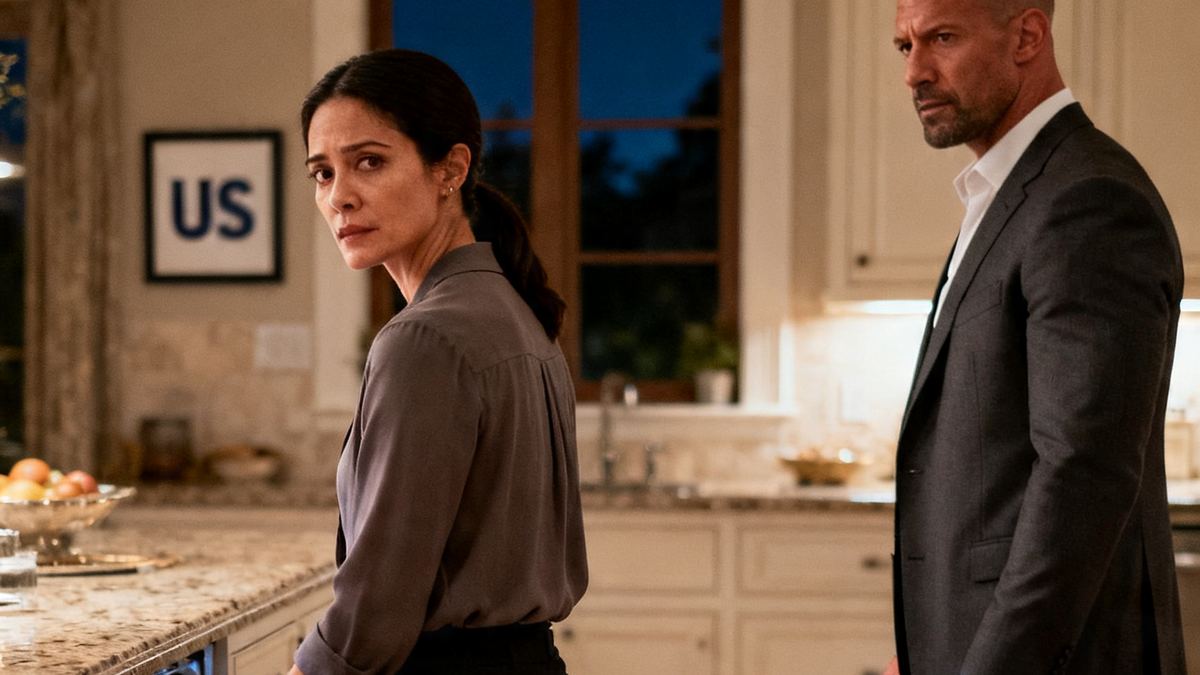
Michael dropped his titanium phone on the kitchen island, the dull thud echoing through our five-thousand-square-foot echo chamber. He’d just gotten the final nod for Executive VP of Product at Vireo Dynamics. The promotion we’d uprooted our lives from Boston to Austin for. The pinnacle. His kingdom of code and quarterly projections.
“It’s going to mean more obligations, Sarah,” he said, loosening his Tom Ford tie. His finger traced the black granite countertop. “The charity galas, the investor dinners at the house. I need a wife who’s present. A real partner in the domestic sphere.”
“The domestic sphere,” I repeated, the phrase tasting like drywall dust. I was still holding a sippy cup of organic apple juice. “Michael, I spent seven years getting my architecture license. I was project lead on the Hines Tower before the boys were born.”
“And now you’re the CEO of the Connelly household,” he smiled, a quick, efficient twitch of the lips that didn’t reach his eyes. “It’s a different kind of build, isn’t it? A much more important one. Let’s not get distracted with fantasies of drafting tables again.”
My drafting table was in the attic, buried under boxes of Christmas ornaments and the boys’ outgrown clothes. I was thirty-four, and my biggest creative outlet for the past eight years had been designing elaborate Thomas the Tank Engine layouts on the living room floor. Liam was seven, Noah was five, and my shoulders ached from carrying a weight that wasn’t just the physical load of two growing children. I hadn’t slept a full night in years.
A few nights later, I found the first crack in his perfect image.
It was the night of the official VP welcome gala at the Blanton Museum. I wore a cobalt blue dress that took me three hours to pick out, squeezing into Spanx that left red grooves on my ribs. I was a ghost in the room, floating behind him as he shook hands, a silent testament to his well-rounded life. My degree felt like a prop, a fun fact Michael could toss out at cocktail parties: “Oh, Sarah actually used to design buildings. Now she builds character. In our sons.”
A colleague’s wife, a woman with a razor-sharp blonde bob named Astrid, cornered me by the minimalist ice sculpture.
“So nice to finally meet you, Sarah! Michael has told us *nothing* about you. So, what do you do?” she asked, her eyes scanning my dress, my shoes, my quiet, compliant smile.
“Oh, you know me,” Michael materialized at my elbow, handing me a glass of champagne I didn’t ask for. He squeezed my arm, a little too hard. “Sarah’s an old soul. A domestic goddess. She’s traded blueprints for baking sheets.”
Astrid’s smile flickered. I watched her mentally catalog me, file me away, dismiss me. My face went hot, and I pressed my nails into my palm until it hurt.
On the drive back through the Texas Hill Country, the silence was thick. Finally, I spoke.
“A domestic goddess, Michael? I spent a year designing a carbon-neutral cultural center in Copenhagen. My model won an international award. You could have told her that.”
He didn’t take his eyes off the road. “Nobody wants to hear about an old life, Sarah. They want to see the now. And the now is a happy family and a supportive wife. It’s a better look for my brand. Let’s be real, your career was a hobby you had before we got serious.”
The assault was so smooth, so final, it knocked the breath out of me. He wasn’t just dismissing my desire to work; he was retroactively erasing a decade of my life, wiping it clean like a whiteboard in one of his sprint planning sessions.
A week later, I was gathering dry cleaning from his closet when my fingers brushed something in the back of a drawer. A rental agreement, folded in thirds, from a building called The Arlo in East Austin. A furnished studio loft, signed six months ago, with a start date on July 1st. My name wasn’t anywhere on it. There was a separate key card in a little paper sleeve. I stood in that walk-in closet, surrounded by his rows of identical Zegna suits, and felt the truth snap into place with a cold, quiet click. The late-night “brainstorming sessions,” the obsessive way he angled his phone away, the sudden, vicious determination to convince me I was nobody—it wasn’t just control. He was building a contingency plan, a secret second life where I was the housekeeper and his actual personal life happened somewhere else. My past, my ambition, any money I might earn—they were all threats to his carefully partitioned reality.
He needed me weak. Broke. Dependent. A piece of furniture he could ignore until he felt like throwing it out.
That night, I didn’t cry. I climbed to the attic, shifted the boxes of ornaments, and uncovered my old drafting table. I brushed the dust off the parallel bar. The cool, smooth feel of it under my hand was like touching a live wire. I wasn’t mourning my marriage. I was mourning the woman I’d let him bury.
The next morning, while Michael was at the gym with his personal trainer, I called a ghost from my past. Not a friend, but a fierce rival. Marcus Chen and I had battled for the same awards in our twenties. We’d loathed each other with a passion rooted in mutual, undeniable respect. Now he owned a boutique firm in East Austin renowned for aggressive, sustainable design.
“Sarah Connelly,” he said, his voice barbed with disbelief. “To what do I owe this blast from the past? Need a recommendation for a general contractor to redo your kitchen?”
“I need a job, Marcus,” I said, my voice flat. “No special treatment. I want the most demanding, time-intensive project you’ve got. Something that will eat me alive and spit me out. I need to come back at a sprint, not a jog.”
There was a long silence. He knew Michael, knew the gossip. He pieced it together in three seconds. “I have a municipal contract that’s a five-alarm dumpster fire. A green-tech community center. The lead architect had a breakdown two weeks ago. It’s sixty hours a week minimum, here on site, dealing with a bunch of skeptical project managers who’ll hate you on sight. You want it?”
“I want it more than you can possibly imagine.”
The only thing I absolutely needed was someone to hold my kids while I was out. I found Lucia, a former teacher and now a nanny whose calm, formidable presence could anchor a hurricane. I paid her first month’s retainer from a small, secret investment account my grandmother had left me—money Michael didn’t know existed and couldn’t touch. I also called a divorce lawyer, a quiet, sharp woman named Ellen who worked out of a strip mall in Round Rock. I met her on my second Tuesday lunch break, eating a gas-station taco while she explained my rights to community property. I left with a checklist and a plan.
Everything was in place. All that was left was to tell him.
The confrontation came on a Sunday evening. The smell of his grilled ribeyes still hung in the air. He was in a fantastic mood, two glasses of Napa cab in, scrolling through Zillow listings for a ski chalet in Telluride.
“Sweetheart, look at this one,” he said, turning the tablet to show me a million-dollar glass-and-timber monstrosity. “I’m thinking we could do Presidents’ Day week there. You’d love the spa.”
“I won’t be able to make it, Michael,” I said, my voice calm as I loaded a plate into the dishwasher.
“It’s on a mountain, you’ll be fine,” he chuckled without looking up.
“I have a deadline that week. The community center project. The concrete pour for the foundation is happening then, and I need to be on site. I signed the contract with Chen Architecture.”
The word “contract” acted like a tripwire. His head snapped up. The charming, relaxed VP vanished, replaced by the predator I’d been watching for months.
“What are you talking about? You signed a contract?”
“I start Monday. A forty-minute commute from here. Lucia will handle the boys’ schedules and I’ll be back for dinner.”
He stood up slowly, placing the tablet screen-down on the table with deliberate, terrifying precision. His face was a mask of cold fury.
“You will do no such thing,” he said, his voice a low tremor. “You are not throwing away our life, my reputation, for some fifty-thousand-dollar-a-year drafting job. It’s pathetic.”
“It’s seventy-five,” I corrected, drying my hands on a towel. “And I’m not throwing away our life. I’m reclaiming my own.”
“You think you can just do this?” he hissed, stepping closer. “I’ll freeze every account. The joint accounts, the credit cards. You’ll have no money for gas, for Lucia, for your precious parking garage downtown. You’ll be stranded here, where you belong, with nothing but a piece of paper from a firm that won’t pay you for another two weeks. You’ll be crawling back by Wednesday.”
My heart was a jackhammer, but my voice came out steady. I walked to my purse, pulled out a manila envelope, and slid two sheets of paper across the counter. The first was a printout from my grandmother’s investment account, showing a cashier’s check already deposited into a new, single-owner account at a credit union he’d never heard of. The second was a notarized statement from our joint savings—$11,200 I’d quietly moved into that new account over the past four months, completely legal as a signatory, just enough to cover expenses until my first paycheck.
“The money is handled,” I said. “So is the childcare. I’ve already spoken to an attorney, and if you try to freeze the joint cards today, I’ll be filing for temporary separate maintenance by noon tomorrow. You don’t want a court ordering you to fund my household while I sue you for divorce, do you?”
His eyes moved over the documents. The crutch of his financial control wobbled. I watched him try to process a scenario where I wasn’t terrified.
“You’d actually do it,” he said, more to himself.
“I’m already doing it. Your access to my time and my labor is cut off.”
He switched tactics, voice dripping with venomous despair. “And I’m supposed to do what? Rearrange my entire executive schedule to be a single dad every time a kid gets a runny nose?”
“You’re supposed to do nothing,” I said, walking past him toward my home office—a room he’d always jokingly called “the reading nook.” “Lucia has full power of attorney for medical and school pickup emergencies. The system is designed to not need you at all. Your life doesn’t have to change in the slightest. The only thing that changes, Michael, is that from this moment on, you don’t have a hostage. You have a wife. A wife who is an architect.”
I turned at the doorway. He just stood there, a corporate giant paralyzed in his own kitchen, holding papers he didn’t know how to counter. I left him like that and went to pack my work bag for the next morning.
I didn’t leave that night. But about a month later, on a Thursday evening when I got home late from a brutal site meeting, I found him sitting in the dark living room, a half-empty bottle of scotch on the coffee table. The house smelled like stale takeout.
“You’re serious,” he said, not a question.
“I filed this morning,” I said, setting my keys down. “The papers are on the kitchen counter. You’ll be served at the office tomorrow if you want to avoid the boys seeing it.” I’d already rented a small house in Mueller, three bedrooms, a tight budget but mine. “I’m moving out with the kids on Saturday. We can figure out visitation. Don’t make this ugly.”
He laughed, a hollow sound. “You’re leaving me for a dump of a community center and a sixty-hour work week.”
“I’m leaving you for a life where I exist outside your brand.”
I walked upstairs, checked on Liam and Noah, and started packing their things into the suitcases I’d hidden in my closet.
Twelve months later, the community center was finished, on time and under budget. It won a regional design award, and I had a new reputation, built one brutal client meeting at a time. My boys were thriving, splitting weeks between two houses, and I’d learned to sleep alone without flinching at every sound. Michael had, after the initial shock, settled into a predictable routine of work and weekend custody, his “brand” a little less shiny without the silent domestic trophy in his marketing materials.
On the day of the official opening, I stood on the green roof, looking out at the Austin skyline. The recycled timber framework overhead was my design, each joint a calculation I’d made myself. I heard footsteps on the stairs and didn’t need to turn around to know who it was. He’d come in a suit, as if this were another corporate event he could claim.
He stopped a few feet away, his mouth opening to form some kind of greeting or critique. I pointed to a detail on a timber knot, a place where the grain swirled like a fingerprint. I didn’t say anything. He followed my gesture, then looked back at my face, and whatever he’d been about to say died in his throat. He just stood there, a visitor in a world I had built without him, and he stayed silent.