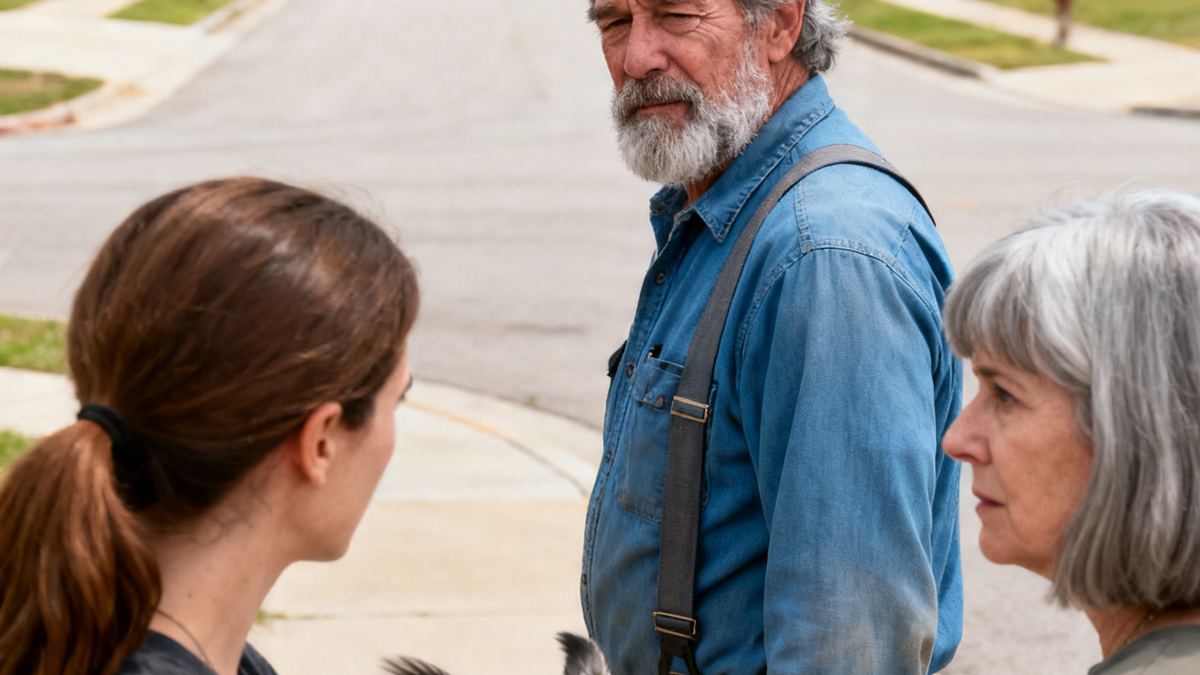
Martin Cole hadn’t built anything in fourteen months.
He used to build things that lasted. Custom cabinetry, mostly. Dovetail joints you could run your thumb over and feel nothing but smooth wood. A river-rock fireplace mantel for that pediatrician over in Black Mountain. A walnut dining table that seated fourteen. People drove up from Asheville just to shake his hand and ask if he was taking new clients. He always said yes. The work hummed through him like a quiet engine. He knew exactly who he was: a man with sawdust in his collar, coffee in a thermos, and a truck that smelled like cedar.
Then his hip gave out. Then his back. Then the doctor said what the doctor says to every sixty-five-year-old carpenter who thinks he’s thirty. So Martin sold the workshop to a nice young couple from Weaverville who painted the walls sage green and put in an espresso machine. He came home, sat in his recliner, and waited for something to feel important. Nothing did.
His wife, Ruth, was patient in the beginning. She brought him tea. She suggested a weekend trip to the coast. She gently pointed out a flyer for a woodworking class at the community college — as a student, not a teacher. Martin grunted at the flyer. He grunted at the tea. He discovered the deep, narcotic pleasure of watching home renovation shows for hours, not because he liked them, but because he could silently critique every crooked tile and sloppy caulk line. It felt like work, almost.
On a damp Tuesday morning in late March, his daughter Jess showed up without calling.
Martin opened the front door and blinked. She was holding a dog. It was the size of a loaf of sourdough, with ears that stood up like two fuzzy radar dishes and eyes that were entirely too large for its face. The dog looked at Martin. Martin looked at the dog.
“Absolutely not,” he said.
The dog wagged its tail.
“Dad, his name is Archie.”
“I don’t care if his name is Ernest Hemingway. I’m not running a kennel.”
Jess pushed past him into the house. Ruth appeared from the kitchen, wiping her hands on a dish towel, and her face did a complicated thing where she tried to look surprised but clearly wasn’t. Martin filed that away for later. Betrayal, he thought. My own wife.
“It’s just for a couple months,” Jess said, settling into the couch like she was negotiating a hostage release. “Josh got the promotion in Houston. We’re driving down next week. We don’t even have an apartment yet.”
“So you’re dumping the dog on me.”
“I’m asking my father for help. There’s a difference.”
Archie hopped onto the rug and began a systematic exploration of the living room. His nose was a tiny vacuum. He inspected the leg of the coffee table. He investigated a dust bunny behind the armchair. He was vibrating with the sheer, ungovernable joy of being alive and indoors and surrounded by people who hadn’t yet thrown him out.
“What’s wrong with him?” Martin asked, watching the little gray body wiggle.
“Nothing. He’s a terrier mix. That’s just… how he is.”
“He looks like a wind-up toy.”
“He was a rescue. They found him in a parking lot near the Ingles in Swannanoa. He’s just happy to be here.”
Martin snorted. “That makes one of us.”
The first week was a cold war. Martin laid down the law with the gravity of a man issuing building codes. No sleeping on the bed. No begging at the table. No unspooling the toilet paper. Archie absorbed these edicts with a tilted head and a tail that never stopped. He was relentlessly, unbearably cheerful. He followed Martin from room to room like a tiny, devoted shadow. If Martin sat in his recliner, Archie curled up on the floor exactly six inches from his left foot. If Martin went to the kitchen, Archie trotted behind him, claws clicking on the hardwood.
“He’s imprinted on you,” Ruth said, sipping her coffee.
“He’s annoying,” Martin corrected.
But the dog had a secret weapon. Every morning at seven-fifteen, Archie would appear at the side of the bed. He wouldn’t bark. He would simply stand there, radiating a patient, expectant energy. If Martin didn’t stir, a small, cold nose would gently press against his dangling hand. It was impossible to ignore. It was like being woken by a very polite ghost.
And so Martin started getting up. For the first time in over a year, he had somewhere to be. Someone who needed him to put on his boots and clip a leash to a collar and walk out into the gray Carolina morning. The dog didn’t care that Martin was retired. The dog didn’t care that his back hurt or that his workshop was now an artisanal candle store. The dog just wanted to go outside and smell the mulch and bark at a squirrel. And because the dog wanted it with such uncomplicated sincerity, Martin found it harder and harder to refuse.
One morning in early May, he was walking Archie along the Swannanoa River. The dog stopped to investigate a patch of wild onion. Martin stood there, holding the leash, suddenly aware of the weight of the morning — the mist rising off the water, the distant hum of a truck on I-40, the cool air on his face. He realized he wasn’t thinking about the workshop. He wasn’t mentally laying out a cut list or calculating board feet. He was just… standing there. Watching a small dog be fascinated by a weed. And it was enough. The thought landed in his chest, solid and strange. When had anything ever just been enough?
He was afraid to look at it too closely.
They fell into a rhythm. The morning walk. The afternoon nap — Archie curled in a sunbeam, Martin in his recliner, the two of them perfectly still. The evening walk, longer this time, often down to the little park with the gazebo. Martin started carrying treats in his jacket pocket. He bought a special blanket for the couch, the soft gray fleece kind, and when Ruth raised an eyebrow, he muttered something about dog hair on the upholstery. Ruth said nothing. She just smiled and went back to her crossword.
Then Jess called. They were settled in Houston. The apartment was great. There was a dog park two blocks away. She’d come up next weekend to pick up Archie.
Martin stood in the kitchen, phone pressed to his ear, and felt the floor drop out from under him. “That’s… great. Good. Perfect.”
He hung up. Archie was in the doorway, watching him with those bottomless black eyes. Martin crouched down, wincing at the creak in his knees. He scratched behind the dog’s left ear, the spot that made Archie’s back leg thump involuntarily.
“Well, little man,” he said, his voice rough. “Looks like you’re heading home.”
Two days before Jess was supposed to arrive, Archie got sick. He wouldn’t eat. He lay on his blanket and shivered. Martin sat with him all night, wrapped in an old quilt, one hand resting on the dog’s warm, fragile ribcage. He watched the clock hands crawl from three to four to five. It was absurd. It was just a dog. But the fear that coiled in his stomach was real and sharp. He couldn’t lose this. Not yet. Not after he’d just figured out why he was getting up in the morning.
The vet in Asheville said it was pancreatitis, brought on by a stolen chicken wing Ruth had accidentally dropped behind the trash can. Archie pulled through. But those twenty-four hours hollowed Martin out. He didn’t say much when he brought Archie home. He just sat in the recliner with the dog on his lap, stroking the soft gray fur, and he made a decision.
When Jess and Josh pulled into the driveway on a Saturday afternoon, Martin was waiting on the front porch. Archie was at his feet, tail thumping against the wooden planks.
Jess got out of the car, saw her father’s face, and stopped.
“Everything okay, Dad?”
Martin cleared his throat. He was never good at this. Ruth always said he built things because he didn’t have the words. So he tried to find them. “I’ve been thinking. You said the new place has a lot of stairs.”
“Well, yeah, it’s a split-level, but — ”
“And you’re both going to be working long hours. Houston’s a big city. A lot of traffic.”
Jess was starting to smile now, a slow, knowing smile. Josh came up behind her, carrying a new dog bed they’d picked up at a pet store in Greenville. He set it down on the porch steps.
“What I’m trying to say,” Martin said, and his voice caught on the words, “is that Archie’s got a routine here. A good one. He knows where the sun hits the rug at two o’clock. He knows the shortcut through the Jenkins’ yard. He’s got… he’s got his river.”
Jess’s smile had softened into something very tender. “You’re asking if you can keep him.”
Martin looked down at the little dog. Archie gazed back up at him with complete, unwavering trust. “I think he’s already made up his mind. I just… didn’t want to assume.”
Jess walked up the porch steps. She leaned down and kissed her father’s cheek. “I knew it the first day, Dad. That’s why I brought him.”
Josh just laughed, shaking his head, and picked up the new dog bed. “I’ll put this in the mudroom. Figure he needs a spare.”
That evening, after Jess and Josh had headed back down the mountain, Martin took Archie on his evening walk. The sun was low, spilling gold through the oak trees. They stopped at the riverbank. Archie waded into the shallows, snapping playfully at the water. Martin watched him, hands in his pockets.
He wasn’t a man who built cabinets anymore. But he was a man a river, a dog, and a quiet sense of purpose had brought back to life. He didn’t need to name it. He didn’t need to explain. The sun was warm on his neck, and the dog was splashing in the water, and ahead of them stretched the whole, wide, unexpected evening.
“Archie,” he called. The little gray head popped up, ears wet and dripping. “Come on, buddy. Let’s go home.”