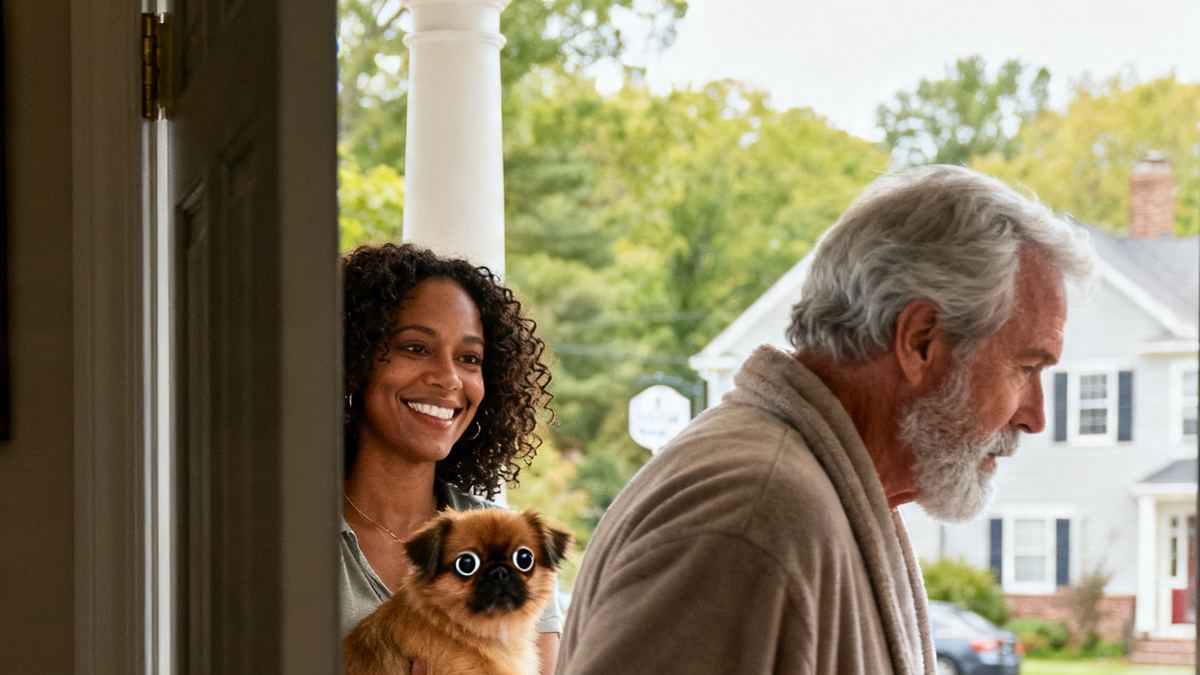
The alarm hadn’t gone off in nearly a year, but Jack Harris still woke up at 5:47 a.m. every single day. He just didn’t get up anymore.
“Jack, honey. It’s almost ten.”
His wife’s voice floated in from the bedroom doorway, gentle but edged with a persistence he’d come to dread. Martha had been patient. For the first few months after his forced early retirement, she’d let him grieve. Now, her patience was morphing into a kind of cheerful determination that felt, to Jack, like being poked with a stick.
“I’m awake,” he lied, his voice muffled by the pillow he’d pulled over his head.
“You’ve been ‘awake’ for two hours. The coffee’s gone cold twice. I’m not reheating it a third time.”
Jack cracked an eye open. The Connecticut morning was unforgivably bright, a crisp October sun slicing through the blinds of their Stamford colonial. He hated it. He hated the silence. For thirty-two years, his mornings had started with the clang of lockers, the echo of his own voice booming down hallways, and the crackle of the walkie-talkie on his hip. Jack Harris wasn’t a teacher; he was the superintendent of buildings and grounds, the man who kept the whole ship afloat. If a boiler blew, they called Jack. If a ceiling tile caved in during a thunderstorm, Jack was there before the lightning stopped. He was essential.
Then the district did a budget “restructuring,” and at sixty-one, Jack was given a plaque, a handshake, and a one-way ticket to a life of watching the leaves fall.
Martha appeared at his bedside, fully dressed, her silver hair pulled back in a neat ponytail. She was already on her second life chapter—yoga on Tuesdays, a book club that was really just a wine club, and a fierce dedication to her vegetable garden. She’d adapted. Jack, on the other hand, had simply stopped. He’d slid from the driver’s seat to the passenger seat and was refusing to even look out the window.
“Why don’t you come to the farmers’ market with me?” she tried. “The Honeycrisps are in season. We can get some cider doughnuts.”
Jack grunted. “I don’t need any doughnuts.”
Martha’s hands went to her hips. “You don’t need anything, apparently. Except that pillow.” She sighed and left the room.
Jack felt a familiar stab of guilt, but it was a dull, distant pain, easily smothered by the weight of his own uselessness. He reached for the remote, ready to lose himself in a mid-morning news cycle he didn’t care about, when the doorbell chimed.
“Are you expecting anyone?” Martha called from the kitchen.
“Nobody ever comes here,” he muttered.
A few seconds later, he heard the front door open, followed by his wife’s delighted squeal and a high-pitched, frantic scrabbling sound that definitely wasn’t human.
“Jack! You need to come out here! Right now!”
With a groan that came from somewhere deep in his bones, Jack swung his legs out of bed, pulled on a tatty robe, and shuffled into the living room. He stopped dead in his tracks.
His daughter, Emily, was standing there, a duffel bag the size of a small suitcase at her feet. But that wasn’t what made Jack freeze. It was the creature in her arms. A tiny, trembling, impossibly bug-eyed dog with fur the color of burnt caramel was staring directly at him. Its body was completely still, but its tail—a skinny little whip of a thing—was vibrating at a frequency that seemed to defy physics.
“Surprise!” Emily beamed.
Jack just stared. “What is that?”
“This,” Emily said, lifting the dog slightly as if presenting a royal heir, “is Hamilton. Ham, for short.”
“Ham. You named a dog Ham.”
“He’s a Brussels Griffon mix. Look at that face. He looks like a tiny, distinguished wizard, right?”
The dog—Ham—panted, revealing a small pink tongue and a severe underbite that made him look perpetually worried and slightly judgmental. Jack looked at the duffel bag on the floor. His eyes caught the familiar pattern. He recognized that bag. It was the one Emily had used for sleepovers in tenth grade. But it wasn’t filled with nail polish and pajamas now. Through the unzipped top, he could see a bag of expensive-looking kibble—that grain-free stuff that cost more per pound than his own coffee—a tangle of leashes, and a rubber chicken missing a leg.
“Em,” Jack said slowly, his voice a low warning. “Why is there a rat in my house with a suitcase?”
“Dad,” her husband, Ben, stepped in, closing the door behind him. “Good to see you too.”
They all migrated to the kitchen, where Martha poured coffee and pointedly avoided Jack’s accusatory glare. The story came out quickly. Ben, an architect, had landed a massive project—a six-month stint heading the restoration of a historic theater in Chicago. They were leaving the next day, their apartment was being sublet, and the pet-friendly rental they’d secured in Lincoln Park had fallen through at the last minute.
“It’s just for a little while, Dad,” Emily pleaded, her hand resting on Jack’s arm. Ham was now on the floor, sniffing the baseboard with the intensity of a bomb-sniffing agent. “A couple of months, tops. As soon as we find a permanent place, we’ll come back for him.”
“No,” Jack said flatly. “Absolutely not.”
“But you’re here all day! You have all this time—”
“Oh, thanks for the reminder, Emily. I’m well aware I have nothing but time. It’s fantastic. I’d love to fill it by picking up after a rodent.”
Ham chose that moment to scuttle over to Jack’s bare foot. He sniffed his big toe, looked up, and let out a tiny, squeaky sigh before planting his furry little bottom directly on Jack’s foot. The tail started up again, thumping against the tile floor like a miniature, erratic metronome.
“He likes you,” Emily said, as if this settled everything.
Jack looked down at the warm, purring weight on his foot. “It’s a canine. It doesn’t have the cognitive ability to ‘like’ anyone. I’m a warm surface.”
Ben and Emily exchanged a look that married couples do when they’ve already won the argument and are just waiting for the other side to realize it. They stayed for an hour, chatting about Chicago, the theater project, the terrible deep-dish pizza they’d have to endure. When it was time to leave, Emily hugged her father tight.
“He needs a walk at seven and five,” she whispered. “And he’s terrified of the vacuum cleaner.”
“Em, the bag,” Jack said, panic rising in his chest. “You forgot your bag.”
“That’s Ham’s stuff, Dad,” she said, already halfway to the car. “You’ve got this.”
And then they were gone, leaving Jack Harris, a man who’d managed a maintenance crew of twenty for three decades, utterly defeated by a seven-pound dog sitting on his foot.
That first week was a cold war. Jack believed in structure, having spent a lifetime imposing it on leaky pipes and unruly teenagers. He stood in the kitchen, a yellow legal pad in his hand, and read Ham the rules.
“Rule one: The sofa is for humans. The armchair is for humans. The bed is especially for humans. Your domain is that oval thing on the floor over there.”
Ham tilted his head, his wizard-beard quivering.
“Rule two: Food is dispensed twice a day. You will not beg. Staring at my meatloaf with those watery eyes is considered begging.”
Ham blinked.
“Rule three: The 5 a.m. nature calls are fine. The 5 a.m. demand for immediate, ecstatic play is not.”
The dog yawned, walked in a tight circle, and curled up on the very corner of the rug that was catching a ray of morning sun. Jack watched him, irritated by his serenity.
Martha, of course, was already smitten. Jack would catch her cooing at Ham in a baby voice, sneaking him bits of unseasoned chicken while the coffee was brewing.
“You’re spoiling him,” Jack grumbled.
“And you’re talking to him,” Martha shot back without looking up. “You think I don’t hear you explaining the offside rule to him during the soccer games?”
Jack opened his mouth to retort, but nothing came out. He had been doing that.
The breaking point arrived on a drizzly Tuesday. The clock hit 4:55 p.m., and Jack was deep into a documentary about deep-sea creatures, his slippers on, a blanket over his lap. The rain was tapping a soft, hypnotic rhythm against the window. He had decided, definitively, that no walk was happening.
Ham, however, had other plans. The dog materialized beside the recliner, his leash clamped in his underbite like a soggy cigar. He didn’t whine. He didn’t bark. He just stood there, a tiny sentinel, dripping the nylon leash onto Jack’s slipper.
“Forget it, Ham. It’s pouring. The sidewalks are rivers. I’m not dragging my ass out there for a dog that weighs less than a bag of sugar. Hell no.”
Ham dropped the leash and placed one small, surprisingly solid paw on Jack’s shin. The eyes. The wise, judgmental, wizard eyes were locked onto his. It was the look of profound disappointment, as if Ham had been promised a boss who’d actually do the job and got a slacker instead.
“Don’t look at me like that. I’m a senior citizen. I have rights.”
The paw remained. A low, guttural “wroof” escaped Ham’s throat, a sound that was far too deep for his tiny body.
Five minutes later, Jack was standing in the park, the hood of his slicker pulled tight, watching a Brussels Griffon mix named Hamilton sniff a wet maple leaf with the reverence of a wine connoisseur. The park was empty. The rain had turned the world a deep, saturated green, and the only sound was the steady hush of falling water. Jack stood there, hands in his pockets, and for the first time in nearly a year, he didn’t feel like he was supposed to be somewhere else. He wasn’t waiting for an emergency call. He wasn’t mentally patching a roof in the middle of a nor’easter. He was just a man in the rain, waiting for his dog to finish investigating a leaf. And it was perfectly, inexplicably, okay.
Two weeks later, Martha came home from her book club to find her husband on the floor, surrounded by plush toys with squeakers of varying decibels. He had a notebook open, filled with scribbled observations. “The chicken is a bust,” he said, not looking up. “Loses his mind for the hedgehog, though.”
A month after that, he drove to the Mobil station on High Ridge Road and bought Ham a tiny plaid raincoat for fourteen bucks. “His undercoat isn’t built for New England damp,” he told Martha, dead serious.
The morning routines transformed. Jack no longer lay in bed until ten. He woke up at six, not to the phantom sound of a school bell, but to the determined snuffling of a small dog pushing a cold nose into his palm. By 6:15, they’d be at the coffee shop that opened at six, the one with a jar of dog biscuits on the counter—free for any dog, but Jack always threw an extra dollar in the tip jar. Ham would sit on Jack’s boot, surveying the morning traffic like a ship’s captain. “He doesn’t like the mail truck,” Jack told Chloe, the barista with the sleeve tattoo who always had a biscuit ready. “The tires make a weird harmonic vibration.”
The call came on a Friday evening, just as Jack was scrambling a single egg—no salt, like the internet said—to mix into Ham’s kibble, a Tuesday-and-Friday tradition.
“Dad! Good news!” Emily’s voice was bright. “We found a place! A duplex in Wicker Park. Totally pet-friendly. We’re coming this weekend to get our little man!”
Jack’s hand stopped mid-stir. The whisk dripped pale yellow onto the tile. He didn’t move. He heard himself say “This weekend?” like it was a question he already knew the awful answer to.
“Yeah! We’ll drive in Saturday morning. I can’t wait to see you guys. Is Ham around? Can you put me on speaker?”
Jack put the phone down on the counter and hit the speaker button. “Ham,” he said, his voice thick. “It’s… it’s Emily.”
At the sound of her voice, Ham’s ears perked up. He did a happy little tap-dance on the tile, his nails clicking a frantic staccato. He knew that voice. It was the voice of the woman who’d rescued him from a shelter in Bridgeport. Emily cooed hellos for a minute, then hung up, promising to be there by noon on Saturday.
Jack stared at the phone. He looked at Ham, who was now returning to his post by the stove, tail wagging in anticipation of the egg. Jack muttered something under his breath that Martha would’ve scolded him for, then forced out a “That’s great, honey” that sounded nothing like him. He didn’t say another word that night, but Martha knew. When he climbed into bed, she put her book down and took his hand.
“You could ask her, you know,” she said softly. “To leave him.”
Jack stared at the ceiling. “He’s hers. She loves him.”
“So do you.”
He didn’t deny it. He had spent nine months denying life was worth living without a job, and now he couldn’t imagine a life without a grumpy little dog who hated mail trucks. He lay there, blinking at the dark, and felt his wife squeeze his hand twice, quick, like she did when the kids were small and something had to be enough.
Saturday morning, Jack was up at dawn. He took Ham for an extra-long walk, letting him sniff every hedge twice. He didn’t talk. He just watched Ham’s little body wiggle through the dewy grass, and he memorized the sight.
When Emily and Ben arrived, there was no big explosion of excitement from Ham. The dog simply walked up to Emily, sat down politely on her feet, and presented his belly for a rub. It wasn’t the greeting of a dog who’d missed his owner desperately; it was the affectionate greeting of a dog who was catching up with an old friend before returning to his life.
They sat in the living room. The duffel bag with the rubber chicken sat by the door, packed and ready.
“Well, little dude,” Ben said, clapping his hands on his knees. “Ready to hit the road? Long drive to Chicago.”
Jack couldn’t look up. He cleared his throat, but nothing came out. “He, uh… he gets carsick if he eats before a long trip. So maybe just some water.”
“Dad,” Emily said gently.
He still wouldn’t meet her eyes. “And don’t use that new leash, the red one. He chews through it in two seconds flat when he gets bored.”
“Dad. Look at me.”
Jack forced himself to look at his daughter’s face. She was smiling. Not a triumphant smile, but one of gentle, knowing love. She pointed past him to a brand-new duffel he hadn’t noticed by the door.
“That’s not Ham’s stuff,” she said. “That’s a year’s supply of his special kibble, the Blue Buffalo small-breed formula, a new orthopedic bed for the living room window, and the hedgehog toy in three different sizes since you said he kept destroying them. The big one was seven bucks on Chewy.”
Jack just stared at the bag, completely speechless. The confusion on his face was so raw, so unguarded.
Ben grinned and threw an arm around his wife. “We knew by about week two, Jack. Martha was sending us videos. The homemade raincoat was the dead giveaway.”
Emily walked over and set the second duffel next to his chair. “We’re not taking him, Dad.” She crouched down and scratched behind Ham’s ears until the dog’s back leg started thumping. “This is where he belongs.”
The silence in the room was absolute. Ham, sensing the shift in the mood, trotted over and jumped onto the sofa next to Jack, settling against his thigh with a contented grunt. Jack finally moved. He placed a broad, calloused hand—a hand that had once held a walkie-talkie and a master key ring—onto the tiny, warm body next to him. He didn’t say thank you. He didn’t make a speech.
He simply nodded, a short, jerky motion, and for the first time in a year, the tightness around his eyes vanished. Martha reached over and squeezed his shoulder.
No one said anything for a long minute. Then Ham let out a long, dramatic sigh, as if bored by the human sentimentality, and began to snore softly. It was the most perfect sound Jack had ever heard. He picked up the remote, found the soccer game, and settled back, his dog a warm, steady heartbeat against his leg. The announcer’s voice filled the room just as Ham snorted in his sleep, and that was that.