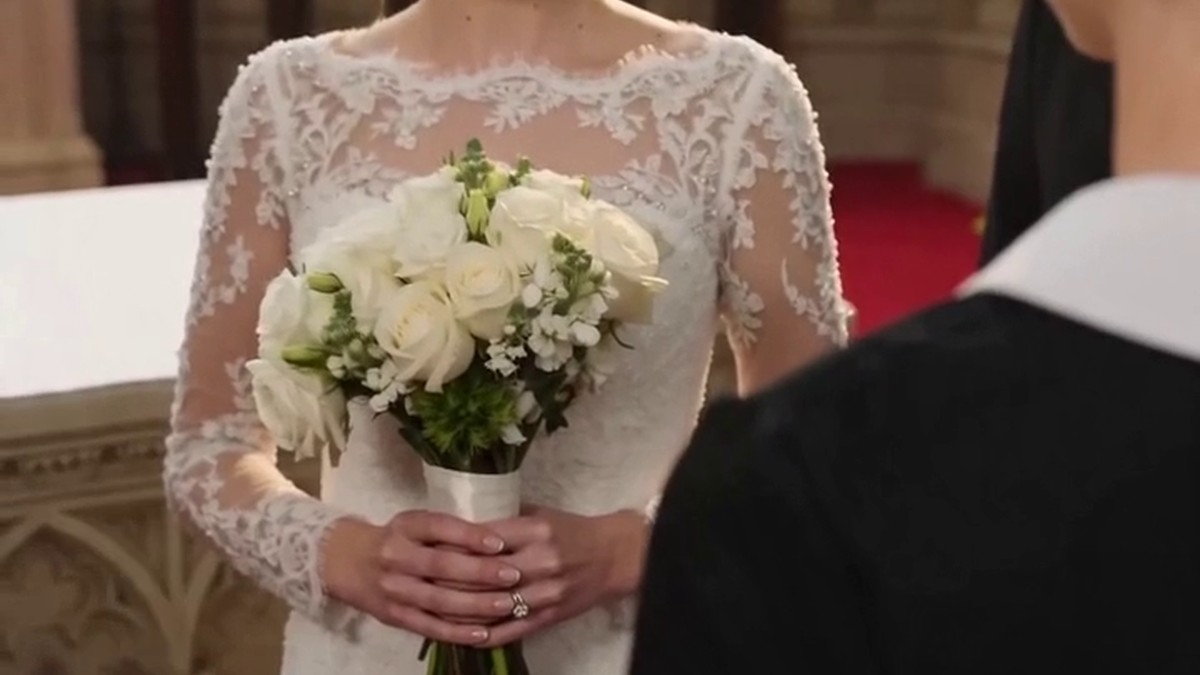
The bride moved down the aisle on her father’s arm, her smile so polished it could cut glass.
Everything looked flawless.
Then — just as the priest drew his first breath to begin — the doors flew open.
A woman in a maid’s uniform walked in like she owned the place.
The whispers started immediately.
The bride’s mother shot to her feet, face flushed crimson.
“What do you think you’re doing? Staff enter through the kitchen. Get out. Right now.”
The woman didn’t flinch.
She looked straight at the bride.
“I didn’t come here to serve anyone. I came to make sure no one in this room spends another minute living inside a lie.”
The entire hall went dead silent.
The bride steadied herself, voice like ice.
“I have no idea who this woman is. Someone remove her.”
The woman reached into her bag and pulled out a worn yellow envelope.
“Oh, you know exactly who I am. I’m the woman you paid to vanish ten years ago.”
The room gasped.
The groom’s brow pulled tight. “What is she talking about?”
The woman opened the envelope and spread the documents like a hand of cards.
“The woman you’re about to marry didn’t inherit her family’s fortune. She stole it. Ten years ago, she forged her own cousin’s identity — after arranging for that cousin to disappear from the country. Every asset. Every deed. Every transfer. All of it built on falsified paperwork.”
The bride’s composure cracked. Her hands started to shake.
“That is a lie!”
From the front row, an older man rose slowly from his seat. The family attorney. He stepped forward, took the documents, and studied them in silence for a long moment.
The color drained from his face.
“These are originals,” he said quietly. “And that’s the signature of my former partner.”
The murmuring spread through the hall like wildfire.
The woman in the uniform took one step forward.
“I spent years cleaning this house. I scrubbed floors. I ironed sheets. I did it because I needed time — and access — to find the proof. No one looks twice at the maid.” She paused. “That was my advantage.”
The bride bolted for the side exit.
She didn’t make it.
Officers who had been waiting just outside stepped in, blocking every door. One of them held up a warrant.
“You’re under arrest. Fraud. Identity forgery. Unlawful seizure of assets.”
The groom stood motionless at the altar. He reached down slowly, pulled the ring from his finger, and held it in his palm for a moment before setting it on the nearest pew.
When he finally looked at her, there was no anger in his eyes. Just a quiet, devastating clarity.
“You didn’t ruin this wedding. You ruined it the day you decided to build your whole life on a foundation of lies.”
As she was escorted out through the same doors she’d walked through as a bride-to-be, the woman in the uniform exhaled for what felt like the first time in a decade.
The weight she’d carried — the years, the silence, the uniform, the waiting — lifted all at once.
Because she understood something now, deep in her bones.
The truth doesn’t hurry. It doesn’t need to.
It just waits for the right moment — and then it walks in through the front door.
The ballroom remained frozen.
Two hundred guests sat in their wedding finery, champagne flutes still in hand, flowers still pinned to lapels, cameras still tilted at angles that no longer made sense. The altar was empty except for a single gold ring sitting on a pew like a period at the end of a very long sentence.
Nobody moved.
Then the groom’s mother broke first. A sound left her — not quite a sob, not quite a laugh — something in between that said *I knew* and *I can’t believe it* at the same time. She pressed her handkerchief to her mouth and sat back down heavily.
The woman in the uniform — who was no longer anyone’s maid — stood in the middle of the aisle and let the silence do its work.
An older gentleman from the sixth row leaned toward his wife and whispered something. She turned and looked at the woman with wide, careful eyes. Others did the same. Studying her. Really looking, maybe for the first time.
The family attorney stepped toward her slowly, the documents still in his hands.
“Elena Vasquez,” he said. Not a question. A recognition. Slow and painful, like a man remembering something he should never have forgotten.
She nodded once.
“I thought you were dead.”
“She wanted you to.”
He looked down at the papers again, then back up at her. There was guilt in the creases around his eyes — the particular guilt of a man who had asked no questions when questions were exactly what the moment had required.
“The transfers,” he said quietly. “The property filings. The probate documents. All processed through my office.”
“Through your former partner,” she corrected. Not accusing. Just precise.
He nodded slowly. “I should have looked closer.” A pause. “I’m sorry, Elena.”
She accepted that with nothing more than a breath.
—
Outside, through the tall glass panels flanking the entrance, she could see the police cruisers. She could see the white of the wedding dress moving between two officers. The bride — *Marguerite* now, not the stolen name she’d worn for a decade — was not going quietly. Her voice carried even through the glass, sharp and insisting, still performing even now.
*It’s a mistake. You have no idea who I am. My attorney will —*
But her attorney was standing inside, holding the very documents that ended her.
The bride’s mother was still on her feet, clutching the back of the pew in front of her. Her face had gone through crimson and out the other side into something pale and wrecked. She knew. Maybe she’d always known. Maybe she’d simply chosen the version of the story that kept the chandeliers lit and the invitations printed on heavy cream stock.
She looked at Elena across the length of the aisle.
Elena looked back.
No words passed between them. None were needed. Ten years of silence had already said everything.
—
The groom — Daniel, she’d learned his name from the wedding program she’d read a hundred times while ironing table linens at midnight — walked the length of the aisle toward her. He moved like a man still getting his bearings, each step deliberate, like the floor might give way.
He stopped a few feet away.
“She told me her cousin emigrated,” he said. “Moved abroad. Lost touch with the family.”
“She told everyone that.”
“Did you try —” He stopped. Started again. “Were there people who could have helped you sooner?”
“I had no identity.” Elena said it plainly, without performance. “She didn’t just take the money and the property. She took the documents that said I existed. I spent three years without a name, legally speaking. By the time I rebuilt enough of a paper trail to get work, I had to be careful.” A beat. “Careful took time.”
He absorbed this. His jaw worked.
“So you took the job here. In this house.”
“Her house,” Elena said. “My grandmother’s house. Where I grew up.” She looked up at the vaulted ceiling, the carved moldings, the chandelier she had climbed a stepladder to dust seventeen times. “I knew every room. I knew where she kept things. I knew she’d gotten careless, because people always get careless when they think the danger is gone.”
“The envelope.”
“In the lining of a coat she hadn’t worn since the fall. She was never particularly imaginative about hiding places.”
Something shifted in Daniel’s expression — grief, maybe, or relief, or both braided together in a way that made them indistinguishable.
“I was going to spend my life with her,” he said.
“I know.”
“I thought I knew her.”
“You knew the performance,” Elena said, and there was no cruelty in it. “She was very good at it. That’s not your failure.”
He looked at her for a long moment. Then he reached into the breast pocket of his jacket and produced a business card. He held it out.
“My firm handles estate restitution. Property law.” He paused. “Among other things.”
She took it.
“I can’t promise it will be fast,” he said. “Or easy. But what she took from you — the deeds, the accounts, the legal identity — there’s a path to getting it back. If you want help walking it.”
Elena turned the card over in her fingers. Felt the weight of it. Such a small thing.
“I’ve been walking difficult paths alone for ten years,” she said.
“I know.” He held her gaze. “You don’t have to anymore.”
—
The guests filed out in clusters, voices low, the festive energy curdled into something stunned and hushed. Caterers appeared in doorways, uncertain whether to bring out the first course. Someone quietly began removing the floral arrangements from the altar. The florist, apparently, was nothing if not practical.
Elena walked to the window.
The cruiser was pulling away. She watched the white dress disappear behind tinted glass — watched the woman who had stolen her name, her inheritance, her decade, become smaller and smaller until the car turned a corner and was gone.
She felt nothing that resembled triumph.
What she felt was quieter than that. Simpler.
Like a room after a window is opened for the first time in years. Like the specific relief of setting down something heavy you’d carried so long you’d stopped noticing the weight — until, suddenly, your hands were empty.
Behind her, the attorney approached.
“Elena.” He stopped beside her. Both of them looking out at the empty drive. “What do you need right now? Immediately, I mean. Tonight.”
She almost smiled.
“A change of clothes,” she said. “And somewhere to sleep that isn’t the staff quarters.”
He nodded. Straightforward. Practical.
“I have a guest room,” he said. “And I believe I owe you, at minimum, a proper dinner.”
She turned from the window.
The ballroom was nearly empty now. Chairs askew, programs left on pews, a single white glove abandoned on the floor near the third row. The whole elaborate theater of the day, dismantled in minutes.
Elena Vasquez walked down the aisle — not the way a bride walks, measured and performed — but the way a woman walks when she knows exactly where she’s going.
Head up. Shoulders back. Unhurried.
She had waited ten years.
She could take her time now.
—
Weeks later, the legal proceedings would move quickly — faster than anyone expected, once the documents were authenticated and two additional witnesses came forward. Employees. Accountants. People who had also wondered, and also stayed quiet, and also, finally, didn’t.
Months later, the house would be restored to her name.
She would stand in the doorway of her grandmother’s parlor on the first morning it was legally, entirely, undeniably hers again. The light would come through the same south-facing windows it always had. The floor would creak in the same spot near the fireplace.
She would make coffee in the kitchen — not the staff kitchen, *the* kitchen — and drink it standing at the window, looking out at the garden, which had been allowed to go slightly wild.
She would find she didn’t mind.
Wild things, she had learned, were often just things that had been waiting patiently for room to grow.