The key turned in the lock with its familiar, heavy click. I stood in the tiled entryway of my son’s house in Flagstaff, purse in hand, coat buttoned to my chin, ready to walk out the door. I’d asked him for sixty dollars. Sixty dollars for a bus ticket down to Phoenix to see my friend Nina. He was at the kitchen island, scrolling on his tablet, stirring his coffee with the little silver spoon that had belonged to my mother.
He didn’t look up. “Why do you need to go now, Mom? You’ve got everything you need right here.”
The words hung in the air, still and cold as the January frost on the windowpane. It wasn’t a question. It was a verdict. I waited for a flicker of something—the boy who used to bring me dandelions clenched in a muddy fist—but he just took a sip of coffee and smiled a small, placid smile. A stranger’s smile. I set my purse down on the hall table. Unbuttoned my coat. Sat back down on the edge of the guest bed and listened to the tick of the central heating. It took me a full hour to understand what had just been stolen.
My name is Margaret Barlow. I’m seventy-one. For thirty-eight years, I ran the administrative office at Coconino High School—purchase orders, budget requests, payroll for substitute teachers. I know what a ledger is. I know what a joint account means. And I will never forgive myself for the speed of my own signature.
It started after the spell I had at the grocery store in August. Nothing dramatic—an Arizona heatwave, low blood pressure, a little dehydration. A paramedic named Carlos checked my vitals and helped me to a bench. My son, David, heard about it from a neighbor before I’d even finished my iced tea. He and his wife, Chloe, were in my living room by six o’clock that evening. Chloe stood in my kitchen, pouring sparkling water into a glass, while David sat across from me with his elbows on his knees, his voice pitched low with concern. “Mom, you can’t stay in this house alone anymore. What if you’d fallen in the shower? What if nobody found you?”
“It was just the heat, David. I’m fine.”
“You’re fine now,” he said, his jaw setting in a way that echoed his father. “But what about in a year? In two?”
Chloe handed me the glass with a tight, sympathetic nod. She was always handing me things instead of speaking. Her kindness was a polished, sealed surface, like a granite countertop. You could see your reflection in it, but you could never see beneath.
By September, I was living in their spare room in Flagstaff, the one left empty after their daughter went off to UC Boulder. It was a pretty room, looking out onto a yard of ponderosa pines and red volcanic gravel. David hung linen curtains I’d picked out. I packed three boxes: photographs, a wool blanket my mother had woven, a few paperback mysteries, and a small radio. My little house on the south side—the one with the creaking porch swing—would be rented out. “To cover the property taxes, so it doesn’t sit empty,” David had explained, and it sounded so reasonable.
The first month was a quiet seduction. Family dinners, the evening news, my grandson Liam stopping by after school to raid the fridge. I felt the warm, narcotic glow of being needed. I helped him with trig homework. I made a meatloaf. I was woven into the fabric of a busy household, and I didn’t notice, at first, that the weave was a net.
The document arrived on a cool October evening. Chloe was loading the dishwasher, the clink of plates a steady rhythm in the background. David placed a single sheet of paper on the coffee table next to my cup of decaf. He held out a pen. “Mom, it’s just a formality. Your pension and the rental income can just direct-deposit into the household account. I’ll handle all the bills, the co-pays, the property tax. You won’t have to stress about a single piece of mail.”
I glanced at the paper. The letters blurred. Liam had been home with a stomach bug all day, and I was bone-tired. I thought: This is my son. He’s an accountant, for heaven’s sake. He’s trying to help. I signed.
November and December slipped by. I had what I needed: David picked up my blood pressure medication, Chloe brought home my favorite brand of English Breakfast tea and those almond biscotti I liked. On Christmas Eve, there was a perfect roast and a fire in the grate, and I sat at the table as a guest in my own life, smiling and saying thank you.
The shock came after the New Year. Nina had called from Phoenix. Her hip was giving her trouble and she was low after the holidays. “Get on the bus, Maggie. I’ll make a pitcher of margaritas and we can complain about our joints.” All I needed was sixty dollars. I went to find David.
“Why do you need to go now, Mom? You’ve got everything you need right here.”
He didn’t shout it. He was calm, reasonable, already turning back to his tablet as if the conversation was over. I saw Chloe in the reflection of the dark window, her movements pausing for a microsecond at the sink before resuming. A look passed between them—a silent, electrical signal of a previously agreed-upon plan. I was not a family member asking for a small sum. I was a line item that was trying to deviate from the budget.
The next day, I asked again. Chloe’s smile was stretched thin. “It’s just terrible weather for a bus ride, Margaret. David will drive you down in a week or two when things quiet down at work.”
A week passed. Then another. Nina called, and I made a dozen soggy excuses, my voice a thin, tinny lie. Finally, in her no-nonsense way, she asked, “Maggie, do you even have access to your own money right now?”
The silence on my end was the answer. I was a former school administrator with a healthy pension, and I could not put my hands on a single dollar. The money—my salary from three decades of budget meetings and fire-drill supervision—vanished into a digital vault, and I did not have the key. David had “forgotten” to get me a debit card for the joint account. He was always about to do it. Tomorrow. Next week.
The dormant accountant in my brain flickered awake. I did the math. My pension plus the rent from my house came to about five thousand dollars a month. My real costs in that house—the tea, a few prescriptions—might have been two hundred. The rest of the nearly five grand was quietly plugging the holes in their financial ship. A boat payment. A HELOC. Their life. And I couldn’t get a bus ticket.
One night, at three in the morning, when the house was breathing the deep, oblivious breath of sleep, I padded into the kitchen. My heart thudded against my ribs as I slid open the drawer where David kept the household files. I found the bank statements for the joint account. Three months of them. Inflows: my pension, my rental check. Outflows: their mortgage, their car insurance, their life. Not a single debit labeled “Mom’s needs.” In my own bank account, I was a ghost.
My hands trembled as I slid the papers back into place, the rage curdling into something far more corrosive: shame. This was my son. The boy I’d taught to ride a bike on this very street. The man who had held my hand at his father’s funeral. He had “taken care of me.” He had taken care of me into a cage.
The next morning, I waited until the house was empty and called Nina on the landline. I told her everything. She was quiet for a beat. Then: “I’m sending my grandson, Mateo, to get you today. He’s got that big pickup. Be ready.”
I didn’t sleep that night. I lay in the dark, listening to the house’s mechanical heartbeat and the distant rumble of a freight train. I was safe here. Fed. Medicated. I could stay in this perfectly appointed museum of benign neglect until I died, wanting for nothing except the single, essential right to say “I’m going to see my friend” without seeking permission.
At dawn, I rose. I packed a single bag—the same leather holdall I’d brought with me. I dressed in my traveling coat and stood by the front door.
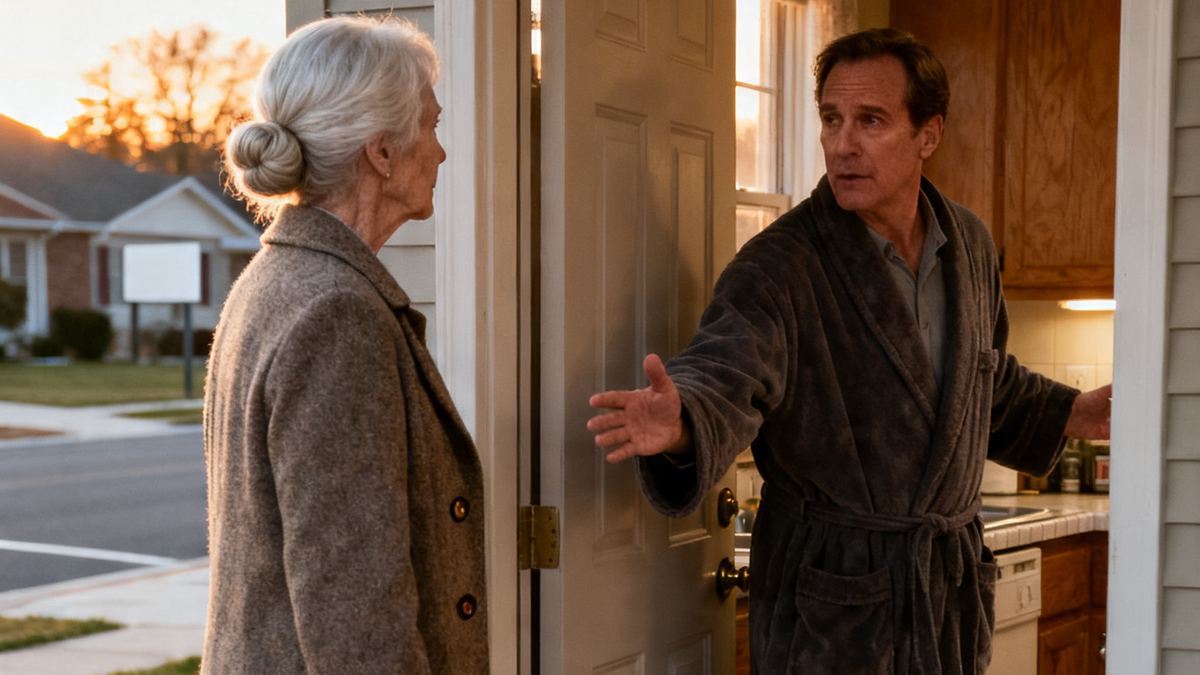
David came down the stairs in his robe, hair mussed, frowning at the sight of me. “Mom? What are you doing?”
“I’m going to Nina’s. Mateo is picking me up.”
A flicker of confusion, then a hardening around his eyes. Something else, too. He wasn’t angry. He was terrified. It’s an awful thing to realize your care wasn’t the asset he was afraid of losing; it was the control. “Mom, let’s just sit down. Have a coffee. We can talk this through.”
Outside, the diesel chug of Mateo’s old Ford rumbled into the driveway. I picked up my bag.
David stepped in front of the door, barefoot on the cold tile, his hand raised in a placating, pleading gesture. He was six years old again, terrified of being left at his first day of school. For half a second, I felt the old maternal pull, the instinct to soothe.
I looked at him, my only son, and saw the full, complex architecture of his manipulation. He was so sure of his own kindness. He hadn’t beaten me or starved me. He’d just reclassified me from an independent woman into a dependent asset, and silenced me with a signature.
“Move, David.”
“Mom, please…”
I didn’t shout. I moved past him, my hand closing on the cold metal of the door handle. I pulled it open, letting in the sharp, high-desert morning air and the sound of the idling truck. I stepped outside and closed the door behind me, not with a slam, but with the definitive, quiet click of a safety deposit box sealing shut.
I sat in Mateo’s truck, the seat vibrating beneath me, and watched the ponderosa pines of the neighborhood blur past. I did not cry. The shame had burned off in the night, and what remained was a cold, clarifying anger.
The five-hour drive to Phoenix unspooled the landscape and my thoughts. I saw the architecture of it all now—the concern that was really a valuation, the “help” that was really a leveraged buyout of my life. I wasn’t going back. Not to the house, not to the account, not to the role of silent, grateful furniture.
I would find an attorney in Phoenix, a junkyard dog of a woman Nina knew who specialized in elder financial abuse. I would go to the Social Security office and reroute my benefits to an account in my own name—an account with a bright, shiny debit card, the keys to my own kingdom. I would demand a full forensic accounting of every penny that had flowed into David’s household and ring-fence the money from the rental of my house. There would be no gentle reconciliation, no “family meeting” mediated by a soothing pastor. He had made me a business transaction, and I would respond in kind: with receipts, statements, and legal letters.
We pulled off the I-17 at a dusty gas station to stretch our legs. I bought a cup of burnt coffee and a packet of peanut butter crackers. I paid for it with a crumpled ten-dollar bill I’d found tucked in the lining of my coat. As I took the small change, the coins clinking into my palm felt like a declaration of sovereignty.
On the final stretch into Phoenix, the sun glinting off the sprawl, my phone buzzed in my purse. The screen lit up with a photo of David from years ago, smiling at a summer barbecue, and the word "Son." The engine hummed. The phone buzzed in my hand, a persistent, electronic pulse of grief and demand.
I didn't answer it. I let it ring until the voicemail picked up. Then I deleted the call log, leaned my head back against the worn fabric of the truck seat, and watched the saguaros begin to dot the horizon, one by one.