Caleb tugged the hood of his sweatshirt lower and hugged the chain-link fence that ran along the back of the grade school. His shoes were still caked with red mud from the holler, and he could hear them before he saw them—the scuff of sneakers on asphalt, a low whistle, then that laugh like a rusty gate.
“Well, looky here. The little mole came up for air.” Travis Boggs planted himself in the middle of the path, arms crossed over a ribbed tank top that was two sizes too big. Two other boys fanned out behind him like it was choreographed.
Caleb didn’t answer. He clenched his jaw and felt the bridge of his glasses dig into the fresh bruise on the side of his nose. His mom had already chewed him out once about breaking another pair.
“What’s wrong, Ray Charles? Can’t see me? Oh wait, you can’t see nothin’ without them Coke bottles.” Travis snatched the glasses off Caleb’s face and held them above his head, bobbing them like a toy. Caleb lunged, but a shove from the side sent him stumbling into the fence. The wire rattled, and a car alarm two blocks over started wailing.
By the time he got home, he’d already worked out the lie. Tripped on a root. Fell into his locker. His mother, Jolene, was still in her apron from the diner, a smear of gravy drying on the pocket. She gave him one look and shook her head.
“Caleb Ray, you are the most tender-hearted boy I ever seen. The world ain’t gonna coddle you. You got to push back.” She handed him a bag of frozen peas from the icebox and went back to the stove, muttering about his father, who’d up and left for a rig job in North Dakota three years back and barely called on Christmas.
The truth was, pushing back only made things worse. They’d moved to this speck of a town in the West Virginia panhandle six weeks ago for a fresh start, but the new school was just a smaller pond with bigger, hungrier fish. Caleb had no crew, no table in the lunchroom, nobody to walk the dirt road with after the final bell. So he walked it alone, past the old Sinclair station and the abandoned lot where the coal tipple used to be, until the blacktop gave out to gravel and the woods swallowed the sound of traffic.
That was how he found the pup.
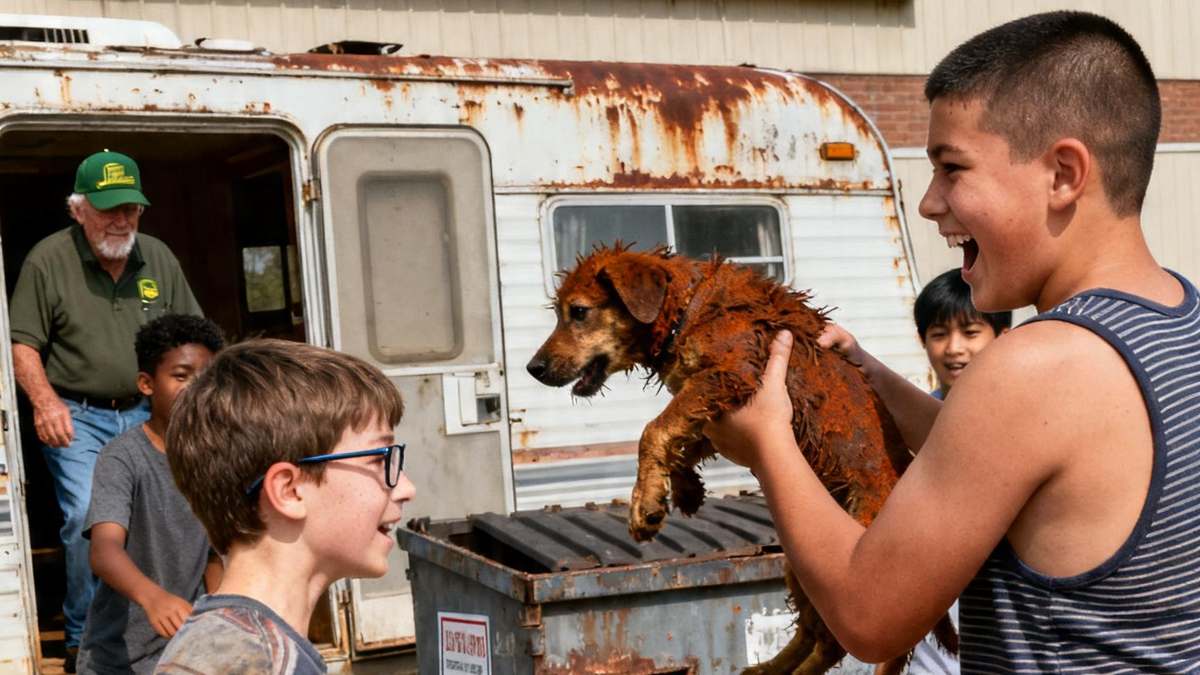
It was a Tuesday, hot as a furnace, and he’d taken a shortcut through the overgrown field behind the Dollar General. Something rustled in a patch of chicory. A scrap of a dog, no bigger than a boot, the color of a rusty axle. It was chasing a crumpled Mountain Dew can, batting it with both front paws, then yapping at it like it had done something personal.
Caleb crouched low, and the pup froze. Then its whole hind end started wagging, and it barreled toward him, tripping over its own ears. He scooped it up and felt the rapid-fire heartbeat against his palm. Its fur smelled like dry grass and old motor oil. He dug out half a bologna sandwich from his backpack, and the pup inhaled it in two gulps.
A low growl rumbled from the tree line. A big black dog stood watching, motionless as a statue, her ribs showing through a coat that had seen better days. The pup wiggled out of Caleb’s arms and bolted toward her, and together they vanished behind a rusted-out dumpster at the edge of the lot.
That night, he asked about it. “Mama, could we maybe—I found this puppy, and it’s all alone, and its mama looks half-starved.”
Jolene set down her fork. There was a smear of ketchup on her plate and a weariness in her eyes that went bone deep. “Caleb. We’re barely keeping the lights on. I’m pulling doubles at the diner just to cover the rent on this trailer. We can’t feed a dog, let alone two.” She took a sip of iced tea. “Maybe when your dad’s child support comes through. Whenever that is.”
He didn’t ask again. But he did start packing extra lunch.
The lot became his after-school routine. The pup, which he’d started calling “Rusty,” would come bounding out the moment it smelled the deli meat, and the black dog, which he called “Shadow,” began to accept his offerings without baring teeth. He’d sit on an overturned bucket and do his homework while Rusty chewed a stick, and for an hour, the world didn’t feel like a trap.
He was careful never to be followed. He’d zigzag through the car wash, cut behind the Baptist church, and watch his back like a fugitive. But kids like Travis Boggs have a talent for finding the one thing you care about and putting a boot on it.
On a Friday in mid-September, Caleb got a perfect score on his West Virginia history exam. He was so eager to tell someone—anyone—that he forgot to double back. He didn’t notice the three sets of footsteps crunching in the gravel until he was halfway across the lot, the bucket in sight.
“Hey, Ray! Got a present for you!” Travis’s voice sliced through the cicada hum.
Caleb spun. Travis was holding Rusty by the scruff, the pup’s legs pedaling in the air, a terrified whimper escaping its throat. Another boy had a thin branch, poking Shadow, who was backed against the dumpster, hackles raised.
“Put him down, Travis. Now.” Caleb’s voice cracked, but he balled his fists and took a step forward.
Travis grinned, all crooked teeth and spit. “Or what? You gonna bore me to death with a book?”
Then Shadow lunged. She didn’t bark, didn’t growl—she just moved, a black bolt of muscle and fur, and from behind the dumpster came two other strays Caleb had never seen, mangy and quick. One caught Travis’s arm, not deep, just enough to make him drop Rusty with a shriek. The branch went flying. The boys scattered like quail, tripping over cinder blocks and old tires, screaming about rabies and calling for their mamas. Shadow didn’t chase far, just stood there, a low vibration in her chest, until the last footstep faded.
Caleb’s hands were shaking. He picked up Rusty and held him tight, the pup’s whole body trembling. It was then that a man’s voice, rough as a gravel road, cut through the ringing in his ears.
“Good girl, Shadow. Good girl. Now get on back before somebody sees you.”
An old man stepped out of a rusted camper trailer parked behind the dumpster, a trailer Caleb had never noticed. He wore a stained John Deere cap and had a cigarette tucked behind his ear. His eyes were the color of creek water and just as unreadable. He looked at the boy, looked at the pup, and gave a single dip of his chin.
“You the one been feedin’ my dogs.”
It wasn’t a question. Caleb swallowed. “I … I thought they were strays, sir.”
“They are. So am I, mostly.” The man took the cigarette and lit it, cupping the flame even though there was no wind. “Name’s Roscoe. What’s your tale of woe, son?”
So Caleb told him. About the move, about the diner, about his dad going silent, about the glasses and the black eyes and the history exam nobody cared about. He didn’t mean to, but the words came out in a rush, and by the end his face was wet and he was mad at himself for crying. Roscoe just listened, smoking that cigarette down to the filter, then stubbed it out on the sole of his boot.
“Them boys’ll be back with trouble. Animal control, most likely. They’ll say the dogs is vicious.” He squinted up at the ridge. “I can’t let ’em take Shadow. She ain’t got nobody but me.”
“We could hide them,” Caleb said. “Up the holler, there’s a old root cellar behind the abandoned gas well. Nobody goes there.”
Roscoe studied him for a long moment. Then he said, “You go on home now. I’ll handle it.”
That night, Caleb barely slept. The next morning at school, the principal came over the PA: all students were to avoid the lot behind the Dollar General due to a feral dog situation. The county animal control had been dispatched, and several students had reported bites. Caleb’s stomach turned to ice. He slipped out a side door during lunch, ran all the way to the lot, but it was already too late. The camper was empty, the dumpster gone. No dogs, no Roscoe. Just a fresh set of tire tracks and a single orange notice stapled to a post: “DANGER: FERAL DOGS.”
He got sick that night. Fever spiked to 103, and Jolene rushed him to the ER down in Elkins, where they kept him for three days with some kind of stress-induced infection. His mom slept in the chair next to his bed, still in her apron, and he heard her murmur to the doctor, “He’s just been carrying the whole world on his shoulders.”
The evening before they were set to go home, Jolene sat on the edge of his bed and pressed a damp cloth to his forehead. “Somebody came into the diner looking for you. Old fella in a John Deere cap. Said he knew you from the lot. I was half out of my mind with worry, and he just … listened. Then he followed me out to the parking lot and tightened the serpentine belt on the car so it’d stop squealing. Wouldn’t take a dime.” She shook her head, a weird little half-laugh escaping her. “Had a black dog with him, and he said the pup you’d been feeding was safe. Said he’d figure out a place for it.”
Caleb’s throat closed. “That’s Roscoe. Did he—are the dogs okay?”
“He didn’t say much more. Just that he’d be back around.”
When they got back to the trailer, a faded GMC pickup with a camper shell sat in the dirt patch out front. The scratchy welcome mat had a pair of muddy work boots on it. Inside, Jolene was stirring a pot of coffee, and on the tiny kitchen table sat three chipped mugs—one of them a new one, a gas-station souvenir mug with a cartoon horse on it.
“Caleb, honey, Roscoe’s here,” Jolene said, her voice softer than he’d heard it in months. “He’s got something for you.”
Out from the narrow hallway, slow and deliberate, came Roscoe. His cap was in his hands, and his boots were cleaned of mud for maybe the first time in a decade. At his feet, on a makeshift leash of baling twine, was Rusty.
Caleb couldn’t speak. The pup bounded over and jumped so hard he nearly knocked the boy back into the door. Roscoe let out a dry chuckle. “Took Shadow and Rusty up to my cousin’s farm the next county over the minute I heard them sirens. Animal control rounded up a couple real strays from the ridge—the two that spooked during the fight—and that was that. Travis’s daddy hollered about lawsuits till the deputy reminded him the lot’s posted no trespassing. Nothing else came of it.”
Jolene poured coffee into all three mugs and pushed the one with the horse toward Roscoe. “He fixed the hot water heater while you were in the hospital. And the step that’s been trying to break my neck for weeks.” She gave the old man a look, something halfway between gratitude and a question she hadn’t finished forming. “We got to talking. A lot of talking. And I figure we can at least try this for a while. The three of us.” She gestured with her own mug toward a worn duffel bag leaning beside the couch. “He’s got a place to sleep, and we’ve got a dog that missed you so bad it chewed a hole in my good apron.”
Caleb looked from his mother’s face to Roscoe’s weathered one, and then down at the pup who was now untying his shoelace with total dedication. He knelt, let Rusty lick the salt off his chin, and for the first time in weeks felt the tight thing in his chest loosen a notch.
The following Monday, when Travis Boggs tried to corner him by the bike racks, Rusty was right there, planted at Caleb’s heels like a little rusty sentinel. The pup didn’t bark. He just sat and looked up at the bully with big brown eyes that held all the menace of a loaded squirt gun—except Travis had already felt what bigger teeth could do out in that lot. Travis’s two sidekicks suddenly remembered they had somewhere else to be. So did Travis. He backpedaled, sneaker scuffing on asphalt, and disappeared around the side of the building without a word.
Caleb picked up his backpack, Rusty’s tail flailing against his shin like a metronome gone haywire. He walked into the school with his head up, the pup’s leash looped over one wrist, ready to be tied to the rack like a promise waiting outside.