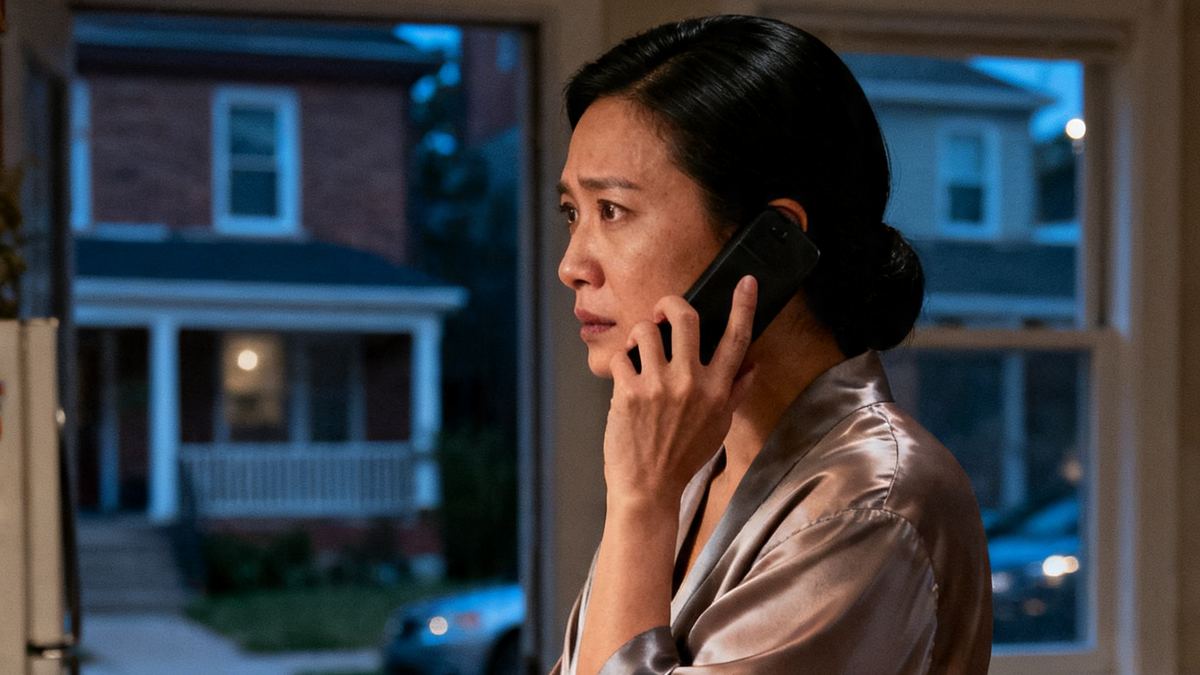
The call came ninety-three days after the divorce was finalized, shattering the careful numbness I’d built around myself. I was on my third glass of a twelve-dollar Pinot Noir, staring at the Chicago skyline from my apartment in the West Loop, when my phone buzzed against the granite countertop.
“Mrs. Chen? This is Northwestern Memorial. It’s about your ex-husband. Collin Nash. He was brought in unconscious about an hour ago.”
The wine glass slipped through my fingers and shattered on the floor. I didn’t look down.
“He’s listed you as his emergency contact. And… there’s something else you should know. He wasn’t alone when he collapsed. A woman was with him. His girlfriend, we believe. She’s twelve weeks pregnant.”
Pregnant. Collin. Girlfriend. I was gripping the edge of the counter now, my knuckles blanched white. We’d tried for six years. Six years of ovulation trackers and timed intimacy and the slow death of hope in a Lincoln Park brownstone with a nursery we never filled.
“Is he going to be okay?” My voice came out steadier than I felt.
A pause. “You should come down, ma’am.”
—
I hadn’t spoken to Collin since the day we signed the papers in a sterile conference room in the Loop. He’d looked at me then with those dark, unreadable eyes and said, “This is for the best, Maya. You’ll see that eventually.” I’d wanted to scream at him, to claw at that composed face, but I’d just nodded and walked out into the February sleet.
What I didn’t know that day—what I wouldn’t learn for months—was that Collin hadn’t left me because he stopped loving me. He’d left because staying meant putting me in the crosshairs of something he couldn’t control.
—
The ICU at Northwestern smelled like rubbing alcohol and too many hours without sleep. A doctor with tired eyes and a badge that read “Dr. Priya Kapoor” stopped me outside room 412.
“You’re the ex-wife?”
“Maya Chen. Yes.”
“He’s stable, but it was close. Acute poisoning. Arsenic, we believe. Someone’s been giving it to him in small doses over a period of weeks.” She glanced at her tablet. “His girlfriend, Tessa, is recovering in maternity. The baby’s fine, but we’re monitoring her closely. She said he’d been staying at her place the past couple of months—she thought he was just rundown.”
“Arsenic?” The word felt foreign in my mouth. “Who would—”
“The police have been notified. And Ms. Chen?” Dr. Kapoor lowered her voice. “When he was admitted, he was lucid for maybe ninety seconds. He kept saying one thing. ‘Tell Maya not to trust the family.’ Over and over.”
She handed me a sealed plastic bag with his personal effects. Wallet. Keys. A folded piece of paper with my name on it in his handwriting. I opened it with trembling fingers.
*Maya—*
*If you’re reading this, you were right about my father. Don’t go to the house. Don’t answer his calls. He knows I kept the files. He knows you’ll be the one to find them.*
*I’m sorry I couldn’t tell you the truth. I thought if I pushed you away, he’d leave you alone. I was wrong. He threatened to make it look like an accident—your brakes, the elevator—if I didn’t let him retire quietly. Even after the divorce, he knew the threat held because he knew one thing about me that never changed: I’d do anything to keep you safe. So I kept my distance and kept building the case.*
*Storage unit 217-B, Oak Park Self-Storage. Code is the date we met.*
*—Collin*
I read it three times, my heart hammering against my ribs. Gregory Nash, the silver-haired patriarch of Nash Industries—a man with a handshake that always lingered too long and a smile that never quite warmed his eyes. The man who’d toasted us at our wedding and whispered something in Collin’s ear that made my new husband’s face drain of color.
Collin hadn’t walked away from our marriage. He’d been waging a war I didn’t know existed. And he’d lost.
—
I went to Oak Park at two in the morning. The storage facility was a concrete bunker off Roosevelt Road, bathed in the orange glow of sodium lights. The code was September 14th—the night we met at a gallery opening in the West Loop, when Collin had accidentally knocked a sculpture off its pedestal and I’d caught it before it hit the floor.
“Nice reflexes,” he’d said.
“Bad installation,” I’d replied.
He proposed eleven months later.
The unit’s metal door rolled up with a groan. Inside, there were boxes of documents. Financial records. Encrypted hard drives. And one file labeled, simply, *Conservatorship*.
My hands shook as I flipped through it. Gregory Nash had been systematically draining his company’s pension fund for years, routing the money through shell corporations in the Caymans and Panama. Collin had discovered it eighteen months ago and had been quietly building a case. But when Gregory found out, he’d made it clear what the consequences would be.
There was a note in the margin in Collin’s handwriting. *He said if I didn’t let him retire quietly, there would be an accident. Maya’s brakes. Maya’s elevator. He said he’d make it look random. He said I’d never know when. He sent photos of you walking to the L six months after the papers were signed, just to remind me the threat was still live.*
That was when Collin filed for divorce. That was when he stopped returning my calls, moved out of our brownstone, let everyone believe he’d just gotten bored of me. He’d built a wall so high I couldn’t see over it, and all along, he was standing on the other side, keeping me safe from a threat I never knew existed.
—
I called my brother-in-law, an assistant district attorney in Cook County, from the parking lot. Daniel picked up on the second ring, his voice groggy.
“Maya? It’s 3 a.m. What’s wrong?”
“Something’s happened. I’m sending you files. I need you to look at them now.”
By dawn, three police cruisers were parked outside Gregory Nash’s estate in Lake Forest. I watched from the passenger seat of Daniel’s sedan as they led the old man out in handcuffs. He caught my eye through the window and for just a moment, the genial mask slipped. Underneath was a flat, calculating stare—a man who’d never once questioned his own right to win.
—
Collin woke up two days later. I was there, in the hard plastic chair by his bed, when his eyes fluttered open. His girlfriend Tessa—a sweet, terrified twenty-six-year-old who turned out to be a graphic designer he’d hired to help digitize the evidence—was in the bed next to him, her hand resting on the small swell of her belly.
“You found the storage unit,” he rasped. Not a question.
“I found it.”
“Maya, I—” His voice cracked. “I wanted to tell you. Every single day. But I couldn’t risk—”
“I know.” I reached out and took his hand. The familiar weight of it, the calluses on his fingers from the years he spent pretending he was just an ordinary guy who liked to tinker in woodshop. “I know everything.”
He closed his eyes. A tear slid down his temple and disappeared into his hair. “I’m sorry.”
“Stop apologizing.”
“The baby,” he said quietly. “I found out two weeks before… before this happened. Tessa and I, it wasn’t—I mean, it happened once, after the divorce, when I was a mess and she was the only person I could talk to. I didn’t plan any of this.”
I looked at the woman in the next bed. She was watching us with a mixture of fear and hope, clearly unsure of who I was or what I wanted. I could have hated her. Ten days ago, I would have. But now I just saw another person caught in the wreckage of Gregory Nash’s greed.
“We’ll figure it out,” I said. “All of us.”
—
The trial lasted four months. Gregory Nash was convicted on multiple counts of attempted murder, embezzlement, and conspiracy. He’ll spend the rest of his life in a federal penitentiary. Sometimes I still pull up the online photo of him being led out, gray and deflated, and wait for the satisfaction to hit. It never does.
Tessa’s daughter was born on a rainy Tuesday in October. They named her Hope. Collin was in the delivery room, and I was in the waiting room with a bouquet of sunflowers because I didn’t know what else to bring. When he came out, his eyes were red and his smile was lopsided, the kind of unguarded expression I hadn’t seen on his face in years.
“She looks like her mom,” he said. “But she’s got my stubborn chin.”
I laughed—the first real laugh I’d managed in what felt like forever. “Poor kid.”
We aren’t back together. I don’t know if we ever will be. But on Thursday nights, I drive to his apartment in Lincoln Park. Tessa kisses the baby and heads out to a movie, and Collin opens a bottle of Cabernet—the twenty-dollar kind, now, not the stuff I used to drink alone. We sit on the balcony, the lake a dark sprawl to the east, the air smelling like rain and exhaust. We don’t talk much. Sometimes my phone buzzes on the armrest; sometimes I let it go to voicemail. The water laps somewhere below us, a siren cuts the distance, then fades. Last week, when I got up to leave, he caught my wrist.
“You want to stay for breakfast?” he asked.
I looked at his hand, then at the skyline, then back at him. “Ask me again next Thursday.”