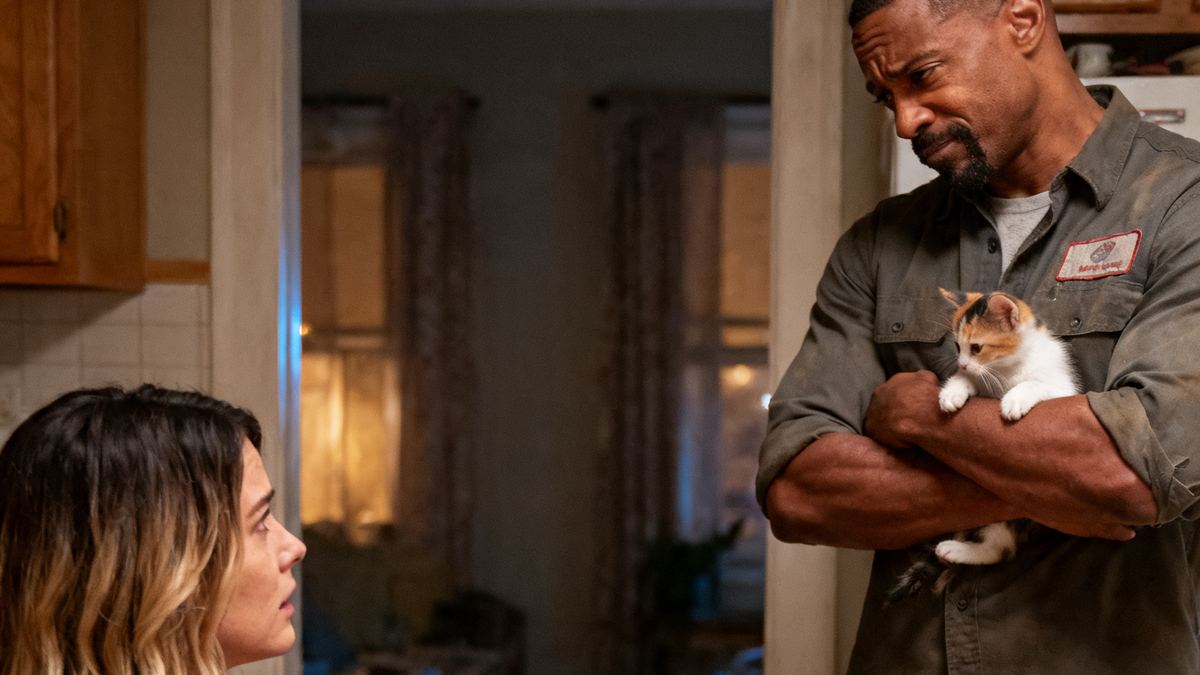
“Chloe, are you out of your mind?” Ryan’s voice cracked as the front door clicked shut two hours early. His eyes locked onto the small, shivering creature nestled in his wife’s arms. “You can’t. You know you can’t. Put it down.”
Chloe didn’t answer right away. She was still shaking. Her floral maternity dress was splattered with mud, and there was a small tear in the sleeve she hadn’t noticed. She walked past him into their Chicago apartment, her back unnaturally straight, and sat down heavily on the kitchen chair. She held the calico kitten tighter, its tiny claws pricking her skin through the cotton. The sting felt grounding.
“I said, put it outside, babe.” Ryan’s tone shifted from shock to a forced authority. “You’re thirty-eight weeks. You’ve read the books. Toxoplasmosis, parasites, ringworm—this isn’t a game. We are days away. Days.”
He reached for the kitten. Chloe’s arm shot out and blocked him, surprising them both with her ferocity.
“Don’t touch her,” she said quietly.
“Her?” Ryan sputtered, jerking his hand back. “It’s an alley cat, Chloe. It’s covered in God knows what. I’m walking it right back down to Fuller Park.”
“No.” The word was a slamming door. “You’re not. She saved my life, Ryan. I almost got hit by a semi-truck on Michigan Avenue forty minutes ago, and she is the only reason I am standing here breathing. So, no. You will not take her. You will go get a can of tuna from the pantry, and you will thank her.”
Ryan stared, his mouth slightly open. The air conditioner hummed loudly in the silence. He looked at his wife’s muddy dress, the tremor in her hands, the wild, unblinking look in her eyes. He sat down.
Chloe took a deep breath, and the kitten started to purr, a tiny motor against her ribcage. “It started with my Aunt Maureen,” she began. “And the dream.”
Four months earlier, Chloe had found her 89-year-old aunt sitting in the dark of her vintage Rogers Park condo, staring at the bay window.
“Maureen, why are you sitting in the pitch black? You scared me half to death,” Chloe had said, flicking on a lamp and setting a bag of Stan’s Donuts on the coffee table. She was five months along then, just starting to really show.
Aunt Maureen didn’t look at the donuts. She was a wiry woman with silver hair and sharp blue eyes that usually missed nothing. But today, those eyes were foggy, distant. “Harold was here,” she said, her voice papery thin.
A chill walked up Chloe’s spine. Uncle Harold had died of a stroke nine years ago, right there in that very condo. Chloe had been the one to find him. She still couldn’t walk past that wingback chair by the fireplace without flinching.
“Auntie, that was a dream,” Chloe said softly, easing herself onto the ottoman. “Just a bad dream.”
Maureen shook her head slowly, her gaze still fixed on the window. “No. He was standing right there on the fire escape. He looked just like he did in ’95. He was knocking on the glass, smiling. He wanted me to unlock it.” She finally turned to look at Chloe, her expression one of hollow dread. “He wanted me to go with him. He said he’d found a nice place and I’d like the garden. But I told him, ‘Harold, I can’t. I have to meet Chloe’s little girl. I have months yet.’ And his smile just… dropped. He looked so furious, I woke up screaming.”
Chloe spent an hour calming her down, making peppermint tea, and insisting it was just prenatal anxiety by proxy. “Dreams are just the brain’s recycling bin, Aunt Maureen. You told me that when I was six and had nightmares about the L-train.” She had laughed it off then, because the alternative was too terrifying to consider. Aunt Maureen died in her sleep three days later, exactly one week after a clean bill of health from her cardiologist.
The dream didn’t come for Chloe until this morning.
After a restless night of kicking ribs and false Braxton Hicks, Chloe had fallen into a deep sleep around 5 a.m. And there was Uncle Harold. He wasn’t on a fire escape in this dream; he was standing in the middle of an empty North Avenue Beach under a flat gray sky. He was younger, wearing that ridiculous Hawaiian shirt he loved. He waved at her, beckoning her toward the icy water of Lake Michigan.
“Uncle Harold, I can’t,” she’d said in the dream, her feet frozen in the wet sand. “I’m about to have the baby.”
His expression curdled. He started stomping his foot on the sand, a childish, impatient gesture she remembered from family picnics when she wouldn’t share her chips. When she still refused to move, he clutched his chest—the exact same way he had nine years ago—and began to sink to his knees. A part of her brain screamed, *He’s already dead, this is a trick,* but the panic was real, physical. She took a step forward.
And then she heard the meow.
A tiny calico kitten sat on the concrete boardwalk separating the sand from the bike path. It meowed again, a desperate, piercing sound. Distracted, Chloe stopped walking toward the water. The moment she stopped, Uncle Harold howled—a sound of pure, enraged disappointment—and the dream shattered. She woke up at 7:00 a.m. in a cold sweat, Ryan’s hand on her shoulder. “Hey, hey, you’re okay. Bad dream. It’s just a nightmare,” he had murmured, half-asleep.
By 9:30 a.m., Chloe had shaken it off. She had an 11:00 a.m. appointment at a salon in the Loop to get her hair trimmed before the baby came. “A little blowout before the blow-up,” her best friend had joked. She decided to walk the two miles. The obstetrician said walking was good; it helped the hips. It was a bright, windy Chicago morning, the kind that scrapes the sky clean.
As she approached the intersection of Michigan Avenue and Randolph, she saw the pedestrian signal counting down: 18… 17… 16. She sped up, her hand resting on the small of her back. She was ten steps from the curb.
That’s when she heard it. A distinct, high-pitched mewl from behind a CTA bus shelter to her left. It wasn’t a bird. It wasn’t a ringtone. It was a kitten.
She froze. It was the same calico kitten from her dream. The exact same pattern—a black patch over one eye, a ginger smudge on the ear, a white-tipped tail. It was huddled against the shelter, shivering and impossibly small.
The countdown was at 8 seconds. Chloe was a highly educated woman; she was a data analyst. She did not believe in fate. But the visual of Uncle Harold sinking into the sand, the memory of Aunt Maureen’s hollow dread, and the sheer, screaming biological imperative to protect this tiny thing overrode logic. She took a sharp, pivoting step to the left, away from the crosswalk, leaning down with a grunt to scoop the kitten up.
And then the world exploded in screeching metal and a hurricane of wind.
A black Chevrolet Suburban, blowing through the solid red light at easily sixty miles an hour, jumped the curb exactly where Chloe would have been standing in three more seconds. It mowed down the crossing signal pole with a scream of aluminum and fiberglass, plowed through a newspaper box, and obliterated the scaffolding architecture of the pedestrian zone before crashing into the stone facade of the Cultural Center. The impact sheared off a ten-foot slab of carved granite, which crushed the exact spot where Chloe’s next step would have fallen.
The sound was a physical blow. People were screaming. Glass rained down from the shattered Crain’s Communications building across the street. Chloe sat down hard on the sidewalk, her back against the bus shelter, clutching the kitten as dust and debris billowed over them.
She never made it to the salon. She walked the whole way home in a state of numbed shock, the kitten tucked under her chin, her phone blown up with emergency alerts and texts from Ryan asking if she was okay. She kept looking down at the tiny, trembling creature. Three-colored. Just like the old story said. Good luck. In Japan, they were called *mi-ke*, messengers of the gods.
Back in the kitchen, the silence was heavy. Ryan’s face had gone the color of old plaster. His hands were gripping the edge of the table so hard his knuckles were white. He looked from the kitten to Chloe’s massive belly and back to his wife’s exhausted, resolute face.
“It sounds insane,” Chloe whispered, pulling the kitten up to her cheek. The little thing purred so loud it sounded like a mini chainsaw. “But the dream, Uncle Harold, Aunt Maureen… and then her. I was going to walk into that crosswalk. I saw the signal. I was going to step off that curb. If she hadn’t made that sound…”
Ryan stood up abruptly, his chair scraping the tile. He paced to the sink and gripped the edge, his back to her. She saw his shoulders shaking.
“A Suburban,” he finally said, his voice a wrecked whisper. “They said on WGN a driver ran the red. High on fentanyl. They said a pedestrian was killed at the scene. I thought… when I couldn’t reach you…”
“I’m here,” she said, tears finally spilling down her cheeks. “We’re here.”
Ryan turned around. He walked over, knelt by her chair, and with a hesitant, calloused finger, touched the kitten’s tiny pink nose. The kitten batted at his finger with a fuzzy paw. A choked, half-sob laugh escaped him.
“I’ll get the tuna,” he said.
Four days later, in a labor and delivery room at Northwestern Memorial, Chloe gave birth to a perfectly healthy, screaming baby girl with a shock of dark hair. They named her Maisie.
When Ryan pulled the car up to their apartment building, there was a massive bouquet of flowers from the neighbors taped to the door, and a brand-new, three-story cat tree visible through the front window.
Chloe walked in carrying the baby carrier. The calico kitten—now named Pavlova, or Pav for short, because the vet said she was a little drama queen—was sitting on the velvet ottoman right inside the door, as if she’d been waiting. She let out a soft chirp of greeting.
Ryan had gone full “cat dad” while Chloe was in the hospital. There was a ceramic water fountain shaped like a lotus flower. Stainless steel litter box in the corner. A small dish of freshly steamed, unseasoned salmon on the mat.
“The vet said this is the best food for brain development,” Ryan announced proudly, taking the carrier so Chloe could take her shoes off. “Her, not the baby. I mean, the baby has breastmilk, obviously. I just wanted Pav to know we appreciate her.”
Chloe laughed, the first deep belly laugh in days. She lifted Maisie out of the carrier. The baby blinked, unfocused, at the ceiling. Pavlova jumped gracefully onto the arm of the sofa, padded over, and sniffed the edge of the baby’s knitted hat. She then curled into a perfect circle right next to Chloe’s thigh, her purr filling the quiet room like a grounding hum.
Chloe looked at her sleeping daughter, the evening light catching the soft pink of her cheeks. If not for a three-second decision and a desperate meow from a dirty alley cat, this moment—this exact, quiet, domestic scene—would not exist. She wouldn’t be here.
No one ever talked about Uncle Harold again. But Chloe never, ever walked past the wingback chair by the window without hearing her Aunt Maureen’s papery voice telling her to unlock the glass. And whenever Pavlova stared intently at the empty corner of the living room, chirping at absolutely nothing visible, Chloe would simply pull her baby a little closer to her chest and say a quiet word of thanks to the little calico guardian who had refused to let her follow.