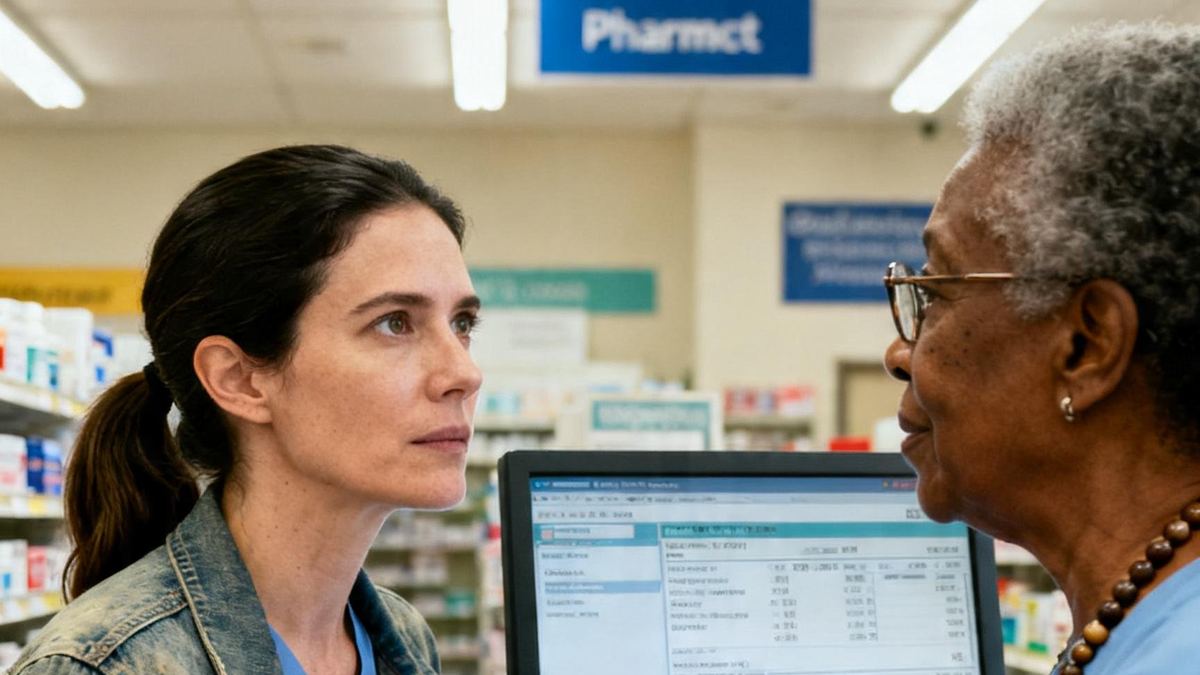
Mrs. Henson’s reading glasses kept slipping down her nose as she pecked at the keyboard. Behind her, the air conditioner rattled like a metal box full of loose screws, and a talk radio station mumbled about the upcoming heat wave. I braced my elbows on the counter and traced the chip in the Formica with my thumbnail—the exact spot where my mother always set her purse.
“Looks like she was only in here twice this year,” Mrs. Henson said. She turned the monitor so I could see. “January tenth: digoxin, ninety-day supply, one-forty-eight with her Medicare. And before that… February eighteenth. Lisinopril, the generic. Thirty-day. Thirty-two dollars and some change.”
My mother had died on June fourth. Four heart medications on her chart, and the last one she’d actually picked up was a single bottle of blood pressure pills in the middle of February. I’d buried her two weeks ago, and the whole time I’d been telling myself the same lie: *At least the meds kept her comfortable.*
Mrs. Henson must have caught the look on my face. “Megan? You okay, hon?”
“Last February,” I said. “You’re sure there’s nothing else?”
She poked a few more keys. “No, sugar. That’s it. She used to come every three or four months for years, but this is the last one we have.” She lifted her glasses by the beaded chain and let them hang against her chest. “I’m so sorry. I know you were close.”
I wasn’t close. That was the whole problem. Travis had been close. Travis had moved her into his house after the second heart scare and spent every day with her while I worked twelve-hour night shifts in the ER down in Greenville. Travis had held her hand through the dizzy spells and told me on the phone, every single month, that her prescriptions were bleeding them dry.
Five hundred dollars a month, for four years. Wired to Travis’s account on the first, marked *Mom’s meds.*
The trip home from the pharmacy was a blur. I pulled into my driveway and didn’t even get out of the car. Just sat there in the early July heat with the engine off and the windows down, the smell of hot pine needles and somebody’s charcoal grill drifting in. My phone showed forty-eight transfers going back to the summer she moved in with him. Twenty-four thousand dollars total. I multiplied it three times and got the same answer.
I called him from the driver’s seat. He picked up after five rings, breathing like he’d just woken up, even though it was three in the afternoon.
“Travis, I went to Mountain View Pharmacy today,” I said. “Mrs. Henson pulled up Mom’s records.”
Silence. Then the refrigerator door opened—I recognized the wet suck of the gasket, that old Amana in his kitchen that Mom always said needed replacing.
“February,” I said. “That was her last pickup. Lisinopril, a thirty-day supply. She didn’t take a single pill after March.”
His breath stopped for a beat. “She must’ve gotten them somewhere else.”
“Mrs. Henson checked the statewide system. Same thing. No other pharmacy. No other scripts.” My voice was steady in a way that felt dangerous. “Where did the money go, Travis?”
He didn’t answer right away. I heard him set a can down on the counter—probably a Budweiser. The faint jingle of the dog’s tags from the yard floated through the receiver. Mom had named that dog Murphy; she’d fed him scraps over the fence even when Travis said it made him fat.
“Mom knew,” he said finally, his tone hardening. “She was the one who came up with it. Said if I told you the real reason—that I couldn’t keep up with the mortgage and the maintenance—you’d want to ship her off to some facility. She didn’t want some stranger bathing her. So she told me to tell you it was for the heart stuff.”
I pressed my forehead against the steering wheel. The plastic was sticky from the sun.
“You could’ve just asked for help,” I said. “You could’ve said, ‘Meg, I’m in trouble.’”
“Right. And you would’ve flown down once a month and handed me a check with a lecture on top. Mom knew how you’d react. She thought this was cleaner.”
“Cleaner. You’ve been lying to me for four years, and Mom lied to me for four years, and that’s *cleaner?*”
“She didn’t want me looking for a real job and leaving her alone all day,” he said, and there it was—the tiniest crack of something raw in his voice. “You were three hours away. You weren’t there when she got confused in the grocery store. You weren’t there when she fell in the tub. I was. So if I got a paycheck out of it, then maybe it was a fair trade.”
I couldn’t speak. Up the street, the neighbor’s sprinkler thumped across the lawn, scattering a handful of grackles. One of the birds landed on my rearview mirror, cocked its head, and flew off.
“I’m not apologizing,” he added. “She stayed in her own house, in her own bed, right up to the end. You want to put a price tag on that, fine. It’s twenty-four grand. I don’t have it. But I ain’t sorry.”
The line clicked dead.
A week passed before I drove up to Hendersonville and let myself into Mom’s house. Travis was out—his truck was gone—so I went straight to her bedroom. The sheets had been stripped and the pillows stacked against the headboard, just the way she liked them. The room smelled faintly of Vicks VapoRub and lavender lotion.
I opened the nightstand drawer. Inside: a Bible with a cracked cover, a picture of my father holding a string of trout, a pair of reading glasses in a felt case. And a white envelope with my name written in her handwriting, the letters tilting to the right.
The letter was dated October, eight months before she died.
*Meggie,*
*If you’re reading this, I imagine you’re upset with your brother. Please don’t be. The money you sent was my idea. My Medicare and your father’s pension covered my actual medicine, but Travis couldn’t keep this house going on his odd jobs, and I refused to watch him lose it. So I told him to say the meds cost more than they did. I hate that I lied to you, but I’d do it again. You were always going to be fine, Meg. You’ve got that steel rod in your spine that scares people a little. Travis… he needed the help, and he needed his pride left intact, and you were too far away to catch what was happening. I know that’s not fair. It isn’t. I just couldn’t choose between my children.*
*Forgive me if you can. And if you can’t, maybe just sit with it for a while. That’s what I did.*
*Love,*
*Mom*
I folded the paper along the same crease and put it in my purse. Then I walked out to the backyard and stood under the old dogwood tree she’d planted the year I was born. Half its white bracts had browned and fallen into the grass, curling at the edges like scorched paper. She’d watered that tree every dry summer, even when her knees got so bad she had to use a stool. She’d never asked for anything in return—not from the tree, and not from me.
The truth sat in my stomach like a stone, but it wasn’t the stone I’d expected. She hadn’t been a victim; she’d been the architect. And I hadn’t been duped by my brother so much as I’d been managed by my mother, who looked at her two flawed kids and arranged the finances the only way she knew how.
I didn’t call Travis on the drive home. The following month, on the first, my phone buzzed with the usual reminder. I stared at the banking app for a long minute, the cursor blinking in the “description” field. Then I typed nothing at all and sent a hundred and fifty dollars. Not the full amount. Not nothing. Just something.
He never mentioned it. I never explained. I think we both understood that it wasn’t about the money anymore—it was about the woman who’d woven us together with a thread made of love and a good, clean lie.