The Boy Who Saw the Cat in a Sack
The latch on Earl’s front gate had been busted since last spring. A rusted screw snapped clean off one afternoon when he’d nudged it with his hip, arms full of firewood. After that, the gate just swung in the breeze, tapping against the post like a slow, tired heartbeat. Earl never fixed it. He’d grown used to the sound, just like he’d grown used to the quiet of his house since Martha passed, and to the calls from his son that came every other Sunday and never lasted more than four minutes.
The cat showed up on a crisp morning in October. Gray, with a patch of white on her chest and a torn left ear. She sat on the porch steps like she’d been invited, not begging, just waiting. Earl came out with the newspaper, saw her, and said, “I can barely feed myself, lady.” She didn’t move. He went inside, found a leftover piece of fried fish, put it on a napkin, and set it down. She ate it, cleaned her whiskers, and curled up by the door.
By the end of the week, she’d found a loose window screen in the kitchen and let herself in. Earl didn’t patch it. He just left a towel on the floor by the radiator, and by the time the first frost hit, she was sleeping in a cardboard box he’d lined with an old flannel shirt.
Leo, who was nine and lived next door, walked past Earl’s place every day after school. The shortcut through the alley took him right by the broken gate. Even though the apple tree in the backyard hadn’t dropped fruit in months, Leo still glanced over the fence out of habit. He’d seen the gray cat on the windowsill a dozen times, and once he’d even waved at her. She’d tilted her head like she was trying to figure him out.
Thursday afternoon, Leo was coming home when he stopped cold at the corner of Earl’s property. Through the slats of the fence, he saw the old man standing by his pickup, a faded green Ford with a dent in the tailgate. Earl was holding a burlap sack, and the sack was squirming. Leo stepped closer. Something inside scratched against the fabric, and a low, desperate mewl slipped out. That sound crawled right under Leo’s ribs and lodged there.
He saw Earl place the sack on the passenger seat, then walk back to the house and return with a box. The box went in next to the sack. The truck started up, coughed once, and rolled out the driveway. Leo crouched behind the hedge, heart hammering. He’d heard stories from his grandma about what people did with unwanted animals in the old days—sacks and creeks and water that didn’t forgive. The image had haunted him since he was six. Now it played out in real life, right in front of him.
He ran.
His mom, Lisa, was dicing onions at the kitchen counter when Leo burst through the door, not bothering to kick off his sneakers.
“Mom! Mr. Harlan put the cat in a sack and drove off!”
Lisa put the knife down. “What cat?”
“The gray one with the white chest! She lives with him! I saw her in the sack, it was moving, he’s gonna dump her in the river, Mom, we have to go!”
Lisa wiped her hands on a dish towel. Her son’s face was red, his backpack sliding off one shoulder, his voice cracking with that fierce, raw fear kids get when they’re sure something terrible is happening and no one’s stepping in.
“Leo, slow down. We don’t know where he’s taking her. Maybe he’s going to the vet.”
“You don’t put a cat in a sack for the vet!”
She couldn’t argue with that. Leo was right. You don’t.
“I’ll talk to him when he gets back,” she offered, but she could already see it wasn’t enough.
“What if it’s too late?” Leo’s eyes were wet. “What if it’s too late, Mom?”
Lisa untied her apron. She thought about Earl Harlan, who had lived beside them for twenty years. The man who fixed her mailbox for no charge, who never raised his voice, who after his wife’s funeral just got quieter, like someone turned down the volume on the world. Not the kind of man who’d hurt an animal. But the sack had been moving. Her son had seen it.
“Get your coat. We’re going.”
They took the minivan. Lisa didn’t have a plan. She didn’t know which way Earl had turned. Leo sat in the passenger seat, scanning the roadside like he expected the cat to appear at any second.
“The river,” Leo said firmly. “Grandma said they always go to the river.”
Lisa turned toward the river. Not because she believed the old stories, but because she couldn’t think of another direction, and because her son was looking at her like she could fix anything.
The road to Willow Creek curved past the old grain silo and dipped into a hollow where the bridge had been patched so many times it looked like a quilt of asphalt. The river ran high and brown from the recent rain. No green Ford. No sign of Earl. Lisa pulled over and turned around.
“He’s not here, sweetheart.”
Leo said nothing. He just stared at the water.
“Let’s try the back road through Sutton,” Lisa suggested gently. “Maybe he went that way for some reason.”
They found the truck on the outskirts of Sutton, parked outside a low brick building. The sign above the door read “Sutton Animal Clinic” in faded letters, the “C” so worn it looked like an “O.” A handwritten notice taped to the window said, “Now accepting walk-ins.”
Lisa stopped the van. “Wait here.”
“No. I’m coming.”
They walked in together. The clinic smelled of disinfectant and something sweet, like canned food. A receptionist in scrubs pointed them toward the exam room, not even asking, because Lisa looked like a woman on a mission and Leo looked like he was about to bolt.
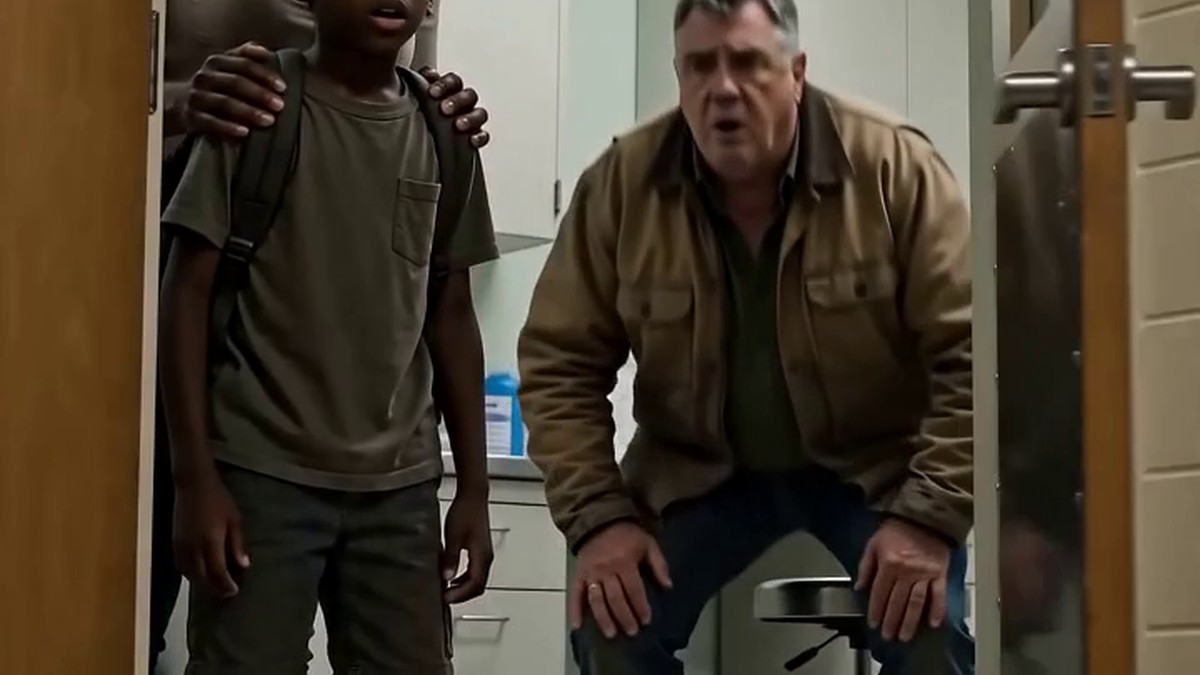
The door was cracked open. Inside, Earl sat on a small stool beside the metal table. The gray cat lay on a folded towel, her sides rising and falling slowly, one ear twitching. A young vet, a woman with purple-rimmed glasses, was gently pressing the cat’s belly.
“When did you first notice?” the vet asked.
“Three days back. She stopped eating. Then she hid under the workbench in the shed. I had to crawl in and get her out. She was meowing real soft at night, like she was in pain.” Earl’s voice was rough but quiet.
“And you brought her in a sack?”
“I poked air holes. Put an old sweater in there. She doesn’t like being held—scratches me up. The sack calms her down. I don’t own a carrier, and the pet store’s closed by the time I thought of it.”
The vet smiled and straightened up. “Well, Mr. Harlan, I’ve got good news. Your cat isn’t sick.” She paused, and Earl’s face went pale. “She’s pregnant. Three, maybe four kittens. She’s healthy, just scared and looking for a safe place. You’ve done everything right.”
Earl took off his cap, rubbed his forehead, and put it back. “Pregnant?”
“Kittens in about a week, I’d say.”
He stared at the cat. She lifted her head and squinted at him, like she was saying, *Well, now you know.* He reached out and scratched between her ears. She started to purr, a deep, rumbling sound that vibrated through the table.
Leo, just outside the door, let go of a breath he didn’t know he’d been holding. His whole body sagged against Lisa. She put a hand on his shoulder and pushed the door open.
Earl looked up, surprised. “Lisa? Leo? What are you doing here?”
Leo stepped forward before his mom could speak. “Mr. Harlan, I saw you put her in the sack. I thought you were gonna… you know… and I made Mom drive everywhere to find you. I’m sorry.”
Earl’s expression changed slowly, like a fog lifting. He looked at the boy, at the red-rimmed eyes, at the way Leo’s hands were clenched in his jacket pockets.
“You thought I was going to hurt her,” Earl said, not a question.
Leo nodded.
The old man got off the stool, his knees popping, and crouched down in front of the boy. His hand, calloused and steady, rested on Leo’s shoulder.
“Son, I’d never do a thing like that. Not ever. You hear me?”
“I know. I know now.”
“A sack was all I had. She doesn’t fight it. I made sure she could breathe. I was scared she was dying. I didn’t think…” Earl shook his head. “But you—you did exactly right. You saw something, and you went after it. That’s what good folks do.”
Leo finally looked him in the eye. “You’re not mad?”
“Mad?” Earl let out a short laugh. “Heck, no. You might’ve just saved her a lot of stress. She needed a vet, and I’d have probably waited too long if I hadn’t panicked today. So thank you.”
Lisa stood back, watching the two of them. Earl glanced up at her, and there was something open in his face she hadn’t seen in years. Not gratitude, exactly. More like being seen clearly for the first time in a long, long while.
The cardboard box from the truck sat on the floor beside the table. It was open, and inside Lisa could see a folded towel, a small bowl of water sealed with plastic wrap, and a bag of cat food—the expensive kind from the shop on Cedar Street that charged double what the grocery store did. Earl had bought it in advance. He’d planned to bring her home comfortable, not to dump her.
On the drive back, Leo sat in the back seat, quiet. The sun had set, and the headlights cut through a light mist rising from the fields.
“Mom,” he said as they turned onto their street, “can I go over to Mr. Harlan’s when the kittens come?”
“If he says it’s okay.”
“He will,” Leo said, with a confidence that had no trace of doubt.
Lisa didn’t ask how he knew. She’d seen the way Earl had looked at her son back in that clinic, like someone remembering that loneliness didn’t have to be permanent.
The kittens were born on a Wednesday evening, a full ten days later. Four of them—three gray like their mother, and one white with a single black splotch on his back, shaped like a coffee stain. Leo came over the next day after school and sat cross-legged on the kitchen floor, watching the little pile of fur squirm and mew. Earl stood in the doorway, arms folded.
“That white one’s a troublemaker,” Earl said. “Already trying to climb out of the box.”
“He’s perfect,” Leo whispered.
Two months later, the gate latch had been replaced. Leo had helped, holding the screwdriver while Earl fitted the new mechanism. The wind no longer rattled it at night. Every afternoon, Leo opened that gate, came in, closed it behind him with a firm click, and walked up to the back porch where the gray cat now lounged on an old cushioned chair. The white kitten—named Casper by Leo, and called “Spot” by Earl to tease him—was officially Leo’s cat, living next door but visiting the backyard daily, chasing grasshoppers and tangling himself in the hose.
One evening in late spring, Lisa watched from her kitchen window as Earl and Leo sat on the steps together, the gray cat weaving between their feet. Earl was showing Leo how to clean a small fishing reel, his gnarled hands guiding the boy’s. Leo laughed at something, and Earl smiled—a real, easy smile that crinkled the corners of his eyes.
She realized she hadn’t heard that smile in two decades of living next door. The cat had wandered into Earl’s life and brought more than kittens. She’d brought a boy who thought the worst but ran toward it anyway, and an old man who finally had someone to open his gate for.
The gray cat stretched, yawned, and settled into a patch of evening sun. She didn’t need to understand any of it. She just purred, loud enough for both of them to hear.