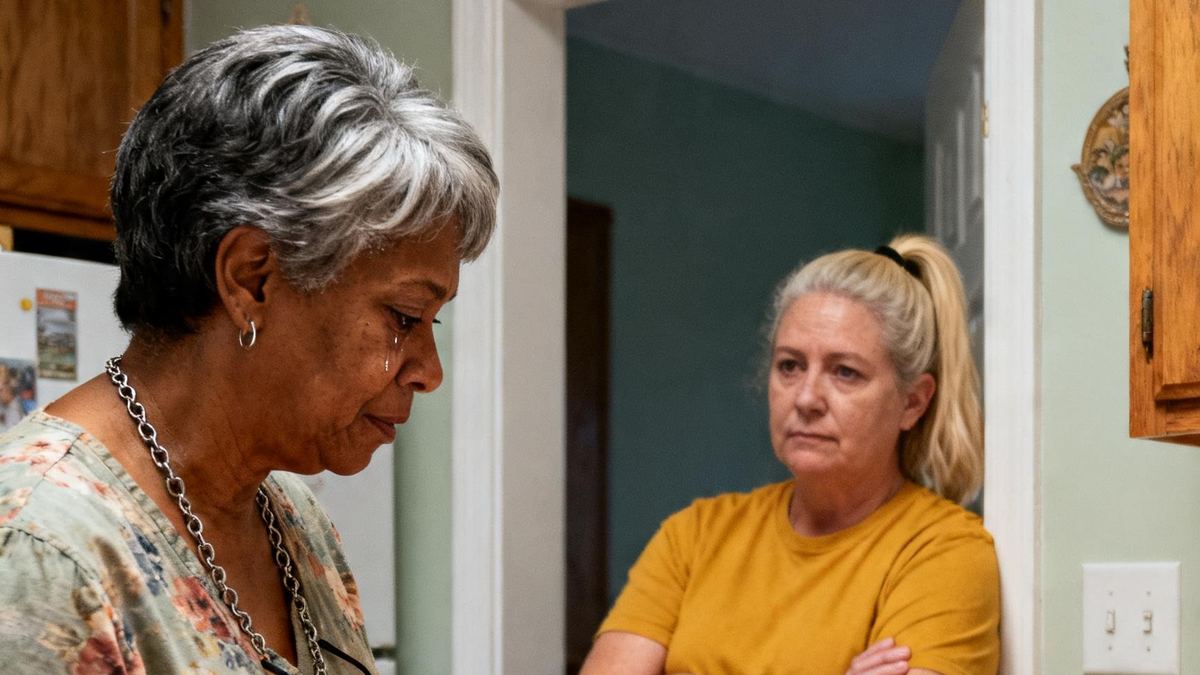
“You’ve got to cut them off, Marlene. Just *stop*. You think they’re gonna wake up one morning and suddenly appreciate you? Not gonna happen.”
Kendra’s voice cut through the thick July heat hanging in my cramped kitchenette. She planted both palms flat on my Formica table, her nails—chipped coral polish, the same shade she’d worn to Mrs. Patterson’s funeral last month—digging into a faded sunflower pattern. Her eyes, tired from her own double shift, held that fierce, pitying love I’d been dodging for years.
Between us sat a lopsided carrot cake from the Food Lion, its cream cheese frosting sweating in the sun. A single candle, number fifty-five, still lay in its plastic wrapper. I hadn’t lit it. Couldn’t bring myself to.
Today was my birthday. My fifty-fifth. A day that was supposed to come with a phone buzzing off the hook, grandkids screaming a messy off-key song through a choppy video call. Instead, my cell sat face-down on the edge of the table, a black slab of cold plastic. It hadn’t vibrated once. No calls. Not a single text. The only notifications were a generic happy birthday gif from my car insurance company and a reminder that my cloud storage was full.
My sons, Tyler and Brandon, had forgotten.
Again.
Every month for the past eight years, I’d worked sixty-hour weeks as a live-in caregiver for a ninety-two-year-old woman in Charlotte, scrubbing her porcelain tub and measuring out her heart medication, and every month, like clockwork, I’d wired five hundred dollars into each of their bank accounts. They took that money—money earned from changing adult diapers and holding the hands of dying strangers—without so much as a “thanks, Mom.” On the fifth of the month, Tyler’s wife would sometimes shoot a thumbs-up emoji. That was the extent of our communication until the first, when a late deposit would suddenly make my phone ring with a brusque, “Hey, just checking, is there a problem with the transfer?”
But a birthday? That wasn’t a financial transaction. No return on investment.
Kendra pushed the unwrapped candle aside. “You’re not their personal ATM. You’re their *mother*.”
I stared at the cake. I knew she was right. I’d known it for years, deep in a gut I’d trained to ignore. But there was a rusted, heavy chain wrapped around my heart that logic couldn’t cut through.
Before you judge a woman for letting her grown sons bleed her dry, you’ve got to walk a mile in her worn-out Skechers. You’ve got to trace the long, busted road she came from.
My road started in a hollow in West Virginia, where I became an orphan before I knew how to spell the word. I was eight when a black-ice accident on Route 19 took both my parents on the same night. With no other family willing to split up a sibling group, I became the spare part in my Aunt Bea’s trailer in Beckley. Aunt Bea wasn’t cruel, but she was drowning—four kids of her own, a husband who worked the mines and drank his paycheck, and a double-wide that was already bursting at the seams. I slept on a cot shoved in the laundry nook, wedged between the washing machine and a wall of damp sheetrock. I fell asleep every night to the smell of Tide and mildew, dreaming of the day I’d have a real house with a real bedroom and a door that nobody else had the right to open.
I worked for every crumb I ate. By ten, I was hauling water buckets for the horses the neighbors kept, weeding a vegetable patch the size of a baseball diamond, and scrubbing Aunt Bea’s linoleum until my knuckles cracked. I wasn't a niece; I was unpaid labor. And I was grateful. Grateful I wasn’t in the state system. Grateful for the stale saltines and the roof that didn’t leak directly on my cot. But at night, looking out the tiny, cobwebbed window by the detergent bottles, I would promise myself: *Someday, a house of my own. A home where I am not a guest.*
That promise got buried when I married Randy at eighteen. Aunt Bea called it “a fantastic opportunity” when she introduced me to him—Randy Parsons, a thirty-year-old mechanic from the next town over with a permanent grease stain under his fingernails and a mother, Lorraine, who never learned how to smile with her eyes. He was looking for a young wife who knew how to keep a house and didn’t talk back, and I was a burden looking for a place to exist. So I traded one crowded home for another, walking straight into a double-wide in Oak Hill with a mother-in-law who treated me like hired help that had gotten above its station.
Lorraine never yelled. She was a master of the cold silence, the sharp sigh, the whisper campaign. She’d wait until Randy came home from the garage, reeking of motor oil and exhaustion, and she’d pour his coffee and murmur, just loud enough for me to hear in the kitchen, that the roast was dry today, or I’d used the wrong detergent, or I’d been “snippy” when she asked me to scrub the baseboards a second time. Randy never asked for my version. He’d just call me into the living room, stand with his arms crossed, and lecture his eighteen-year-old wife about respecting his mother in her own house.
I had two sons in that trailer—Tyler, then Brandon. I poured every ounce of the love I’d never received into those boys. They were my whole world. They were the only reason I survived the silent dinners and the nights I stared at the ceiling, feeling like a ghost in my own life. Randy was twelve years older and forever a stranger, a man who’d wanted a housekeeper and gotten one, and Lorraine was his permanent shadow.
When the boys were teenagers, I finally cracked. I couldn’t look in the mirror and see just a body doing chores anymore. I was forty-one years old. I had never bought my own bedsheets, never chosen a paint color, never invited a friend over without Lorraine’s permission. So when a neighbor told me about an agency hiring live-in caregivers in Charlotte, I saw a door and I kicked it open. I told Randy and Lorraine I was going to earn money for a new house for all of us. It wasn’t a lie—I just let them assume it would be Lorraine’s name on the deed.
The first six months in Charlotte, working for the elderly Mrs. Harmon in her sprawling Dilworth bungalow, I didn’t send a dime home. I opened my own bank account. I saved. And for the first time in my life, I bought a potted geranium without asking anyone’s permission. The silence from Oak Hill quickly turned into an ultimatum. Randy called, his voice a sharp crackle over the line: “You send that money home, or you don’t bother comin’ home at all.”
I told him I’d take the second option. The divorce papers came a week later.
Lorraine did not forgive me, and she made that her final project. Over endless Sunday dinners and fishing trips I wasn’t invited to, she and Randy systematically rewrote my sixteen-year-old boys’ memories. I became the villain: the selfish woman who abandoned her family for some fancy city life in a rich old lady’s mansion. They never said I was changing soiled sheets and grinding up pills and crying myself to sleep in a 10×10 caretaker’s room off the pantry. They just said I’d “picked money over my own children.” By the time Tyler turned eighteen, he’d stopped taking my calls. Brandon followed suit. I wasn't invited to their high school graduations. I learned about their weddings through a grainy Facebook photo album posted by a cousin of Randy’s.
The guilt was a living thing, a sharp-toothed creature that settled in my stomach and gnawed. I’d left. It didn’t matter that I left to survive; in their eyes, I’d left *them*. So eight years ago, when I finally scraped together enough to buy a tiny, sun-yellow bungalow in Weaverville—my own house, with a front porch and a door that locked from the inside—I tried to buy my way back into their lives. I’d failed as a present mother, so I’d become a useful one. I divided my paycheck: rent, gas, heartburn meds for me, and two equal wire transfers of five hundred dollars each for Tyler and Brandon. Every single month. A penance, I told myself. A monthly proof that I loved them, even if I wasn't allowed to say it out loud anymore.
And they took it. Without warmth, without questions, without a thank you. Tyler’s wife would sometimes send a text: “Received.” Brandon’s number stayed a black hole. They only reached out when a holiday delayed the bank transfer by a day. “Hey Mom, we were counting on that, just making sure everything’s okay.” *Mom*. The word, dripping with transactional impatience, cut deeper than silence.
Which brings me back to the carrot cake and the candle.
Kendra pushed a fork toward me. “Eat some cake. And then get your phone and call your bank.”
I didn’t eat. I just stared at that single, unlit candle until the sun dipped behind the neighbors’ rooftop. That night, I lay awake in the bungalow I’d fought so hard for, listening to the cicadas scream in the dark. The chain around my heart felt different now—not heavier, but brittle. Rusted through.
The next morning, I got up, made a pot of coffee, and walked to the small roll-top desk in my hallway. I took out the worn checkbook I used for the monthly transfers and ground my pen into the paper for a good ten minutes before writing two identical notes:
*Brandon, I love you. This is the last money I’ll be sending. I need to take care of myself now. I hope you can understand someday.*
*Tyler, I love you. This is the last transfer. I’m sorry I can’t keep doing this. I’m here if you ever want to talk.*
I sent the wire. It was the first of the month. Five hundred to each. Last payment.
Three days passed. The silence was louder than ever, but this time it felt… clean. On the fourth day, my phone finally lit up. *Tyler calling.* My hand trembled as I swiped to answer, my heart a jackhammer against my ribs. Maybe he’d say he was sorry. Maybe he’d invite me to finally meet my three-year-old grandson.
“Hey.” His voice was flat, already annoyed.
“Hi, honey.”
“We got your weird note. What’s this about the money stopping?”
I took a breath, steadying myself against the kitchen counter. “It means I’m not sending it anymore. I’m fifty-five. I need to start saving for when I can’t work these caregiver shifts.”
A short, scoffing laugh. “You’ve got to be kidding me. You promised you’d help us. We’ve got the car payment due next week, and the kids’ daycare. You’re seriously doing this now? What, you’re gonna punish *us* because you feel like being dramatic?”
“No,” I said, and my voice came out quieter than I expected, but steadier. “I’m not punishing you. I’m just done trying to pay for a relationship you don’t want to have. I’m your mother, Tyler, not a loan officer.”
“After what you did to Dad and Grandma? You’ve been trying to make up for it, and now you just quit? Typical. You know what, Mom? If you cut the money, don’t bother calling anymore. I’m serious. We don’t need that kind of flaky in our lives.”
I closed my eyes. The rusted chain finally snapped, and the silence it left behind wasn’t scary. It was open space. “Okay,” I whispered. “If that’s how it has to be. I love you. Goodbye.”
He hung up before I finished. Brandon never called at all.
I stood in my kitchen, the morning light painting yellow squares on my linoleum, and I listened. No ringing phone. No anger. Just the hum of the refrigerator and the distant sound of a lawnmower. I had done the one thing I’d been terrified of for two decades: I had stopped begging.
The next few weeks were raw, like a scrape that stings every time you bend. I’d find myself reaching for my phone, then pulling my hand back. Kendra dragged me to a book club at the Weaverville library, where I didn’t say much but drank bad coffee and listened to women my age argue about unreliable narrators. I planted zinnias along the porch railing, my hands in the warm dirt, not asking anyone for permission. I watched the sunset every night from a white rocking chair I’d bought at a yard sale, sipping sweet tea spiked with too much lemon.
One Sunday at the tiny Methodist church I’d started attending just to be around people, I overheard a young woman in the pew behind me, a stranger, whispering to her friend. She was a single mom, barely twenty-two, just kicked out by her boyfriend, trying to figure out how to pay for her daughter’s asthma medicine before the week was up. Her voice cracked with a panic I recognized in my marrow.
That afternoon, I walked into the pharmacy in town. I didn’t know her name. I just told the pharmacist, “The young woman with the little girl, the inhaler—ring it up for me.” I paid seventy-three dollars and forty cents, cash, and left before she could see my face.
Walking back to my car, my phone buzzed. A text. My heart, the old fool, still jumped. But it was just Kendra: *How’s my favorite badass? Wine on the porch tonight?*
I smiled. The porch. My porch. I typed back: *Bring the cheap stuff. I’ll make popcorn.*
I got in the car, and before I pulled out of the lot, I opened my contacts, scrolled past “Tyler” and “Brandon,” and put the phone down on the passenger seat, screen facing up, no longer waiting for it to light up.