The thing about Seattle in February is the damp gets into your bones long before the temperature actually drops. I was coming off a double shift at the hospital, running on burnt coffee and the kind of exhaustion where your thoughts start to feel like someone else’s. The light rail platform was empty except for the announcements echoing off the concrete and one old woman sitting on the bench near the vending machine.
Two overstuffed tote bags at her feet. A scarf tied tight under her chin. She wasn’t looking at her phone or reading anything — just watching the tracks with this expression that made me slow down.
I almost didn’t stop. Fourteen-hour shift behind me, lower back screaming, the works. But something about how she sat there, completely still, made me turn around after a few steps.
“Ma’am? You waiting for the next train?”
She blinked up at me. “Oh, honey. I’m waiting for the 7:15 ferry.”
It was 9:40. The last ferry to Bainbridge left at 7:15.
Her appointment at Virginia Mason had run three hours late — scheduling mix-up, someone forgot to call her, and by the time they wheeled her out of imaging, the last run had already crossed the Sound. She’d been sitting on that platform for two hours, too proud to call anyone.
“My son’s in Singapore,” she said, like that explained everything. “The time zones, you know.”
Her name was Margaret. Widowed eleven years, lived alone in a cottage her husband built back in the eighties. The son — some kind of software architect — sent money every month and called twice a year. She told me the garden was giving her trouble and the deer had gotten into the apple trees again.
I called an Uber.
She started in on the cost — “Oh no, sweetheart, that’s forty dollars easy, I can’t let you —”
“Margaret, it’s raining and I’m not letting you sleep on a bench. Come on.”
The driver was a kid, maybe twenty-two, who helped her into the front seat like she was his own grandmother. We took the long way over, rain streaking the windows, and she talked about her husband Frank and how he used to play the mandolin — badly, she said — on Saturday mornings while she made pancakes.
When we pulled up to the cottage, she grabbed my wrist.
“You come inside. Just for a minute. I’ve got blueberry scones — the real ones, not that Starbucks nonsense — and I’m not taking no for an answer.”
The place smelled like cedar and vanilla. Every surface was clean, but in that careful way that tells you someone’s been filling hours with small tasks. A little china teapot on the stove. A photo of a man with a mustache and a mandolin on the mantelpiece.
We sat at her kitchen table for an hour. She asked about my work, my life, whether I had anyone to go home to. No judgment when I said no, just this knowing little tilt of her head, like she’d already figured that out.
Before I left, she pressed a brown paper bag into my hands.
“Raspberry jam. I put up forty jars in August, and I swear to God I’m going to drown in it before spring. Take it.”
It was heavy. Four jars at least.
—
The Thursday after that, my apartment buzzer went off at seven in the evening. I wasn’t expecting anyone. Through the intercom, a man’s voice: “Are you Claire? Claire Delgado?”
“Who’s asking?”
“I’m Margaret Chen’s son.”
My stomach dropped, the kind of drop that doesn’t wait for logic. I fumbled the door open.
He was mid-forties, maybe, standing in the hallway with a suitcase and an expression like he’d been carrying something heavy for a long time and just now felt the weight.
“Don’t worry,” he said quickly. “She’s fine. She’s actually… she’s better than she’s been in years, I think.”
David. The son. The one who called twice a year — when he remembered.
We stood in my doorway because I was too stunned to invite him in, and he told me he’d flown back from Singapore on three hours’ notice because his mother had called him — actually called him — breaking a two-year silence. Not to ask for anything. Just to talk about the woman who’d brought her home.
“She said, ‘David, a stranger treated me better than my own family,’” he said, and his voice cracked on the word “stranger.” “She wasn’t trying to make me feel guilty. She was just… telling me about her week.”
He handed me a package wrapped in brown paper and kitchen twine. “She doesn’t know I’m here yet. I wanted to give you this first.”
It was a throw blanket. Hand-knitted, cream-colored wool with a cable pattern that must have taken weeks. There was a note tucked into the folds: *For cold hospital nights. — M.*
I read it four times before I could look up.
—
I started driving out to Bainbridge every other Sunday. Some weekends I’d help her prune the apple trees or patch a bit of roofing felt. Other weekends we’d just sit on the porch with iced tea, and she’d tell me about Frank’s mandolin and the time they drove to Yellowstone in a car that overheated every eighty miles.
David moved back. Not to her house — he got a place in Poulsbo, twenty minutes away — but he was there. Every weekend. Every dinner. He found work at a firm downtown and took the ferry in reverse, the commute everyone else complains about, and never said a word about it.
A year passed like that.
And then one Tuesday I went in for a routine procedure that turned into an overnight stay. Nothing serious — a minor complication, the kind of thing they want to monitor but not the kind of thing you call people about. I told nobody.
At 8:15 the next morning, the curtain around my bed moved.
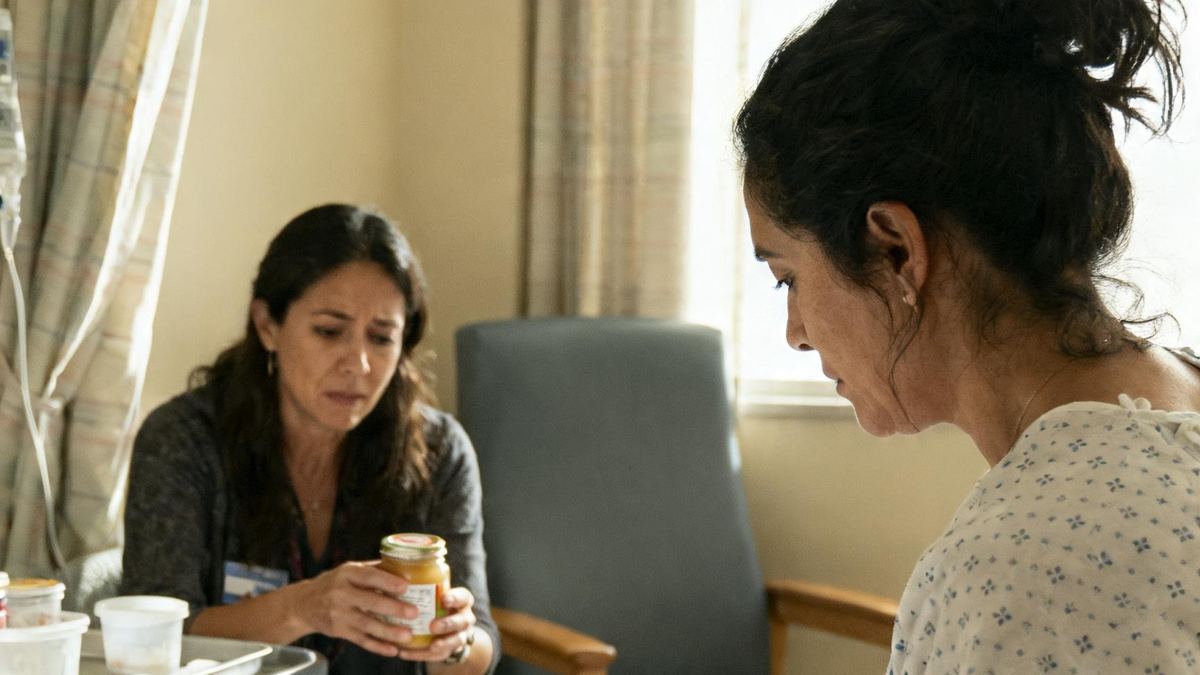
Margaret walked in with a cane I’d never seen before, a little plastic sticker of a sunflower on the handle. She was carrying a Tupperware container and a glass jar with a rubber band around the lid.
“Homemade applesauce,” she announced, setting both on the rolling tray. “And ginger snaps. The nurses said you could have solids after seven.”
I stared at her. “How did you even get here?”
“David drove. He’s in the parking lot.” She lowered herself into the visitor chair, breathing hard from the walk down the corridor. “Child, you spent forty dollars on an Uber for a woman you’d never met. You think I was going to let you sit in a hospital bed alone?”
She reached over and straightened my blanket — the cream-colored one, which I’d brought with me without even thinking.
“Now,” she said, unscrewing the applesauce lid. “Tell me what the doctor said. Word for word. I want to know exactly what we’re dealing with.”
We. I blinked. She waited, jar in hand.
Margaret’s cane leaned against the bed rail, the little sunflower sticker catching the light from the window. She stayed until the end of visiting hours. David came up for the last forty minutes with a deck of cards and a box of mediocre cafeteria coffee, and the three of us played rummy while the monitors beeped and the shift changed.
At the end of visiting hours, her cane tapped down the hall — a slow, uneven rhythm, David’s hand at her elbow. Right before they turned the corner, she looked back through the window in the door and raised her palm.