Avery Collins was eleven years old when she decided her mother was the most beautiful fool she'd ever know. Helen Collins had cheekbones that could cut glass, a master's in microbiology from a state school, and a voice that made people in the grocery store turn around. She could have gone anywhere—Chicago, New York, a lab with her name on the door. Instead she married Dean, a man with calloused hands and a plan to revolutionize mushroom farming in southern Indiana.
The mushroom farm failed. Then the hydroponic lettuce venture failed. Then Dean started failing at being sober, which turned out to be a full-time project. Helen took a job at the county health department, pressed her lips together, and aged fifteen years in five. Sometimes, late at night, Avery would come downstairs and find her mother sitting at the kitchen table, staring at a checkbook that never balanced, and Helen would look up and smile the saddest, proudest smile Avery had ever seen.
“Don't worry about me, baby,” she'd say. “I made my choices.”
Avery decided she would make different choices. She would make *smart* choices.
Briarwood, Indiana, didn't have a lot of smart choices to offer, so she made her own. Valedictorian. Summer jobs at the community college library. A full ride to Purdue. She walked onto campus with one rule: never let your heart write a check your future can't cash.
She was everything the professors noticed. Not because she was the prettiest—though at five-foot-nine with her mother's dark hair and hunter-green eyes, she turned heads—but because she was the most prepared. She read the syllabus before the first lecture. She cited papers the grad students hadn't heard of. In lab, she worked with a stillness that made people uncomfortable.
Dr. Elliott Vance noticed her in the third week of her junior year. He was the head of the Biochemistry department, fifty-two years old, with a full head of silver hair and the kind of quiet authority that made deans defer to him. His wife Linda worked in the university archives—a soft, thin woman who wore cardigans in August and looked at her husband the way a drought looks at a cloud. They had two daughters, one in high school, one away at Carleton.
It was Linda who actually introduced them.
“Elliott, this is the student I was telling you about,” she said, stopping him in the hallway outside his office. She had her hand on Avery's elbow, proprietary, hopeful. “Avery Collins. She's been doing remarkable work in Dr. Kapoor's lab. I think her methodology could be useful for your grant project.”
Elliott Vance looked at Avery. Avery looked back. She didn't blink.
“Is that right,” he said. It wasn't a question.
It started with a research assistantship. Then it was late nights in his office, going over data that didn't need going over. He started finding reasons to touch her shoulder, her hand, the small of her back when they walked through doorways. Avery knew exactly what he was doing, and she knew exactly what she was doing right back.
She smiled at the right moments. She let her silences stretch just long enough. She never said anything that could be quoted back to her. When he kissed her for the first time in his car—a black Tesla, leather seats, the parking garage at midnight—she let it happen, then she pulled back and said, very calmly, “Dr. Vance, are you sure your wife wouldn't mind?”
He looked devastated. She had him.
The affair lasted two years. She got the co-authorship. She got the letter of recommendation for the PhD program. She got the conference invitations and the private tutoring sessions and the gold bracelet she never wore in public. Elliott started talking about leaving Linda—always in the dark, always half-whispered, like a teenage boy promising to run away. Avery always said the same thing: “Let's not be reckless. You have daughters. Your career.”
What she meant was: *I'm not ready to carry your baggage yet.*
Then, in the spring of her senior year, three weeks before graduation, she realized she was pregnant.
The first thing she felt was rage. Not at him—at herself. She'd been so careful, so precise, the spreadsheet girl. But her body had its own ideas. She sat in the bathroom of her off-campus apartment and looked at the little pink line and thought about her mother. She thought about the checkbook at the kitchen table. She thought about how easy it would be to make an appointment and make this go away.
She didn't.
Partly it was something she couldn't name, something stubborn and ancient. Partly it was the cold calculation she'd always relied on. Elliott had a big house, an investment portfolio, a tenured position. A child was leverage, and leverage was security.
She told him in his office on a Thursday afternoon. She didn't cry. She placed the clinic paperwork on his mahogany desk and said, “I'm keeping it. You need to figure out what you're doing.”
Elliott stared at the paper. His face went through three shades of pale. He started talking about timing, about his wife's health, about the project deadline, about how much he cared for her. He said, “I'll take care of everything. Just give me time.”
Three weeks later, he got the call from Johns Hopkins. The research project—the one Avery had helped him refine, the one she'd stayed up nights formatting and editing and practically rewriting—had won a major federal grant. They wanted him to lead a new institute in Baltimore. The offer came with a salary twice his current one, a brownstone in Federal Hill, and a press release that didn't mention her name once.
He left on a Tuesday. No goodbye. No plan. He just stopped answering her texts, then her calls, then the emails. His secretary sent her a cashier's check for ten thousand dollars and a signed form withdrawing from all mentorship responsibilities. Linda, apparently, had given him an ultimatum: the family goes to Maryland clean, or she takes him for everything.
Avery had the baby alone in a county hospital in Lafayette. She named him Henry, after her father, which wasn't nostalgia so much as a grim little joke on herself. The baby came out screaming, full of fury, with a thatch of dark hair and his father's square jaw. When she held him for the first time, she didn't feel a flood of love. She felt the weight of a decision she could never undo.
She finished her degree by correspondence. She worked as a lab tech during the day and a night dispatcher for a plumbing company. She lived in a one-bedroom apartment with a crib jammed between the kitchen counter and the front door. Her mother drove up twice a month with Tupperware containers of casserole and didn't say *I told you so*. She didn't have to.
Avery told herself she wasn't broken. She was just paying the price.
Five years went by. Henry grew into a serious, silent boy who liked to take things apart and put them back together wrong. Avery stopped flinching when she heard the name Vance. She stopped checking his institution's faculty page. She stopped waiting for a knock that wasn't coming.
And then, on a Thursday in October, the knock came.
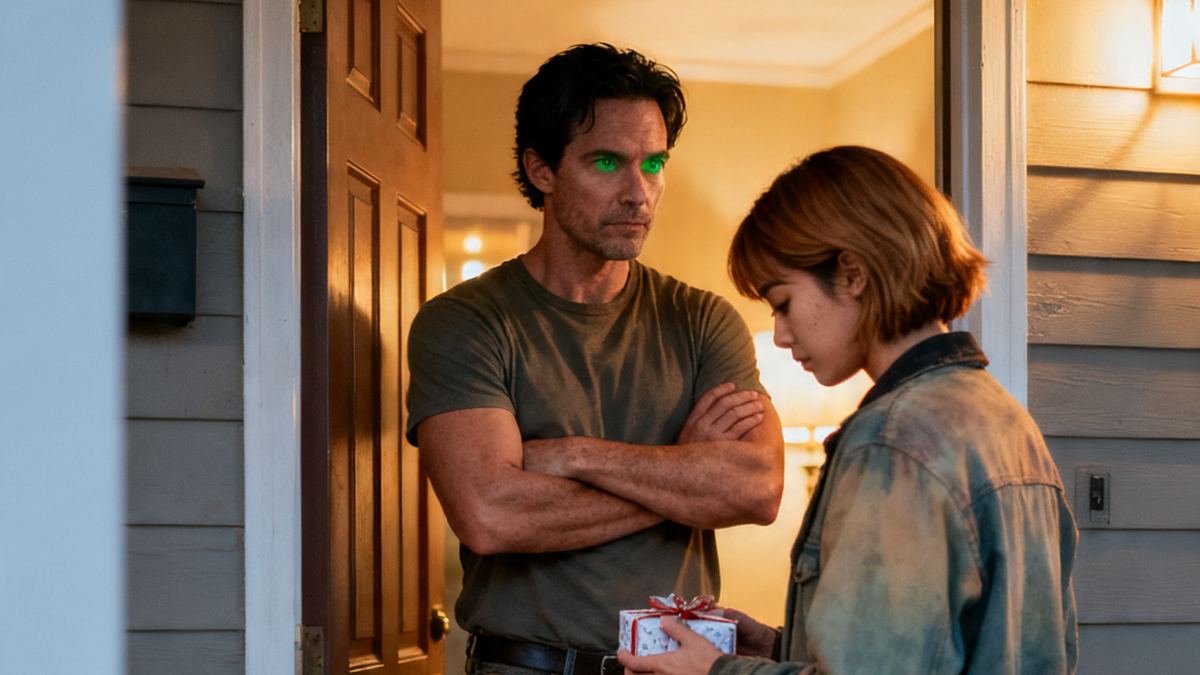
She opened the door of their apartment—a better one now, in a neighborhood with trees—and there he was. Elliott Vance, sixty pounds heavier, his silver hair thinner, his face set in a kind of hopeful desperation that made her stomach turn. He was holding a gift-wrapped box the size of a microwave.
“Avery,” he said. His voice cracked on the second syllable.
She didn't move from the doorway. “What do you want?”
“I left her,” he said. “Linda and I… it's over. I've been thinking about you. About our son. I made a terrible mistake.”
Behind her, in the living room, Henry was building a castle out of cardboard bricks, humming off-key. Avery could hear the little *thwump* of each brick stacking. She stepped forward and pulled the door nearly shut behind her, blocking his view.
“You made a lot of mistakes,” she said. “I was one of them. You don't get to come back from that.”
He started to argue. He started to say he'd changed, that he was sorry, that he'd set up a trust fund, that he wanted to be a real father. She let him talk for a full minute without interrupting. Then she said: “The boy in there doesn't know your face. He doesn't know your voice. You're not going to teach him what love looks like by walking away twice.”
Elliott's hand went to the box. He pulled off the lid. Inside was a miniature drone, gleaming and expensive. “I just want to meet him,” he said. “One time. Please.”
Avery looked at the drone. She thought about her mother, about the mushroom farm, about all the promises her father had broken and how Helen had always, always left the door unlocked.
She reached out and took the box from his hands.
“I'll give it to him,” she said. “And I'll tell him it came from a man who wasn't ready. If, when he's eighteen, he wants to find you, I won't stop him. But you don't get to walk in and out of his life whenever you feel lonely. You don't get to be a lesson he has to unlearn.”
Elliott's face crumpled. He looked old. He looked like someone who'd spent his whole life trading up and had just realized the market was closed.
She waited until he turned and walked back to his rental car. She waited until the taillights disappeared at the end of the street. Then she went back inside, locked the door, and sat down on the floor next to her son.
Henry looked at the box. “What's that?”
“A gift,” she said. “From someone who owed me a lot more.”
He opened it, pulled out the drone, and his face lit up exactly the way she'd once seen her mother's face light up on a rare good day with her father. The sight made her want to laugh and cry at the same time.
Instead, she helped him snap the wings into place. The drone lifted off with a buzz, wobbling toward the ceiling, and Henry whooped with delight. Avery sat on the floor, her back against the couch, and watched him fly.
She didn't feel empty. She didn't feel triumphant. She felt, for the first time in years, something close to quiet. Her mother would understand, she thought. The choices you make don't vanish just because you wish them away. You carry them, you raise them, and sometimes, if you're lucky, you teach them to fly straight.