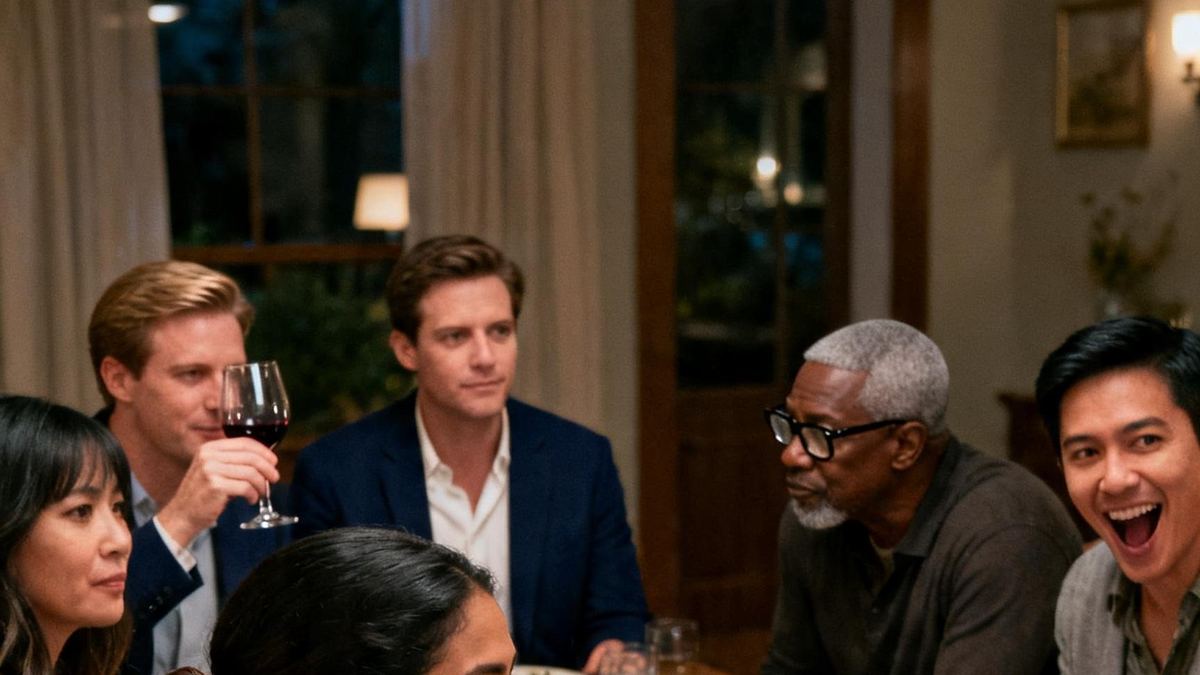
Kyle set down his fork, dabbed at the corner of his mouth with a cloth napkin, and swiveled toward his boss with the easy confidence of a man about to seal a deal. We were seven people around our reclaimed-wood dining table in Boise, Idaho—the one Kyle had insisted on because it made us look like “people who host.” His regional manager Alan Ross was there, plus two senior dispatchers and their wives. I’d spent the afternoon pressing tablecloths and chilling the pinot grigio.
“Maggie’s a miracle worker,” Alan said, reaching for the roasted potatoes. “My wife tried this leek-and-mushroom thing last Thanksgiving and the fire department showed up.”
Everyone laughed. Kyle laughed too, but his jaw tightened almost imperceptibly. He needed tonight to be about *him*—his judgment, his leadership potential, his perfectly curated life. Not about me. Not about the food I’d made while he stood in the bathroom rehearsing talking points about throughput metrics.
“She had a good teacher,” Kyle said, leaning back. He took a slow sip of wine. “You should’ve seen her when we met. Girl from a double-wide outside of Nampa—I mean, no running water half the time. She showed up to our first date in shoes she’d colored in with a Sharpie because the soles were peeling off.”
The table went silent. Alan’s wife paused with her fork halfway to her mouth.
I felt the blood drain from my face and settle somewhere in my chest.
That story was not his to tell.
I’d whispered it to him in a motel room in McCall three years earlier, after we’d been dating six months. We’d split a bottle of cheap whiskey. I told him about my mother working double shifts at the truck stop, about stuffing newspaper in my sneakers in seventh grade because my toes had punched through. About sitting in the locker room before gym class, praying nobody would notice the streaks of black ink bleeding down the canvas. I’d never told another living soul. He’d held my hand in the dark and said, *I’ve got you.*
Now he was serving it up between the pork tenderloin and the crème brûlée like a party anecdote.
“Anyway,” Kyle went on, gesturing with his glass, “point is, Alan, I know how to spot potential and develop it. She didn’t even own a proper coat when we met. I built all of this from scratch.” He swept his arm around the dining room like he was presenting a quarterly report.
I watched Alan Ross. He didn’t laugh. Didn’t smile. Just set his fork down very carefully and studied Kyle as though seeing him for the first time.
Kyle, oblivious, was still riding his own momentum. He turned to me with that smug, expectant look—the one that said, *Play along, babe, we’re a team*—and nodded toward the kitchen. “Mags, why don’t you grab the dessert plates?”
I didn’t move.
“Maggie,” he repeated, a little sharper.
I picked up my butter knife and tapped it once against the rim of my water glass. The sound cut through the room. Alan’s wife flinched.
“You left out the best part,” I said. My voice came out steady, which surprised me. “The black shoe polish I used? It was the kind with the little sponge applicator. Ninety-nine cents at the Albertsons on Garrity Boulevard. I bought it with quarters I’d saved from collecting cans.”
Kyle blinked. “Okay, sweetheart, I don’t think anyone needs the inventory list—”
“And the reason I was crying in the locker room,” I continued, “wasn’t because the polish ran in the snow. It was because Kendra Whitfield stepped on my foot on purpose during basketball drills and the whole toe cap split open. And I still finished the game.”
Alan’s dispatcher—a heavyset guy named Roy—set down his drink. His wife was staring at me with something between horror and recognition.
“The point, Kyle, since you missed it, is that I was eleven years old and I had already figured out how to show up and fight when everything was falling apart. That’s not a funny story about being poor. That’s not a before-and-after commercial for your mentorship. That’s *mine*. And you just traded it for a shot at a bigger office.”
I slid the ring off my finger. It caught on the knuckle—my hands were still swollen from scrubbing sheet pans. Kyle had picked it out at a jeweler downtown, a rose-gold band with a tiny conflict-diamond solitaire. He’d said it looked “appropriate to our station.”
The ring made a soft thud on the linen tablecloth.
“Maggie, sit down,” he hissed. His ears had gone the color of raw salmon. “You’re making everyone uncomfortable.”
“No,” Alan Ross said quietly, from the other end of the table. “She isn’t.”
Kyle’s head whipped around. “Alan—look, it was just a joke. She’s being dramatic. This is what I deal with at home, honestly.”
Alan stood up. He was a short man, built like a fire hydrant, with a gray buzz cut and hands that had actually turned wrenches in his twenties. He’d started on the loading dock at the Salt Lake City hub and worked his way up over thirty years. He didn’t look angry. He looked tired.
“Kyle, I grew up in a trailer park outside of Pocatello with an outhouse and a woodstove,” he said. “My mother sewed my jeans out of feed sacks until I was fourteen. You know what I don’t do? I don’t auction off my wife’s worst moments to impress a room full of people.”
He turned to his wife. “Janine, get your coat.”
“Alan, please,” Kyle said, scrambling to his feet. “That’s completely different. I didn’t mean—”
“You meant exactly what you said,” Alan interrupted without turning around. “And I’ve spent fifteen years building a culture where my team doesn’t have to worry about getting gutted in the break room. You just showed me who you are when you think you’re in charge. We’ll talk Monday.”
He didn’t say about what. He didn’t have to.
Roy and the second dispatcher and their wives were already pushing back their chairs, murmuring awkward thanks that weren’t really thanks. Janine paused by my shoulder on her way out and touched my wrist, just for a second. She didn’t say anything. She didn’t need to.
The front door clicked shut. The house went silent except for the soft hum of the refrigerator and the ticking of the grandfather clock Kyle’s mother had insisted we take—the one that never kept time right and chimed at eleven forty-three for no reason.
Kyle stood frozen by the table, his napkin still clutched in one hand.
“You just cost me the regional director spot,” he said. His voice was flat, disbelieving. “Over a stupid story. A story that was *true*.”
“No,” I said, pushing my chair in. “You cost yourself. I just stopped paying the tab.”
I walked to the hall closet and pulled out the bag I’d begun packing three weeks earlier—the one with my laptop, my grandmother’s quilt, and a manila folder of documents. I’d stashed it behind the winter coats, telling myself I was being paranoid. Turns out I was being prepared.
Kyle followed me to the door. “Where are you going?”
“To my sister’s in Caldwell.”
“You don’t have a sister in Caldwell.”
“Claire,” I said. “You met her once. You told her she laughed too loud and she shouldn’t wear yellow because it made her look ‘aggressive.’ She’s had a spare room ready for me since February.”
His mouth opened and closed. For a man who always had the right line, the perfect pivot, the charming deflection—he had absolutely nothing.
I pulled on my coat. It was a parka from a clearance rack at Fred Meyer, the kind with the slightly crooked zipper. I’d bought it with my own money from the part-time bookkeeping I’d started doing online in secret, squirreling away cash in a separate account he didn’t know about.
“I’ll FedEx the rest of my stuff,” I said. “You can keep the table.”
Outside, the October air hit my face—cold and clean and smelling faintly of wood smoke from someone’s chimney down the block. My sister’s pickup was idling at the curb, her golden retriever Buster panting happily in the passenger seat. She’d driven forty minutes, no questions asked, because I’d texted her one word: *Ready.*
I climbed in. Buster licked my ear.
Claire didn’t say anything right away. She just reached over, squeezed my knee, and pulled away from the curb. The house with the reclaimed-wood table shrank in the side mirror until it was just another set of porch lights among thousands.
Six months later, I was living in a rented studio above a bakery on Thirteenth Street. The floor slanted slightly. The radiator clanked at odd hours. Every morning at five, the smell of sourdough starter drifted up through the vents.
I’d taken a full-time accounting job at a small nonprofit that helped foster kids buy school supplies. The pay was modest. The people were kind.
Kyle, I heard, had been passed over for promotion and transferred to the Pocatello satellite office—a converted trailer near the interstate. His mother had posted something cryptic on Facebook about “women who destroy good men with their ambition.” Claire screenshot it and sent it to me with a row of crying-laughing emojis.
One Saturday morning, I was sitting on my fire escape with a mug of coffee, watching the sun come up over the Boise foothills. The bakery delivery truck rumbled below. Somewhere a few blocks over, church bells were ringing.
My phone buzzed. It was a text from Kyle: *I’ve been doing a lot of thinking. I think we owe it to what we had to try again. I forgive you.*
I stared at the screen for a long moment. A pigeon landed on the railing, cocked its head, and flew off.
Then I deleted the message, blocked the number, and finished my coffee.
It had gone cold anyway.