The kitchen in their new house smelled of pancakes and fresh coffee. Claire set the plate in front of her son Ethan and watched him reach for the syrup without being asked. The morning light cut through the window above the sink, catching the faint scar on his chin—the one he'd gotten falling off his bike at seven, still silent, mouthing his pain instead of crying out.
"We should plant something for her," Ethan said. "Maybe those orange flowers she drew all the time."
Claire's hand stopped midair, the spatula dripping batter onto the counter. Eight years. Eight years of notes slipped under bedroom doors, therapy sessions where he stared at walls, school meetings where teachers whispered like she wasn't standing right there. And now her son was talking about his twin sister over breakfast like he was discussing the weather.
"Poppies," she managed. "She drew poppies."
"Yeah. Those."
Outside, the moving truck was still half-unloaded, boxes marked KITCHEN and ETHAN'S ROOM stacked in the hallway of the rental in Jasper Creek, Colorado. A thousand miles from the lake house in Minnesota. A lifetime away from everything that had shattered them.
—
It started the summer the twins turned five.
Claire had been packing the car for their annual trip to Clearwater Lake. Her husband Mike was supposed to be home by noon—he'd promised, swore on his life he'd be there—but two o'clock came and the driveway stayed empty. She found the kids huddled behind the garage, Ethan's arm around his sister Lily, both of them pale and too quiet.
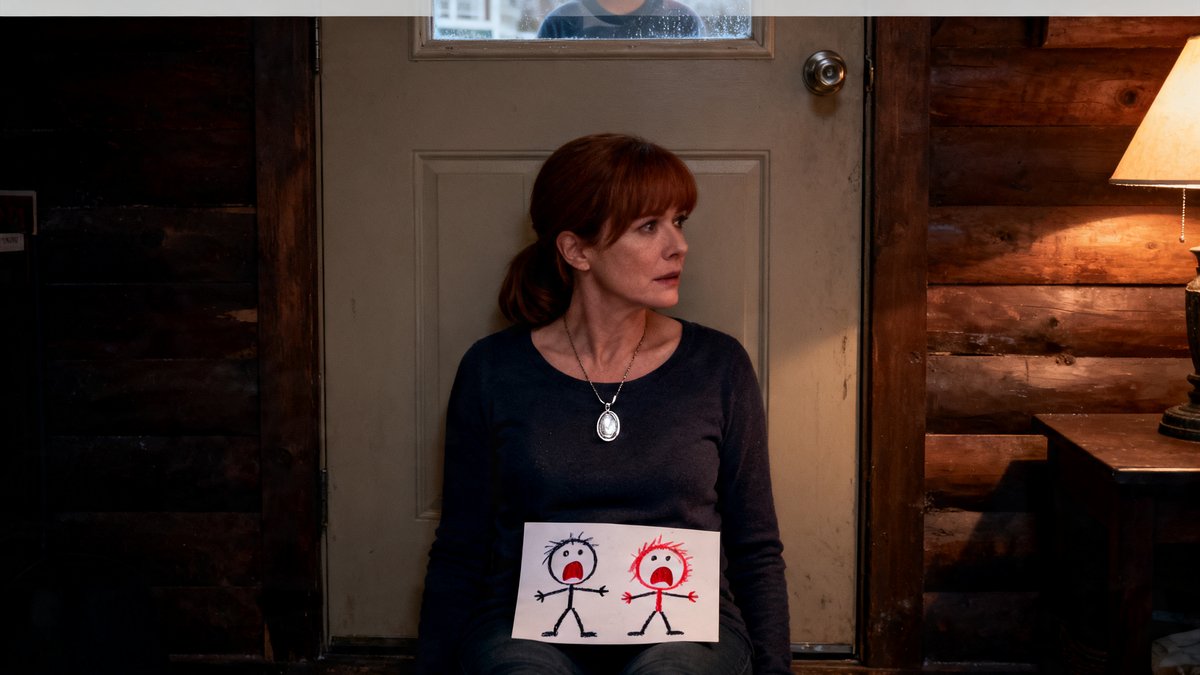
"Mommy," Lily whispered, clutching a crayon drawing she'd done of two stick figures yelling at each other, red scribbles for mouths.
"What is it, baby?"
"Uncle Rich is mad at Daddy. Daddy said bad words. Uncle Rich said we're gonna lose the house."
Claire had pulled them close, said it was grown-up stuff, nothing for them to worry about. Loaded them into the car. Two hours later, Mike finally showed up at the lake cabin, jaw tight, phone pressed to his ear, waving off every question she asked.
The next morning, Lily drowned.
The sheriff called it a tragic accident—unsupervised children by the dock, a slippery rock, the kind of thing that happened in a split second and destroyed families forever. Ethan had been the one to find her. He'd run screaming to the cabin, but by the time Mike dove in and pulled her out, she was already gone.
And Ethan stopped speaking.
Not a word. Not a whisper. Not a single sound for eight years.
—
Claire tried everything. Speech therapists, trauma specialists, art therapy, music therapy, a woman in Denver who claimed she could unlock childhood mutism through equine bonding and charged four hundred dollars an hour. Ethan drew pictures, wrote notes in careful block letters, nodded and shook his head and sometimes, when he was really frustrated, banged his fist against the wall until his knuckles went white.
But he never made a sound.
Mike said they should give him time. Mike said a lot of things, always from behind his laptop in the home office, always with the door half-closed, always just out of reach. Their marriage became a series of logistics—who was picking up Ethan, who was making dinner, who was calling the insurance company about the latest therapy claim.
The distance between them grew so wide Claire couldn't remember what it felt like to cross it.
The day everything broke open was the eighth anniversary of Lily's death.
Claire had made Lily's favorite dinner—spaghetti and meatballs, the way their Italian grandmother used to make them, with extra garlic and fresh basil from the garden. She didn't know why she did it every year. Maybe to prove Lily wasn't forgotten. Maybe to force the family into the same room, facing the same ghost.
Mike's brother Rich showed up uninvited, as he always did. Rich with his three-thousand-dollar suits and his new Tesla and his grating habit of clapping Mike on the back like they were business partners instead of brothers who'd been tearing each other apart for years over their father's construction company.
"Smells fantastic, Claire. You outdid yourself."
She didn't answer. She was watching Ethan, who sat rigid at the head of the table, fork in his fist, knuckles white. His eyes were fixed on his father.
Mike wouldn't meet his gaze.
Halfway through dinner, Ethan's chair scraped back from the table with a sound like a scream.
He stood up.
He raised his arm and pointed directly at his father's chest.
"You knew," he said.
His voice was rusty, cracked, deeper than Claire had imagined it would be after eight years of silence. The sound hit her ribs like a physical blow.
"You knew why I stopped talking."
Then he turned, face crumpling, and bolted for his room. The door slammed hard enough to rattle the framed photos in the hallway—the ones that still had Lily in them, frozen at five years old, forever wearing a yellow sundress and holding a bouquet of dandelions.
Claire sat frozen, spaghetti cooling on her plate, staring at her husband.
Mike's face had gone gray. Not the gray of grief—she knew that color intimately, had worn it herself for years—but the gray of absolute terror.
"Mike."
"It's nothing. He's confused. He's been through—"
"What did you know?"
Rich set down his fork with exaggerated delicacy. "Claire, let's not make a scene."
She didn't look at him. "Get out of my house."
"Excuse me?"
"Get. Out."
Rich left. Mike retreated to his office. And Claire found herself sitting on the floor outside Ethan's bedroom, her back against the door, her hand pressed flat against the wood like she could feel his heartbeat through it.
Hours passed. The house went dark.
Then, sometime after midnight, a folded piece of paper slid under the door.
Then another. And another.
Six notes in total, written in Ethan's careful handwriting, the letters cramped and pressed hard into the paper like he was afraid they'd disappear if he didn't force them deep enough.
The first note said: Lily heard them fighting.
The second: Uncle Rich said if Dad told anyone, we'd all be sorry.
The third: Dad said he'd fix it before anyone found out.
The fourth: Lily drew a picture. She was going to show Mom. She said Mom would know what to do.
The fifth: After Lily died, Dad threw the picture in the fireplace. I watched him burn it.
The sixth: I didn't speak because I was afraid they'd do to me what they did to Lily.
—
The next morning, Claire drove three hours to a rundown apartment complex in a Denver suburb. The woman who opened the door was in her late sixties, with sharp eyes and a guarded posture that softened the moment Claire said her name.
"Nora Hendricks?"
"Who's asking?"
"My son hasn't spoken in eight years. Last night he told me my husband and his brother are responsible for my daughter's death. You're the only person who might know why."
Nora let her in. Made coffee. Sat her down at a kitchen table covered in old files and legal documents and told her everything.
She'd been the accountant for Freeman Construction for nearly two decades. Three years before Lily died, she'd noticed discrepancies—money moving through shell companies, fake invoices, tax fraud on a scale that would bring the whole company down. When she brought it to Rich, he'd laughed. When she threatened to go to the authorities, he'd fired her, blacklisted her from the industry, and threatened to sue her for defamation if she ever spoke a word of it.
"I tried to warn Mike," Nora said, her voice flat with old anger. "He knew. He knew everything. But Rich had him convinced that exposing the fraud would destroy the family name, cost everyone their jobs, their homes, everything their father built. So Mike went along with it."
"And my daughter?"
Nora's expression cracked. "I don't know what those children overheard. But I can tell you this—the week Lily died, I sent Mike a letter. I told him I was going to the state attorney general. I told him I had proof."
Claire's hands were shaking. "Did he show Rich?"
"I assume so. Four days later, Lily was dead, and I got a phone call from Rich. He said if I valued my life, I'd forget everything I knew."
"You think they—"
"I think your daughter's death was an accident," Nora said carefully. "The sheriff's report was thorough. But I also think Rich used that tragedy to bury his crimes, and Mike let him. He let that little boy believe something unspeakable for eight years rather than face the truth."
—
Claire drove home with a box of documents on the passenger seat—copies of everything Nora had kept hidden for over a decade, waiting for someone to finally ask.
That night, she didn't confront Mike. She didn't rage or cry or demand explanations. She sat in her car in the garage for an hour, reading through financial records and forged signatures and threatening letters until the pattern of her husband's cowardice was burned into her brain.
The annual Freeman Construction Founders' Dinner was three weeks away. Rich was going to be honored with a lifetime achievement award. Three hundred employees, shareholders, and local business leaders would be in the room.
Claire RSVP'd for two.
—
The ballroom of the Grand Denver Hotel was packed. Chandeliers dripping crystal, champagne flutes catching the light, the hum of conversation punctuated by bursts of laughter from the corner where Rich held court, already flushed with victory and expensive scotch.
Claire wore red. A dress she hadn't worn in years, from before the funeral, before the silence, before she'd become a ghost haunting her own life. Mike walked beside her, confused by her sudden interest in the event but too relieved to question it.
"You look beautiful," he said, and the words landed like an insult.
She smiled. "Thank you."
They took their seats. Salads were served. Speeches began. Rich was introduced, and the room erupted in applause as he climbed the stage, arms raised like a king accepting tribute.
The MC handed him the microphone.
"Thank you, thank you. You know, when our father started this company out of a one-car garage in 1962—"
Claire stood up.
Conversations at nearby tables faltered. Mike grabbed her wrist. "Claire, what are you doing?"
She pulled free and walked toward the stage. The crowd rustled with confusion. Rich's grin stiffened.
"Claire, this isn't really the time for—"
She took the microphone from his hand.
"Good evening." Her voice filled the ballroom, amplified and steady. "My name is Claire Freeman. My brother-in-law Rich has been stealing from this company for over a decade. He committed tax fraud, falsified financial records, and destroyed the career of an innocent woman who tried to expose him. My husband knew about it. He helped cover it up."
Gasps. Murmurs. Someone dropped a glass.
"My five-year-old daughter Lily overheard them fighting about it the day before she drowned. My son Ethan heard it too, and spent eight years in silence because he believed his uncle was capable of murder. Rich let him believe that. Mike let him believe that. They let an eight-year-old boy carry that terror alone rather than face the consequences of their own corruption."
Security was moving toward the stage. Claire raised a hand and they stopped—something in her face, her posture, the absolute certainty of a woman with nothing left to lose.
"I have documentation. I have witness testimony. I've already sent copies to the state attorney general's office, the IRS, and three investigative journalists." She turned to Rich, whose face had gone the color of old cheese. "This award you're about to receive? You stole it. Just like you stole my family."
She set the microphone down on the podium and walked out.
—
The investigation took fourteen months.
Rich was indicted on seventeen counts of fraud, embezzlement, and witness intimidation. He took a plea deal that stripped him of his position, his shares, and most of his assets. The company barely survived the scandal, but it survived—under new leadership, with new oversight, with Nora Hendricks brought back as a consultant at triple her old salary and a public apology from the board.
Mike wasn't charged. But Claire filed for divorce the morning after the gala, and the settlement gave her enough to buy the house in Jasper Creek and start over. He moved into a one-bedroom apartment in Denver and sent Ethan birthday cards he never opened. Claire didn't push. She'd learned something in those eight years of silence: you couldn't force someone to heal on your timeline.
The scholarship fund was Nora's idea. Claire used the money from selling the old family home—the one Rich had almost lost them, the one soaked in so many painful memories—to create something that would outlast the wreckage. Grants for people who'd been pushed out of their jobs for doing the right thing. Small gestures with long ripples.
—
And now here they were, four months after the move, in a kitchen that smelled like pancakes.
Ethan was talking about poppies.
Claire poured herself a cup of coffee and sat down across from him. "She used to draw them everywhere. Remember when she colored them on the wall in the hallway?"
Ethan's mouth twitched—almost a smile, the first one she'd seen in years that wasn't forced. "You yelled. But then you framed it and hung it up anyway."
"Best artwork I ever paid a security deposit to replace."
They ate in silence for a moment. Comfortable silence. The kind that didn't need filling.
"Mom?"
"Yeah?"
"I don't think she's mad anymore. Lily, I mean." He pushed a piece of pancake around his plate. "I used to think she was. Because I didn't tell anyone. But I think she understood."
Claire reached across the table and covered his hand with hers. She didn't say anything. She didn't need to.
After breakfast, they went to the garden center and bought poppy seeds—California poppies, bright orange, the kind that came back every year whether you remembered to water them or not. They planted them along the back fence, under the aspen trees, where the afternoon sun hit just right.
Ethan dug the holes. Claire dropped in the seeds. Neither of them spoke.
But for the first time in eight years, the silence felt like a choice instead of a prison.