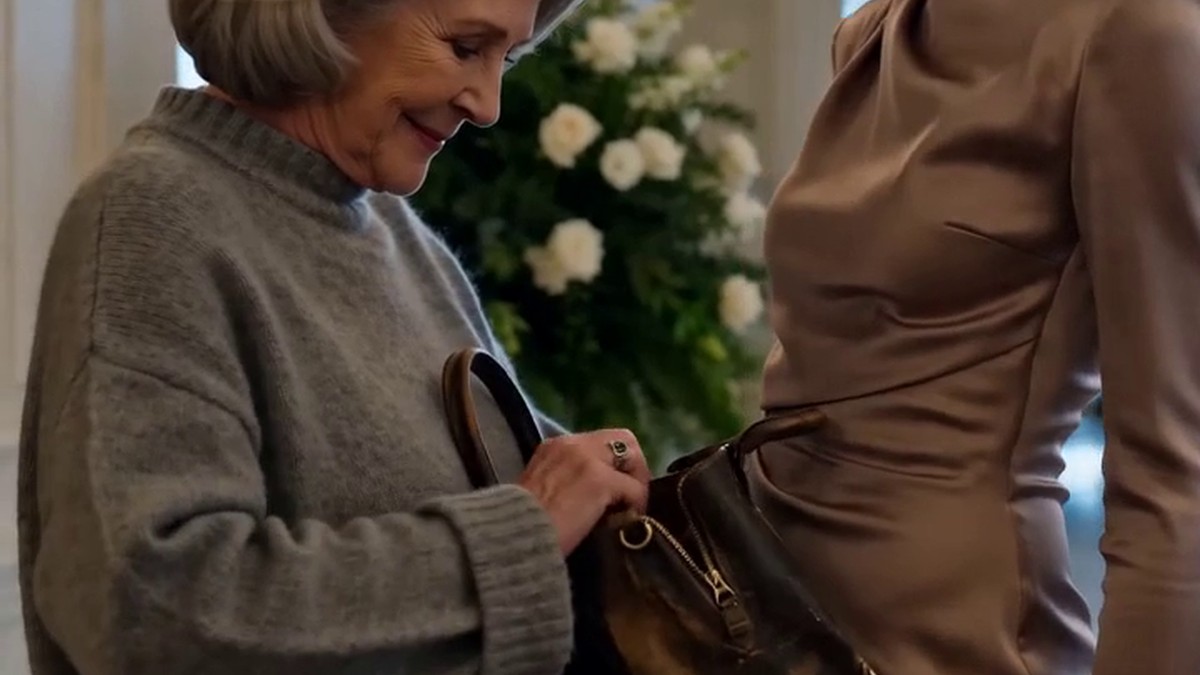
The first cut came before Margaret Collins even reached the white linen table. “Mother, did you really come here tonight?” Sophia Whitmore’s voice sliced through the Michelin-starred hush like a broken wine glass, and fifty heads turned in unison toward the entrance.
The Auberge was a cathedral of understated wealth—crystal chandeliers dripped honeyed light onto patrician faces, each table a carefully composed still-life of silver and Baccarat. Sophisticated murmurs wove through the air, the quiet rhythm of power at rest. And there, at the threshold, stood Margaret.
Seventy-five years old. Gray wool sweater. A small, scuffed handbag clutched in both hands. She wore the kind of dignity you earn over decades, not purchase on Madison Avenue. Her eyes found Sophia’s, and she offered a smile as gentle as chamomile tea.
“My son invited me to join the dinner,” Margaret said, her voice calm as still water.
Sophia’s gaze crawled down the older woman’s sweater, then swept the glittering room, letting the comparison hang. She leaned in, lips barely moving, but her next words carried to every corner. “This place is not suitable for someone like you. You know how you get in crowds, Mother—confused and out of place.”
A businessman near the window set his wineglass down too carefully. An older couple at the next table exchanged a look of shared secondhand shame. The waiter froze mid-step, sensing blood in the water. Margaret did not move. She simply stood, rooted as an ancient oak, and let Sophia’s words fade into the chandelier light.
“I am not confused,” Margaret said quietly. “I was invited by my family.”
Sophia crossed her arms, the corners of her mouth curling upward. “Your family? Do you really think sitting here will make people believe you belong? After last Christmas, when you couldn’t even remember the cab?”
The silence that followed was the kind that presses against your eardrums. Every whispered judgment became a needle—“she doesn’t look like someone who would eat here,” “maybe she walked into the wrong restaurant,” “some people don’t know their place.” Margaret heard them all. She could have catalogued each one by the shape of the cruelty. Yet she remained still. She’d learned, in seventy-five years, that silence could open more doors than anger ever could.
Sophia turned toward the young maître d’ hovering near the host stand. “Excuse me. This woman is not part of our reservation. She arrived without being expected.”
The young man—Carl, his nametag read—glanced at the reservation list, then back at Margaret, his brow creasing. “I’ll check with the host.”
Sophia smiled as though the verdict had already been spoken, and she stepped closer to her mother-in-law, her voice a silken blade. “You should have called before coming. Like you were supposed to for the gala in April—oh, wait, I forgot to pass that invitation along.”
Something flickered behind Sophia’s eyes—just a twitch, a quick shadow of uncertainty—before she pulled the mask back down. “Daniel says many things. Tonight is important. These people are executives, investors, community leaders. They are not here to see someone dressed like they’re going to a grocery store.”
Margaret lowered her gaze, but not from shame. From disappointment. Slowly, with the kind of deliberate care that only age can teach, she reached into her handbag. The entire room watched. She withdrew a small wooden box, its finish worn smooth by years of handling, and set it on the edge of the table.
Sophia laughed, a brittle, crystalline sound. “What is that? Another memento from the home?”
“I brought something Daniel asked me to bring,” Margaret said. She did not open it.
“Do you really think that old box proves anything?” Sophia nearly spat.
“It proves exactly what it needs to prove.” The firmness in Margaret’s voice stopped Sophia cold. For the first time that evening, the younger woman took a step backward.
And then the heavy glass doors swung open.
Andrew Keller, the manager of The Auberge, was a man who never hurried. Tall, silver-templed, and perpetually serene, he moved through the restaurant like a diplomat through a palace. But now his stride was quick, almost urgent. His eyes swept the room, found Margaret, and his entire demeanor shifted—from urbane professional to startled recognition.
He crossed the dining room in swift, sure strides. “Mrs. Collins? Forgive me, I didn’t know you were coming tonight. Carl should have been informed.”
Margaret looked up, and her expression softened with genuine familiarity. “It’s quite all right, Andrew. I was a last-minute addition.”
Sophia’s head swiveled between them, her composure cracking. “You know her? Andrew, this woman is just—”
Andrew Keller straightened, and when he spoke, his voice carried the natural authority of a man who had managed this room for fifteen years. “Mrs. Collins is the sole owner of The Auberge, madam. Her husband Edward founded this restaurant, and she has been the guiding hand behind it ever since his passing. Every person on staff knows her name. I’m only sorry she wasn’t recognized sooner.”
A collective ripple ran through the dining room. The same businessman who’d set his glass down earlier now looked at Margaret as though seeing her for the first time. The older couple exchanged a new look, this one laced with wonder. Sophia’s face drained of color, leaving only two bright spots of rouge high on her cheekbones.
“That’s impossible,” Sophia whispered, and then, louder, “that’s impossible. Daniel would have told me.”
“Daniel did tell you,” came a new voice from the entrance.
Daniel Collins walked in, loosening his tie, his jaw set. He’d slipped in during Andrew’s announcement, and now he crossed the room straight to his mother, bending to kiss her cheek. “I told you I wanted you here, Mom. And I told Sophia this dinner was in your honor. She just never believed me.”
Sophia’s mouth opened and closed, but no sound came. The guests who moments ago had whispered about misguided old women now stared at Sophia with something colder than curiosity.
Daniel turned to Andrew. “Thank you. I think it’s time my mother was properly acknowledged.” He gestured toward the small wooden box still resting on the table. “You brought it.”
Margaret placed the box into her son’s waiting hand. “You asked me to. For the board meeting tomorrow, you said. Though I’m beginning to suspect tonight had more than one purpose.”
A shadow crossed Daniel’s face—a mix of guilt and resolve. “The board meets to confirm the new chair. I needed them to see you, to understand who they’ve been dismissing. And I needed Sophia to show herself in front of witnesses who couldn’t look away.” He opened the box, revealing the old silver watch inside, its face scratched, leather strap cracked with age. “Dad’s watch. The one you used to open every staff meeting, every negotiation. Tomorrow, it sits at the head of the table.”
Sophia found her voice again, thin and sharp. “You set this up. You set me up.”
“Yes,” Daniel said, and there was no pleasure in it, only the hard weight of a long-overdue decision. “You’ve spent four years erasing my mother from this family’s story. You cancelled her invitations to every public event. You told people she was confused, losing her memory, that she couldn’t manage her affairs. You called her a liability. I let it go on too long because I didn’t want to believe it. But tonight, I made sure the people who matter saw the truth.”
Margaret raised a hand gently, pausing him. She looked at Sophia—not with anger, not with triumph, but with the same steady, probing calm she’d worn since she arrived. Her voice was quiet but so clear it seemed to fill every corner of the room.
“Sophia, you thought old age somehow made me invisible. You were wrong. I was never invisible. I was just waiting. Waiting for you to show Daniel exactly who you are. You did that tonight, in front of witnesses he can’t ignore.”
Sophia’s expression cracked open. For a split second, the bravado crumbled into raw panic. “Daniel—you can’t do this. I’m your wife.”
“Yes,” Daniel said quietly, “and she’s my mother. The difference is, she’s never lied to me. You have. Extensively.”
He signaled to Andrew, who had already summoned a security officer from the lobby—a quiet, discreet man in a dark suit. It was done with such smooth choreography that most guests only noticed when Sophia let out a short, indignant laugh.
“You’re seriously throwing me out?”
“I’m asking you to leave tonight’s dinner,” Daniel said. “The rest we’ll settle with lawyers. You’re no longer welcome at this table, or in this restaurant.”
Sophia stood frozen for a long moment. Then, with a toss of her hair and a futile attempt to reclaim dignity, she walked toward the door. The security officer followed her without a word, and the door swung closed with the whisper of well-oiled hinges.
Silence returned, but a different kind of silence—not the repressive quiet of judgment, but a watchful, respectful hush. Margaret looked around the room, absorbing the faces that once pitied her. She did not gloat. She simply smiled, the same gentle curve of lips she’d worn when she entered.
“Forgive the disruption,” she said to Andrew. “Now, let’s have dinner. Could we have the bottle of Pétrus I set aside for a night like this?”
Andrew inclined his head, a quiet smile breaking through. “Of course, Mrs. Collins. It’s been waiting.”
As she sat at the head of the table, the old silver watch now resting beside her plate, Daniel took the chair opposite, his hand covering hers for a brief, private moment. The room gradually resumed its murmured conversations, but a subtle shift had occurred—every gaze that drifted toward Margaret’s gray sweater now held something closer to awe.
She’d walked into the restaurant as a forgotten grandmother. She would leave as the quiet empress of her own kingdom, having reclaimed in one evening what decades of silent sacrifice had earned. The watch ticked softly beside the butter dish, its steady hands measuring not the minutes passing, but the end of one long, patient silence.