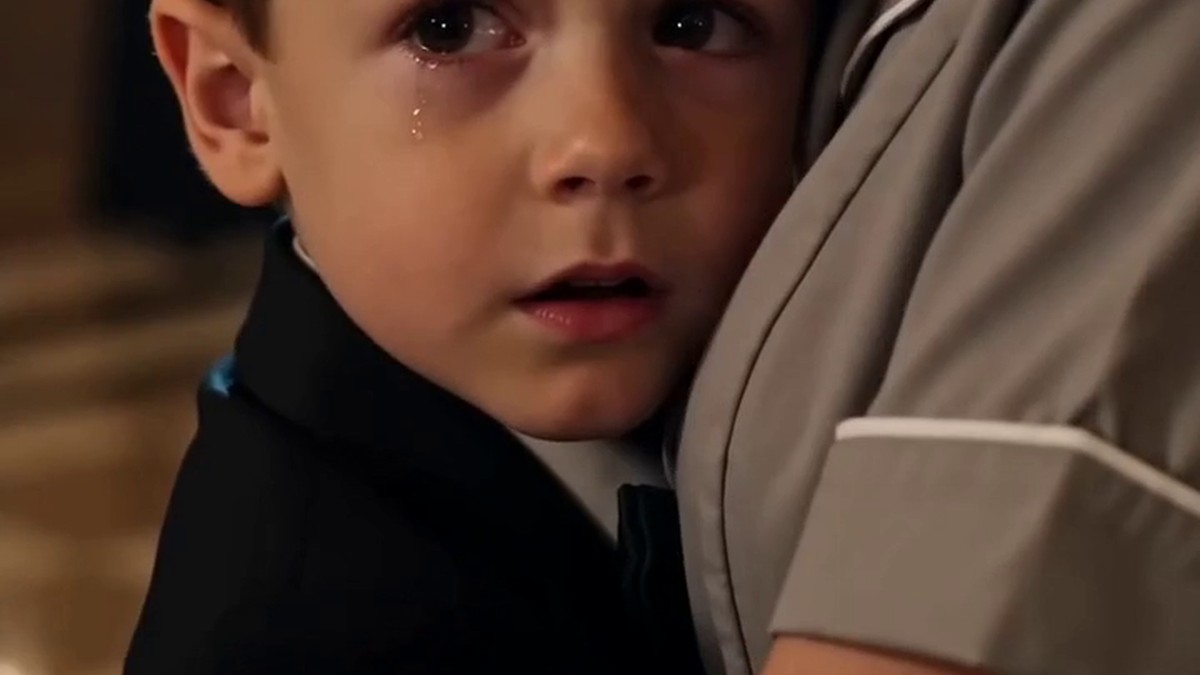
The three-year-old’s cry split the air like a crack of thunder, tearing through the polished quiet of the mansion and stopping time itself.
Heads swiveled. Conversations collapsed mid-sentence. Crystal glasses hovered, forgotten, as little Noah — all of three years old, swallowed up by a miniature black tuxedo — wrenched himself free from his nanny’s grip and bolted across the gleaming marble floor with the terrifying single-mindedness that only a desperate child possesses.
He wasn’t running toward the glittering guests. Not toward the extravagant décor, not toward the powerful man whose home this was. He was running toward the one person nobody had thought to look at — the quiet woman in a plain gray uniform, standing like a shadow pressed against the far wall.
She went rigid. The silver serving tray slipped from her fingers and hit the marble with a crash that rang through the entire ballroom like a gunshot.
“Noah…” she breathed, her voice fracturing, tears already spilling before she could stop them.
The boy collided with her, arms locking around her neck, holding on as though the world might try to pull them apart again.
“You came back,” he sobbed into her shoulder. “I knew you would.”
Silence fell over the room like a held breath.
Across the ballroom, Vanessa’s polished smile curdled into something raw and frightened.
“Get him away from her,” she snapped, voice slicing through the stillness.
Nobody moved.
Because Ethan Caldwell had raised one hand — a single, quiet gesture — and that was enough.
For the first time all evening, his eyes weren’t on his radiant fiancée. They were fixed on the woman in gray.
On the way her arms had closed around the boy before she’d even made a conscious decision to move.
On the way Noah pressed his face into the curve of her neck, every muscle in his small body finally, completely, at rest.
Something seized in Ethan’s chest. The image felt like a memory clawing its way up from somewhere buried. Impossible. And yet — undeniable.
Noah pulled back just enough to look at his father with wide, tear-bright eyes.
“Daddy,” he said, with the blameless honesty of a child who doesn’t yet know what the wrong question sounds like — “why does everybody keep calling Mommy the maid?”
The floor seemed to tilt beneath Lauren’s feet. Her knees nearly buckled as every face in the room turned toward her at once.
Ethan moved forward slowly, as if the air had thickened around him. The color had drained from his face entirely.
When he spoke, it was barely above a whisper.
“Noah… what did you just call her?”
The boy blinked. Confused. Certain.
“Mommy.”
The word landed in the silence like a stone dropped into still water, and the ripples went everywhere.
No one breathed. No one looked away.
Ethan stood there staring at a face he had grieved. A face he had convinced himself was gone — erased from the world two full years ago. He watched recognition dismantle disbelief, piece by piece, until there was nothing left but the truth standing right in front of him.
His lips parted.
“Clara…?”
The sound that moved through the crowd wasn’t quite a gasp and wasn’t quite a scream. It was something in between — the collective exhale of a room realizing that the invisible woman against the wall had just become the only person in it.
Lauren — Clara — did not run.
She had nowhere left to run. She had tried that once, and it had cost her everything. That was why she had taken this particular job, in this particular house — not by accident, not by coincidence, but because it was the only way back to Noah she could find from the wreckage of a life someone else had demolished. She had spent six weeks angling for the position, counting on the fact that no one looks twice at the woman refilling the water glasses. She had counted on invisibility to buy her time. She had not counted on a three-year-old.
So she stood still, Noah’s small hand clutched in hers, and she let Ethan Caldwell see her face for the first time in two years, three months, and sixteen days.
She had counted every single one.
“It’s me,” she said. Simple. Stripped of everything but the truth. “I’m alive.”
The words hit him like a physical blow. She watched his jaw tighten, watched his throat work, watched two years of grief fight two seconds of disbelief — and lose.
“That’s impossible.” His voice was barely sound. “I was told — they said you — the accident —”
“There was no accident.”
The words fell into the room like shards of glass.
Noah pressed himself against her hip, suddenly sensing the current running through the adults around him, the way children always do — not understanding the language but reading every frequency underneath it. She kept her hand on his back. Steady. *I’m here. I’m not going anywhere.*
Not this time.
Ethan’s eyes moved between her face and his son’s, and she could see the exact moment the shape of things began to shift for him. The scaffolding of the last two years — the grief, the acceptance, the slow reconstruction of a life without her — she could see it starting to crack.
“You need to explain—”
“Ethan.” Vanessa’s voice came like a blade through silk. “Darling.”
She moved through the crowd the way she moved through every room — as though it existed for her, as though the laws of space and social gravity bent in her direction as a matter of courtesy. She positioned herself at his side with practiced ease, one manicured hand resting on his arm, her diamond engagement ring catching the chandelier light like a warning flare.
Her eyes, when they settled on Clara, were not frightened anymore.
They were careful.
“I think we should get Noah upstairs,” Vanessa said. The voice of reason. The voice of calm. “This woman is clearly disturbed — she’s taken advantage of the boy’s attachment and —”
“I have photographs.”
Clara’s voice surprised even herself with its steadiness.
She reached into the deep pocket of her gray uniform — her hand finding the folded envelope she’d carried every shift, every day, like a talisman against the moment she would finally need it — and drew it out.
Vanessa went very still.
“Photographs,” Clara continued, addressing Ethan, only Ethan, letting the crowd dissolve to noise at the edges, “of the transaction. Bank records. A transfer, Ethan. To the clinic that falsified the report. To the man who told you I was dead.” She paused. “Dated four months before our marriage ended and six months before I woke up in a hospital in another state with no identification, no phone, and no memory of the last seventy-two hours.”
The silence in the room changed quality. It became the kind that precedes something irreversible.
“She’s lying.” Vanessa’s composure was extraordinary. Clara had to give her that. The woman was a cathedral of control — magnificent architecture, nothing holy inside. “She’s clearly unstable, she’s constructed some delusion —”
“The account number,” Clara said, “ends in 4471.”
She watched Vanessa’s face.
She watched it very carefully.
And there it was — the smallest flinch. A millisecond of recalibration. A flicker so fast that most people in the room wouldn’t have caught it.
Ethan caught it.
She knew by the way his hand dropped from Vanessa’s touch. Not dramatically. Not in a burst of anger. Just — a quiet withdrawal, the way warmth leaves a room when a window opens. So complete and so final that Vanessa’s fingers found only air.
“How do you know that number?” he asked. He was not looking at Clara.
He was looking at his fiancée.
Vanessa opened her mouth. Closed it. The smile held — God, it held, like a fracture held together by surface tension — but something behind her eyes was calculating distances, exits, angles of escape.
“Ethan, I —”
“*How do you know that number.*”
The room had ceased to exist for him. Clara could see it. Two hundred guests, strings of lights, champagne sweating in crystal flutes — all of it gone. There was only Vanessa, and there was only that number, and there was the answer assembling itself in the space between them without anyone having to say a word.
Vanessa’s smile finally broke.
Not all at once. It dissolved at the edges first — the performance bleeding away, the architecture crumbling from the outside in — until what remained on her face was something rawer and uglier and more honest than anything Clara had ever seen from her.
“You were *nothing*,” Vanessa said softly. Directly to Clara now. The room receded; it was just the two of them, and the truth at last, ugly and living in the open air. “You had no idea what he was worth. What he was going to become. You were playing house while I —” she caught herself, reeled it back, but the words were already out, already in the air, already heard by two hundred people in absolute silence.
“While you what?” Ethan’s voice had gone somewhere very quiet and very cold. Clara had heard that voice once before. She had hoped never to hear it again, and now she was profoundly, overwhelmingly grateful that it was pointed somewhere else.
Vanessa said nothing.
She was too intelligent for that, at least.
Noah pulled at Clara’s hand. She looked down at him — at his face tipped up toward hers, at the bewildered furrow between his small brows, at the absolute trust in his eyes, unchanged and undiminished and utterly certain of her.
“Mommy,” he said, quieter now. “Are we going home?”
The fracture in her chest split wide open.
She knelt down so they were level, his face and hers, and she cupped his cheeks in both hands — the cheeks she had memorized, had carried with her through every terrible day of the last two years, had pressed her face into a pillow and wept over in the dark of rented rooms in cities where no one knew her name.
“Yeah, baby,” she whispered. “We’re going home.”
She heard, rather than saw, Vanessa’s heels on the marble — a precise retreat, the measured exit of someone who has lost the room and knows it, who is already calculating the next move, the lawyer to call, the story to shape. Two of Ethan’s security staff moved to follow without being asked. Vanessa did not make a scene. That, Clara supposed, was the one thing you had to grant her.
She heard the great doors open and close.
She heard the crowd release its collective breath.
And then Ethan was crouching down beside her, so that the three of them were at Noah’s height, and his face was close enough that she could see all the things two years had carved into it — the grief lines at his eyes, the new sobriety in his jaw, the way loss had stripped something young away and left something more real underneath.
“Clara.” Just her name. An entire conversation compressed into two syllables.
“I know,” she said. “There’s so much — I know. There’s so much I have to tell you.”
“You don’t have to —”
“I do.” She held his gaze. “I need to. All of it. Even the parts that are going to be hard to hear.”
He was quiet for a moment. She watched him work through it — the disbelief, the grief folding backward to make room for relief, the relief complicated by anger that hadn’t yet found its proper shape, and underneath all of it, something she recognized from a lifetime ago, before everything had broken.
He nodded, once.
Noah, sensing the shift, inserted himself between them with magnificent three-year-old authority, grabbing one of each of their hands.
“Are you staying for dinner?” he asked his mother, with the breezy logistics of someone who has identified the important variable and moved on.
A sound came out of Clara that was half-laugh and half-something-else entirely.
“Yeah,” she managed. “I think I’m staying for dinner.”
The chandelier threw its light across the three of them — kneeling on the marble of the ballroom, the trappings of wealth and performance and other people’s ideas of importance glittering uselessly all around them — and the crowd, slowly, as though remembering how, began to breathe and move and speak again.
But Clara barely heard any of it.
She was looking at her son’s face. The way his cheeks were still wet. The way he was already chattering to his father about the dessert he’d spotted near the kitchen entrance, already bouncing on his heels, already released from whatever small, insistent grief had lived in him for the last two years without him having words for it.
The grief that only knows: *something is missing. Something should be here.*
That grief was gone now. She could see exactly where it had lived — in the set of his shoulders, in the way he’d always pressed his face into the curve of her neck the moment she held him, like he needed to confirm she was solid. She hadn’t understood it before tonight. She understood it now.
She had been the missing thing.
And she was here.
Outside, the city hummed and blazed with its ordinary, indifferent light. Inside, somewhere far away down a corridor, a door closed on the life that might have been — the wrong life, the built-on-a-lie life, the one that had cost Clara everything and would have cost Noah more.
She got to her feet. Noah went with her, still holding her hand with the focused grip of a child who has decided he is not letting go.
Ethan rose beside her. He didn’t reach for her. Not yet. There were two years standing between them that would take more than one night to cross. She knew that. She thought he knew it too.
But he was close.
And for the first time in two years, three months, and sixteen days, the air didn’t feel like something she was simply surviving. It felt, however cautiously, however provisionally, like something she was allowed to breathe.
“Come on,” Ethan said quietly, a hand settling at the edge of Noah’s shoulder — not claiming anything, just present. “Let’s get out of here.”
Noah beamed.
Clara exhaled.
They walked out through the great doors — past the glittering guests and the gleaming marble, past the wilting centerpieces and the abandoned champagne, past everything that had been built to impress and the ruins of the woman who had built it — and into the cool and ordinary dark beyond.
Behind them, the ballroom hummed back to life, buzzing with the most extraordinary story anyone in it would tell for years.
Ahead of them: the beginning of the very long, very honest, very necessary conversation that would put things right. Not easily. Not without the sharp edges of everything that had happened. But truly, and together, and without anything hidden.
Noah walked between them, his small hands in theirs, swinging lightly with each step.
Mommy on one side.
Daddy on the other.
The gap in the middle — the one he’d felt in his bones without knowing what to call it — finally, quietly, closed.