The first thing I registered was the gold band on my finger.
Then the headache hit. A brutal, dehydrated pulse behind my eyes that made the morning light feel like a physical assault. I was in a bed that wasn’t mine, staring at a ceiling that belonged to a hotel room so expensive it didn’t even smell like a hotel. It smelled like cedar and cold air and trouble.
I sat up too fast and the room tilted. My dress from last night—Gabriella’s rehearsal dinner, the open bar, the shots of mezcal with the bride’s cousins—was draped over a chair that probably cost more than my monthly rent in Pilsen. On the nightstand, a glass of water, two Advil, and a piece of paper.
Not just paper. A certificate. Cook County seal. Yesterday’s date.
And two names: *Emily Renata Winter* and *Theodore Jameson Kane*.
My boss. The CEO who barely made eye contact with anyone below the executive floor. The man the *Tribune* called “the ghost of the Gold Coast”—a thirty-four-year-old billionaire who had inherited a crumbling real estate empire and rebuilt it into a fortress while becoming a complete recluse. He only communicated through his assistant Lydia. He fired a VP once for using the wrong shade of blue in a presentation.
And apparently, he was my husband.
I stared at the signature at the bottom of the page. Mine was a drunken scrawl, the “W” in Winter looping off into nowhere. His was a blade—sharp, precise, final.
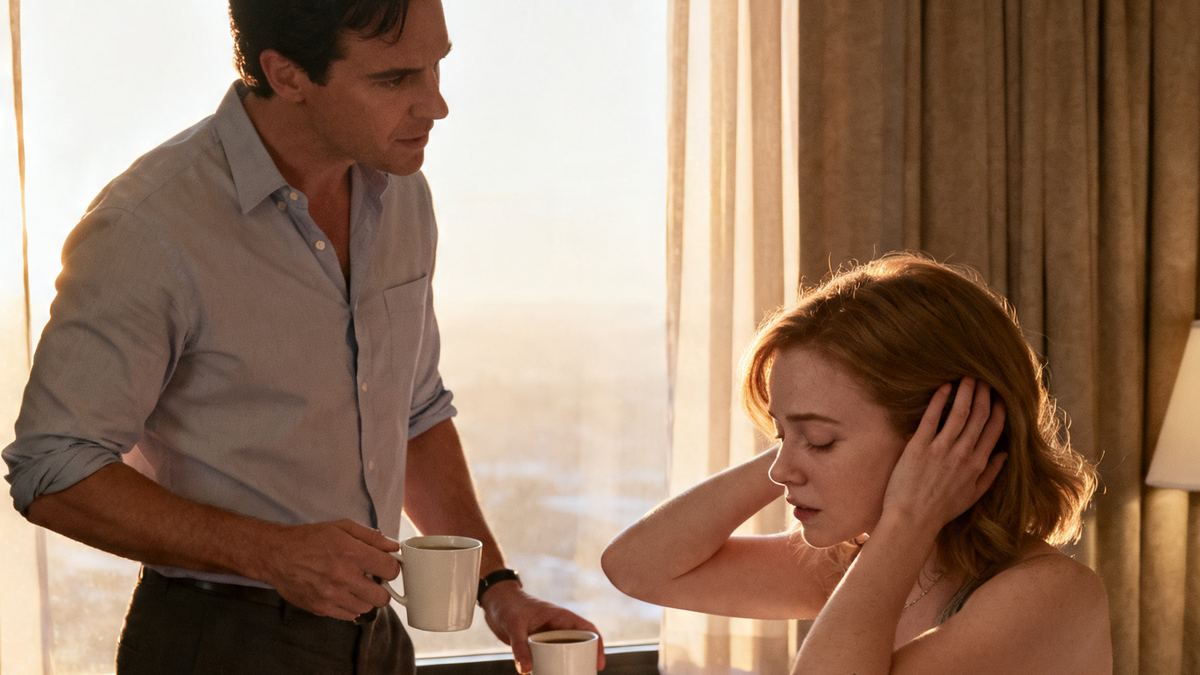
The door to the suite opened and there he was. Theodore Kane. Tall, dark-haired, wearing slacks and a button-down with the sleeves rolled to his forearms like he’d already been up for hours. He was holding two cups of coffee from that place on Michigan Avenue where a latte costs fourteen dollars.
“You’re awake,” he said. Not a question.
I opened my mouth and nothing came out. I pointed at the certificate. Then at him. Then at my ring. My hand was trembling so badly the gold caught the light and threw sparks on the wall.
“This isn’t real.”
He set one of the coffees on the nightstand next to the Advil. “It’s very real. We were married at 2:17 this morning. A licensed officiant administered the vows in this room. Your friend Gabriella’s cousin works for the county clerk’s office and expedited the filing.”
My brain was a fog machine. Scraps of memory surfaced and dissolved before I could grab them—the hotel hallway, an elevator, my phone in my hand, *his* face looking down at me with something I couldn’t name.
“I don’t remember any of this.”
Theo leaned against the dresser. “You arrived at my door at one in the morning. You were drunk, but functional. You had your phone. On it was a forensic accounting trail you’d been building for three months—bank statements, offshore shell companies, emails between our senior counsel, Trevor Blackwood, and three board members. They were structuring a scheme to sell off the company’s core assets to a shell corporation in the Caymans. The paper trail was designed to point directly at you as the mastermind.”
I felt the blood drain from my face. Trevor Blackwood. Twenty-year veteran of Kane Properties. My mentor when I’d started as a junior accountant three years ago. The man who’d given me access to the server logs because “you’re the only one I trust with the real numbers.”
That trust had been a leash. And I’d been too grateful to see it.
“You showed me everything,” Theo continued. His voice was maddeningly calm, but his knuckles were white around his coffee cup. “You said that if they knew what you’d found, you’d be dead by morning. Not fired—*dead*. These are men who’ve stolen forty million dollars. They have contacts. They have offshore security teams. And you, a twenty-eight-year-old staff accountant with a studio apartment and a rescue pit bull, had just become the only thing standing between them and a clean getaway.”
I pressed my palms into my eyes until I saw stars. “So I asked you to marry me? Like some kind of—what, protection racket?”
“You asked me to save your life.” His voice dropped. “You said you didn’t want to die for someone else’s greed. That you’d been stupid and brave and now you were terrified, and you didn’t know where else to go. And then you pointed out that as my wife, you’d have spousal privilege. You couldn’t be compelled to testify against me—and by extension, you’d have standing to file a protected whistleblower claim without being immediately arrested as a co-conspirator. You’d also inherit a voting seat on the trust that controls this company. Trevor couldn’t touch you.”
I lowered my hands. “And you just… said yes?”
“I said no. Twice.” A muscle in his jaw twitched. “I told you to sober up. I told you we’d handle it in the morning. And you said—” He stopped. Looked away.
“What did I say?”
He met my eyes again. “You said, ‘Please don’t let them make me disappear. I know you don’t owe me anything, but I’m asking anyway. Please.’” He took a breath. “And for reasons I’m still trying to understand, I believed you. I believed *in* you. You’d built a case against three of the most dangerous men in Chicago real estate, alone, in secret, with nothing but a laptop and late nights after everyone else went home. That kind of courage doesn’t come from nowhere.”
The silence in the room was enormous. Somewhere far below, a boat horn sounded on the river.
“What happens now?” I asked.
He checked his watch—a Patek Philippe, thin as a communion wafer. “In forty minutes, the board convenes for an emergency meeting. Trevor called it yesterday. He plans to present his ‘evidence’ of embezzlement and recommend that you be terminated and handed over to the FBI for prosecution. The board will vote. With his three allies, he has the numbers.”
“And if I walk in as your wife?”
The corner of his mouth lifted. It might have been a smile. “Then he has a problem. A spouse can’t be isolated and fired without cause. A spouse has legal standing to demand an independent audit. A spouse can call the FBI herself and offer a counter-narrative with full protection. He won’t just lose the vote—he’ll be exposed. And I’ll make sure he knows it.”
I swung my legs over the side of the bed. The room spun once, then steadied.
“I’m going to need clothes.”
“Lydia left a suit for you in the bathroom. Your size. She’s frighteningly competent.”
“And a toothbrush?”
“Three. She’s an overachiever.”
Twenty minutes later I stood in front of the mirror, dressed in a navy blazer and slacks that fit like they’d been tailored for me. My hair was pulled back in a knot so tight it hurt, but pain was good. Pain kept the panic at bay.
Theo appeared behind me in the reflection. He’d put on his jacket. The two of us looked like a corporate power couple from some glossy magazine spread. Strangers playing a part.
“One thing,” I said. “When we’re in there—if I freeze, if I can’t speak—”
“You won’t freeze.”
“You don’t know that.”
He stepped closer. “I know you walked into a lion’s den last night with nothing but a phone and a prayer and convinced a man who hasn’t trusted anyone in a decade to sign a marriage license at two in the morning. You’re not the freezing type.”
I turned to face him. “Why haven’t you trusted anyone?”
Something flickered behind his eyes—old pain, quickly buried. “That’s a conversation for another morning.”
“How many mornings are we going to have?”
“That depends entirely on you.” He held out his hand. “The boardroom is on the forty-second floor. The elevator takes ninety seconds. Use them to breathe.”
I took his hand. His palm was dry and warm and completely steady. We walked out of the suite, down the long corridor, and into the elevator.
The descent felt like a countdown.
When the doors opened on 42, the hallway was already buzzing. Assistants froze mid-step. A junior analyst dropped a stack of folders. We walked past them without slowing, Theo’s hand now resting at the small of my back—a light touch, but one that grounded me.
The boardroom doors were massive. Mahogany. Soundproof.
Theo pushed them open.
Twelve people around a table the size of a small boat. At the far end, mid-sentence, stood Trevor Blackwood. White hair, pink face, crocodile smile. A projector screen behind him displayed a chart with red arrows pointing accusingly at a single name: *Emily Winter*.
He stopped talking when he saw me.
“Miss Winter,” he said, recovering quickly. “I’m afraid this is a closed session. Security can escort you to HR where—”
“She’s not going anywhere.” Theo’s voice cut through the room like a blade through silk. He pulled out the chair at his right hand—the seat traditionally reserved for the CEO’s guest of honor. “Sit, Emily.”
I sat. The room inhaled collectively.
Trevor’s smile faltered. “Theo, with all due respect, this is highly irregular. This woman is the subject of a criminal referral to the U.S. Attorney’s office. Her presence here is a liability.”
“This woman,” Theo said, pulling a slim velvet box from his jacket pocket and placing it on the table, “is my wife. As of nine hours ago. Here’s the certificate. The clerk’s office can confirm it, though I’d prefer you not waste their time.”
The silence was absolute. Trevor’s face went through several colors—pink, white, gray. The three board members flanking him exchanged looks that belonged in a police lineup.
“You’re joking,” Trevor whispered.
“I don’t joke about marriage.” Theo circled the table slowly, the way a prosecutor approaches a witness. “And I don’t joke about fraud. Emily came to me last night with a complete forensic accounting of fourteen shell companies, routing through the Caymans and Cyprus, all funded by capital that ‘leaked’ from our redevelopment projects over the last eighteen months. The trail was designed to end at her desk—but the originating IP addresses trace directly to your home office in Winnetka, your vacation house in Vail, and Mr. Barrett’s server in Zurich.”
One of the board members—Barrett—made a choking sound.
“That’s absurd,” Trevor spat. “A fabrication by a desperate junior employee trying to save her own skin.”
“Then you won’t mind explaining it to the FBI.” Theo tapped his phone. Four times. The boardroom doors opened and three agents in dark suits walked in, badges out. A woman in the lead—tall, sharp-eyed, a federal prosecutor’s energy radiating off her.
“Mr. Theodore Kane contacted our office at 5 a.m.,” she said. “We’ve reviewed the evidence. Trevor Blackwood, Carlton Barrett, Marcus Yee—you’re under arrest for wire fraud, conspiracy to commit securities fraud, and obstruction of justice.”
Trevor backed away from the table, hands raised, voice cracking. “This is a mistake. I’ve been with this company for twenty years. I built this company.”
“You stole from this company,” Theo said quietly. “And you tried to destroy a woman who did nothing but her job well enough to catch you. You don’t get to play the victim.”
The agents moved in. Hands behind backs, cuffs clicking shut. The other board members sat frozen, some pale, some furious, all realizing the ground had just shifted permanently beneath their feet.
Trevor’s eyes found mine as he was led past. He didn’t look like a corporate titan anymore. He looked small and old and terrified.
“You,” he hissed. “You did this.”
“No,” I said. My voice came out steady. I had no idea where the steadiness was coming from. “You did. I just took notes.”
The doors swung shut behind him and his co-conspirators.
Theo turned to the remaining board members. “This company has been run by a cancer. The cancer is now removed. My wife will be joining the trust as a voting member, effective immediately. We’ll be initiating a full independent audit and restructuring. Anyone who has a problem with that can resign right now.”
Nobody moved.
“Good.” He turned to me. “Let’s go.”
We didn’t speak in the elevator. Didn’t speak walking down the hallway. Didn’t speak until we were alone in his office, fifty-two floors above the city, the lake glinting silver in the distance.
I walked to the window and pressed my forehead against the cold glass. My heart was still hammering.
“I can’t believe I did that.”
“Which part?” He was standing near his desk, not moving toward me, giving me space.
“All of it. Coming to you. Getting married. Sitting in that room while a man who could have destroyed me got led away in handcuffs.”
“You’ve been doing the hard part for months. Tonight was just the reveal.”
I turned around. “And what about us? Is there an ‘us’? Or is this just an extremely elaborate legal maneuver with rings?”
He was quiet for a long moment. Then he crossed the room and sat on the edge of his desk, closer to my level.
“Last night, when I said no the second time, you grabbed my wrist. You were shaking. And you said, ‘I’m not asking you to love me. I’m asking you to see me. I’m more than the girl who brings you spreadsheets. I’m more than the person they’re trying to frame. And I think you’re more than the man who hides in his office and scares everyone away. Just—see me.’” He paused. “I saw you. I saw someone who was terrified and still fighting. Someone who’d done something nearly impossible and still didn’t think she was worth saving. And I realized I didn’t want to live in a world where people like you get thrown away.”
My throat was tight. “I was really drunk.”
“You were really honest. It’s the same thing.”
I laughed—a short, surprised sound that turned into a hiccup. “So what do we do now?”
“We have options.” He reached into his jacket and pulled out a folded document. “This is a petition for annulment. Fully prepared. All you have to do is sign it and we pretend this never happened. I’ll still protect you through the transition. You’ll keep your job, your seat on the trust, everything you’ve earned. No strings.”
I looked at the paper. Then at him. “And the other option?”
“We stay married. We get dinner tonight—a real dinner, not a room-service tray. We talk. We tell each other things that aren’t about indictments or shell companies or who’s trying to destroy whom. We figure out if the two people who saw each other at two in the morning are still here in the daylight.”
The city hummed below us. Somewhere, a train was rattling over the Loop tracks.
“What’s your vote?” I asked.
“I’ve been alone for ten years,” he said. “By choice. By design. I thought it was easier. Safer. And then a junior accountant from my finance department broke into my suite at one a.m. and told me my own company was about to collapse and she was the only one who could prove it. She looked me in the eye and asked me to trust her. And I did. I don’t want to un-learn that.”
I walked over to him. Took the annulment papers. Held them for a moment.
Then I tore them in half.
“Dinner,” I said. “But nowhere fancy. I’ve had enough fourteen-dollar coffee to last a lifetime.”
His smile was small, almost shy—nothing like the man who’d commanded the boardroom an hour ago. “There’s a diner on Belmont. Open twenty-four hours. Bad lighting, better pancakes.”
“That sounds perfect.”
He reached out. Touched my hand—just the tips of his fingers against my knuckles. “I’m not promising this will be easy.”
“I’m not asking for easy.” I turned my hand over, let my palm rest against his. “I’m asking for real.”
“Then real is what you’ll get.”
We stood there for a moment, two people who’d started the day as strangers and were ending it as something else entirely—something still unnamed, still fragile, but breathing.
Outside, the wind off the lake pushed clouds across the sun. The towers of the Loop cast long shadows over the river. And in a glass office fifty-two floors above the pavement, a woman who’d been certain her life was over discovered it had only just begun.
Six months later, we stood on the roof of that same building on a warm September evening. The sky was orange and pink, the city spreading out beneath us like a lit circuit board. My pit bull, Gus, was sprawled on a blanket near the heat lamps, snoring.
Theo handed me a glass of wine. “No regrets?”
“Not one.” I took a sip. The wine was cold and crisp. “Though I still can’t remember our wedding.”
“Good. It was a terrible ceremony. You kept trying to negotiate the rings.”
“Negotiate how?”
“You wanted to keep them both.”
We laughed—the easy, full laugh of people who’d learned each other’s rhythms. The corporate conspiracy was ancient history. Trevor and his associates were awaiting trial. The company was solvent, restructured, transparent. And I’d started a foundation with my trust dividend to help whistleblowers afford legal protection.
But none of that was the important part. The important part was this: the way his hand fit into mine. The way he looked at me across a room full of strangers like I was the only fixed point in a spinning world. The way he’d told me, three weeks ago, in the kitchen of the Lincoln Park house we now shared, that he’d never expected to be happy and that I had rewritten his entire understanding of what a life could be.
“We should do it again,” I said.
He raised an eyebrow. “Do what again?”
“Get married. A real ceremony. One I’ll remember.”
He set down his glass. Turned to face me fully. “Emily Winter-Kane, are you proposing to me?”
“I think I am.”
He reached into his pocket. The gesture was so smooth, so practiced, that I knew he’d been carrying it for a while. A small velvet box. Inside, a ring—white gold, a diamond that wasn’t flashy but caught the fading light like a captured star.
“I was going to wait until our anniversary,” he said. “But you’ve always had a habit of getting there first.”
I held out my hand. Watched him slide the ring onto my finger beside the simple gold band from our first, forgotten wedding.
“This time,” I said, “we’re doing it sober.”
“Absolutely not.” He pulled me close. “You’re far more entertaining with a little mezcal in you.”
I kissed him on that rooftop, with the city beneath us and the first stars breaking through the evening sky, and I kissed him for everything we’d survived and everything we were about to build.
Below us, somewhere, a boat horn sounded on the river.
The city kept moving. And so did we.