I took the early shuttle from Pagosa Springs, so I got home a full day before they expected me. The knee was better—three weeks of mineral baths and PT had done more than the surgeon promised—so I left the wellness center with a clean bill of health and a quiet kind of hope. The drive up the mountain took two hours, winding through pines and the last of the autumn aspen, and by the time the van dropped me at the top of my gravel road, I was already imagining my own teakettle, my own reading chair, my own quiet bedroom with the view of the San Juans.
I rolled my little suitcase up the porch steps and stopped.
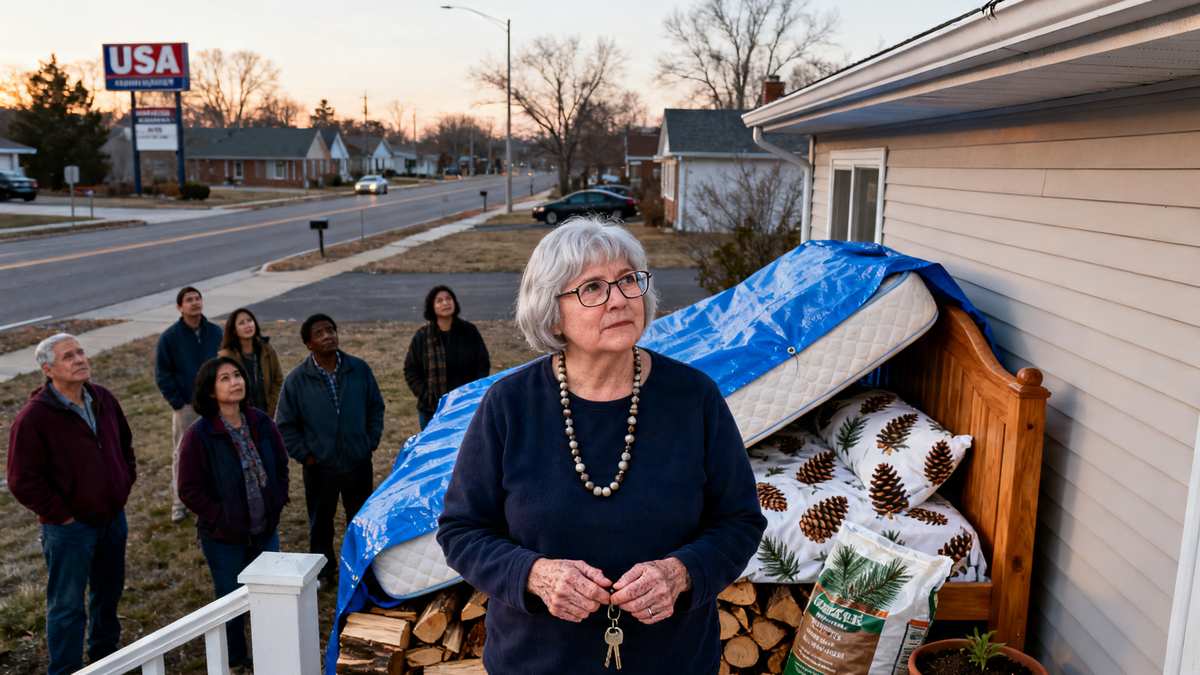
My bed was outside. The queen-size maple bed Mike and I bought the year after we married—the one with the carved acorn finials he touched up every spring—stood against the porch railing, wrapped in a blue tarp like a body waiting for the coroner. The headboard leaned against the wall, and the mattress, still wearing my flannel sheets printed with pinecones, was wedged between the firewood rack and a bag of potting soil.
For a long moment I just stood there, key in hand, listening to a chickadee scold from the gutter. Then I pushed open the front door.
The house smelled wrong: coffee and some kind of air-freshener plug-in, vanilla-scented, that I’d never bought. In the hallway, the little pinecone wreath I’d hung was gone. I walked past the living room—where a brand-new sofa bed sat in plastic wrap, still tagged—and stopped at the door to my room. The room that had been mine for thirty-two years.
Ryan, my son-in-law, had his back to me. He was on his knees under the window, using my old screwdriver to attach a cable management strip to the baseboard. Two wide monitors glared from what used to be my grandmother’s writing desk, now pushed up against the wall. The closet door was open: my clothes were gone, replaced by a filing cabinet. On the floor, my rose-colored rug was rolled up like a suspect at a crime scene.
Ryan wore noise-canceling headphones, the big kind. He didn’t hear me until I set my keys on the hall table.
He practically jumped out of his skin. “Barbara! You—I thought you weren’t back until tomorrow.”
“I came home a day early.” My voice sounded flatter than I felt.
He pulled off the headphones, gestured vaguely at the monitors. “We were gonna talk—Emily was going to call. We wanted it to be a nice surprise, you know? A new setup. The sofa’s the one you liked at Costco, the good model with the memory foam.”
“Emily knew about this?” I asked.
The pause told me everything. “It was… yeah. Her idea.”
That was the moment the shock turned into something colder. Ryan I could almost forgive—he was the man my daughter brought home six years ago, a decent enough guy who’d never quite stopped being a guest in my house. But Emily. My own daughter had decided to move my bed onto the porch without a word.
I am Barbara Turner, sixty-four years old, retired administrative secretary from the Durango school district. Mike died eight years ago next month, the cancer fast and mean. We’d bought this three-bedroom ranch house in ’92, when Emily was a toddler, and Mike redid every inch himself: the pine cabinets, the stone fireplace, the chandelier in the dining room with the etched glass shades. After he was gone, the house felt both too big and exactly the right size.
When Emily and Ryan asked to move in three years ago—“just until we save a down payment, Mom, maybe a year, max”—I didn’t blink. I gave them the master bedroom because it had its own bath. I took the smaller room at the end of the hall, the one with the window facing the mountains. My bed, my dresser, my books. Enough.
A year became two, then three. The down payment never materialized. Ryan switched jobs twice. Emily took a floral design certification that cost four thousand dollars. They traded in their Honda for a Subaru, went to Cabo for a friend’s wedding. “We’ll get serious about saving soon,” Emily always said. “We just need a little more time.”
I went to the knee retreat on a referral from my orthopedist, a three-week program covered by Medicare. For the first time in three years, I slept in a room where nobody ran a blender at ten p.m. for post-gym protein shakes. I left with a lighter step and a secret resolution to reclaim some corner of my life.
Then I came home and found my bed under a tarp.
I called Emily at the flower shop where she works part-time. She answered after three rings, breathy, in her customer voice. “Oh, hey, Mom. Ryan texted me. Listen, I was going to call tonight and explain…”
“Emily. My bed is on the porch.”
A beat. “I know. Okay, here’s the thing. Ryan got that promotion—the regional IT manager spot—but they’re strict about remote workers having a dedicated office with a door that closes. He can’t work from our bedroom anymore, I’m in and out all day, it doesn’t look professional. So we thought your room would be perfect. We bought you a new sofa bed, the good one. It’s in the living room, still in the plastic. You’ll have the whole living room to yourself, the fireplace, the big TV. It’s honestly more space.”
She said it all in one breath, like if she paused she’d have to hear how it sounded.
“You came into my house,” I said, “you took my bed out of my room, and you’re telling me all this over the phone.”
“Mom, don’t be dramatic. It’s not ‘taking.’ It’s reorganizing. We all live here now, we have to share.”
Share. We all live here. In my house.
I hung up and sat on the edge of the still-wrapped sofa. In the hallway, the cedar-lined hope chest Mike had built for me was shoved under the coat hooks, my photo albums piled on top. Nobody had asked.
That evening Emily came home with a bakery box from the place in town that makes my favorite cherry pie. She set it on the counter, cut slices, put the kettle on. The ritual of apology: I’d seen it a hundred times since she was a teenager.
“Mom, sit. Let’s talk normally.”
I sat. The pie was good. The tea was hot. Emily’s voice was soft, the same voice she’d used to ask for a horse when she was twelve.
“Here’s the reality,” she said. “If Ryan doesn’t have a proper office, they’ll make him go back to in-person, with a commute to Denver twice a week. He’ll lose hours, we’ll burn through savings on gas, and we’ll never get out of here. We can’t afford a place on our own. You know what rents are like. A one-bedroom in town costs more than our whole car payment.”
I set down my fork. “Then maybe you shouldn’t have gone to Cabo. Or bought the Subaru. Or delayed saving for three years.”
Her face tightened. “That’s not fair.”
“Fair?” I could feel my pulse in my ears. “What’s not fair is finding my bed on the porch and being told I’m being dramatic.”
She looked away, and for a second I saw the girl who used to hide her bad report cards under the cereal box. Then her expression hardened into something more adult and careless.
“Look, if Ryan can’t have the office, we’ll have to move out,” she said. “But we have nowhere to go. We’d be homeless. Is that what you want? Your daughter and son-in-law living out of their car because you didn’t want to sleep on a perfectly good fold-out?”
The old knot tightened under my sternum. Every time Emily played the helplessness card, I’d folded. I’d been raised to believe a mother never turns her child away—my own mother would roll over in her grave if I did. But my mother never fell asleep on a sofa bed in her own living room while her son-in-law claimed her space.
I didn’t answer that night. I made up the new sofa, which actually was comfortable, and I lay staring at the chandelier Mike had hung over the dining table twenty-five years ago. One of the glass shades still had the faint crack I’d sealed with super glue. If Mike were alive, no one would have dared move that bed. Not because he was scary—he was the gentlest man I’d ever known—but because with him around, certain things didn’t need to be said out loud.
In the morning, I went into the kitchen while Ryan was in the shower and walked into the room that used to be mine. I’d grabbed a watering can before I even knew what I was doing. On the windowsill, one of my African violets still sat—the only survivor. The leaves were drooping, the soil cracked like dry riverbed. I gave it water, slowly, until it darkened to the color of good earth.
Then I called my friend Nancy, who lives two streets over and used to be a real estate agent. We talked for forty minutes, mostly her listening while I laid out the mess. She said the same thing I already knew: my name is on the deed, I hold all the cards legally, but the emotional part was stickier than a pine sap trap.
At ten-thirty, Emily called from the shop. “Hey, Mom. How’d you sleep? The sofa good?”
I could hear the false brightness in her voice. The same tone she used when she wanted me to say everything was fine.
“It’s a fine sofa,” I said. “I’m still trying to figure out why I’m sleeping on it.”
Silence. Then, “Mom, I don’t have time to fight right now—my boss is looking at me.”
“Then come home early. We’re going to have a real conversation tonight. All three of us.”
I hung up before she could deflect again. My hand was shaking, but the violet on the windowsill looked just a little straighter.
That evening, I was ready. I’d spent the afternoon moving my things back into my room—just the small stuff, my books, my framed photo of Mike. At six o’clock, I asked Ryan and Emily to sit at the kitchen table. I served the rest of the cherry pie, and I told them the news.
“Tomorrow, the bed moves back into my room,” I said. “I’m not asking. I’m telling.”
Emily’s mouth dropped open. “Mom, we already set everything up—Ryan has a video call Monday morning, his boss will see the background…”
“He can take the call from the living room, or from your bedroom. Or he can go to the library. I’m not debating this.”
Ryan sat very still, toying with a spoon. He had the decency to look embarrassed, but he didn’t say a word.
“So we just—what, we’re supposed to move out?” Emily’s voice was high and tight. “You’d really kick us out over a room?”
“I’m not kicking you out,” I said, and I kept my voice as steady as a mountain pond. “But I am reclaiming my home. You’re adults. You have jobs. You have thirty days to find a place. I’ll help with the security deposit—I’d rather give you money than give up my room.”
Emily burst into tears. Real tears, not the performative kind. She accused me of being cold, of not understanding how hard things are for their generation, of choosing a bedroom over my own daughter. Part of me wanted to fold right there, to say never mind, just stay. But I looked at the chandelier, and I thought of Mike, and I didn’t.
Ryan finally spoke. “She’s right, Em. We should have asked.” He looked at me. “We’ll be out by the end of the month.”
Emily stormed off to their bedroom and slammed the door hard enough to rattle the glass in the china cabinet. I didn’t follow her. I walked into my room—still full of their office clutter, but mine—and I closed the door. The violet on the sill had perked up, one tiny new leaf uncurling.
The next morning, Ryan helped a neighbor’s teenage son move the bed back inside. I washed the pinecone sheets and made the bed with the quilt my grandmother sewed. By noon, the room smelled like lavender and old wood, the way it used to. I opened the window wide and let the mountain air pour in, cold and piney and clean.
That night, I climbed into my own bed for the first time in twenty-four days. Down the hall, I could hear Emily and Ryan packing boxes, their voices muffled but not angry—something had shifted, some necessary break. I didn’t feel triumphant. I felt like I’d been walking with a stone in my shoe for three years and had finally sat down to shake it out.
Outside the window, the peaks were dark against a star-filled sky, and a light wind moved through the ponderosas. I turned off the lamp and listened to the sound of my own house settling around me. For the first time since Mike died, it sounded like mine.