I’m 61 years old, a widower going on eight years now. My name’s Gary, live up in Boone, North Carolina — a little house with a slanting porch and a view of Grandfather Mountain when the fog lifts. After my wife passed, the kids scattered: my daughter teaches at a college in Oregon, my son manages a brewery in Asheville. They call on Sundays, stop by twice a year if I’m lucky. Most evenings I sat on the back deck listening to the neighbor’s hound bark at squirrels, a glass of iced tea going watery in my hand. I figured this was just how the story ended — quiet, small, predictable.
Then back in March I was scrolling through Facebook, killing time, and there she was: Eleanor. My high school sweetheart from Hendersonville, the girl I took to the junior prom in a rented powder-blue tux. She’d moved away junior year after her dad got a job at a mill in Gastonia. We swore we’d write. We didn’t. Forty-some years evaporated like that.
I sent her a message. Just a “hey, remember me?” She answered within the hour. Her profile picture showed a woman with silver hair pinned up, eyes still that same deep brown. We started messaging, then the phone calls stretched past midnight. Finally I drove three hours to meet her for coffee at a little place off the Blue Ridge Parkway — I brought a handful of wild black-eyed Susans I’d picked from the roadside. She laughed and said nobody’d given her flowers in twenty years. Her fingers trembled when she took them.
Everything after that felt like a movie on fast-forward. I’d drive down every weekend, we’d walk through the trails at Moses Cone Manor, share a slice of sweet potato pie at the diner, talk about everything and nothing. One evening in June, standing by my pickup — a beat-up ’98 Ford F-150 — I just said it: “So, what do you think? Get married? Tackle the rest of this thing together?”
She didn’t look away. She said, “Alright, Gary.”
We married in a tiny white chapel in Valle Crucis, no more than thirty people. I wore my one suit, she wore an ivory dress that skimmed her ankles, lace at the collar. The air smelled like dry leaves and woodsmoke. My son played bartender, my daughter got teary. Everyone said we looked like a pair of teenagers playing house. But I felt a strange tightness in my chest all day.
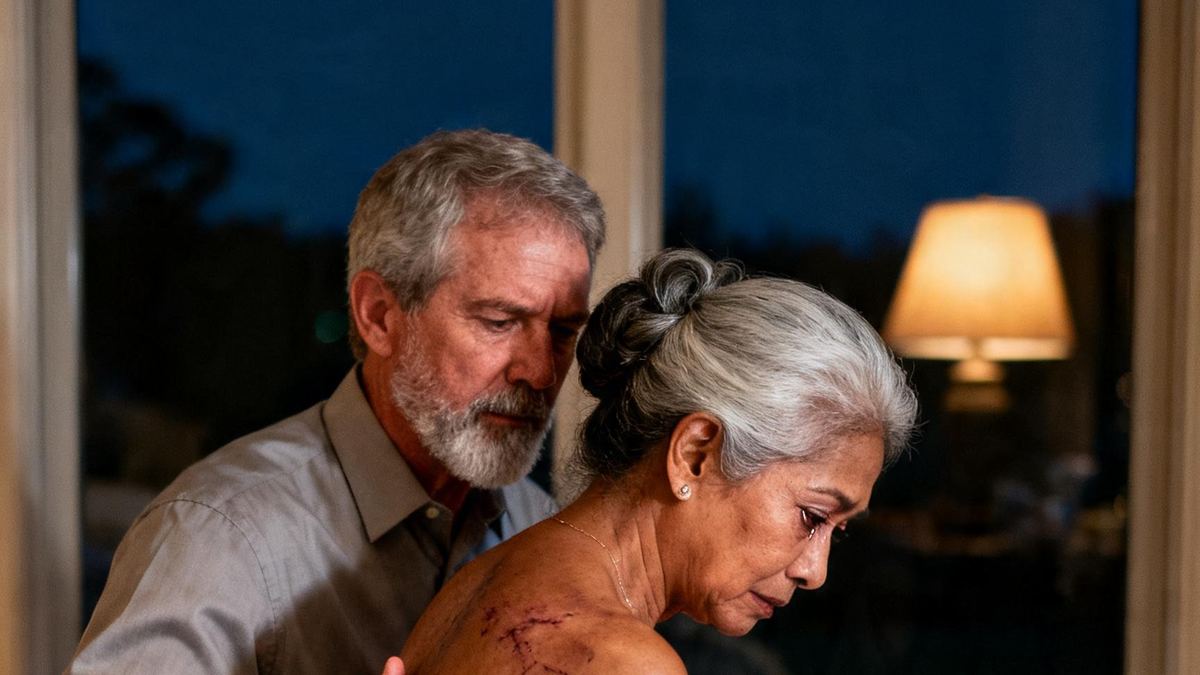
Later, back at my house, I shut the door and poured us a couple of glasses of cheap champagne. Eleanor stood by the window, the last light on the mountain ridges turning everything orange. I stepped up behind her, breath catching like some green kid. My fingers found the top button of her dress.
The fabric slipped down her back.
My whole body locked.
A web of scars spread across her shoulders and spine — raised white lines, some thin as thread, others wide and puckered. I saw what looked like an old cigarette burn near her right shoulder blade. Her lower back carried a crooked ridge of bone that had healed wrong.
My hand dropped. I tried to speak, but all that came out was a dry croak: “What… honey, what happened?”
She pulled the dress back up, not hurried, not ashamed. Just tired. She sat on the edge of the bed and folded her hands in her lap.
“I guess you need to know.”
Her first husband, a man named Richard, owned a chain of car dealerships in Charlotte. Big personality, big donor to the church, shook every hand he met. At home he turned into a different person. It started with words — you’re stupid, you’re fat, nobody else would want you. Escalated to shoves, then fists, then whatever was within reach. Once a cast-iron skillet. Another time he ground a cigar out on her arm because the roast was overdone.
Her son, Martin, tried to intervene when he was fifteen — got a broken jaw for it. He works construction in Texas now, calls her every Christmas. Her daughter Kayla left for the University of Washington at seventeen and never came back; they text, but there’s a wall there even I can feel.
The hospital visits became routine. Eleanor would tell the nurses she’d fallen off a ladder, slipped on the ice. The doctors never pressed. Five or six years ago, Richard dropped dead of a stroke in his office, a pen still in his hand. She’d been free ever since, living on her own in a little apartment, working part-time at an animal clinic. Peaceful. Quiet. Until me.
She stopped talking. The room was so still I could hear the refrigerator humming in the kitchen.
I couldn’t swallow. My hands were shaking. I poured myself a bourbon from the bottle on the dresser and walked barefoot out to the deck. The air was sharp, October-cold. The dog next door let out one low bark, then silence.
Standing there, looking at the black outline of the ridge, I thought about my own marriage — twenty-six years with a woman who died holding my hand in a hospital bed. We’d had our fights, sure, slammed doors, days of silence. But I never laid a hand on her. The idea of doing what Eleanor’s husband had done… it made me sick to my stomach.
I stayed outside maybe five minutes, maybe fifty. The bourbon sat untouched on the railing.
Then I went back inside.
She was right where I’d left her, staring at the floorboards. The wedding dress lay pooled around her hips. Without a word I sat next to her, the mattress sagging under my weight. I reached over and put my palm flat on her back, right over the worst of the scars. She flinched — a small, practiced flinch — and then went still.
“Listen to me,” I said. “You’re done with all that. You understand? Done. No one’s raising a hand to you ever again as long as I’m breathing.”
Her shoulders started to shake. I pulled the quilt up around her and just sat there, my hand not moving. She cried for a long time, the kind of crying that doesn’t make sound.
We didn’t sleep that night. Sometime around three in the morning she leaned her head against my shoulder and said, “I was so scared you’d see and… leave.”
“Not a chance,” I told her.
That was six months ago now. The house feels different. Warmer. We drink coffee on the deck in the mornings and watch the mist crawl up the valley. I fixed up the spare room into a little art studio for her — she’s taken up watercolors, painting the mountain laurel and rhododendron that bloom in our yard. I catch her humming while she stirs the stew sometimes, a sound so ordinary it almost breaks something loose in my chest.
Last week we drove up to Beacon Heights for a short hike. The wind was biting, the leaves all gone. I was struggling with the trail map when I felt her hand slip into mine — no hesitation, no flinch. She just stood there, looking out at the endless blue hills, her grip easy and sure.
I folded the map and held on.
That’s it. That’s the whole story. No big lesson, no neat bow. Just two people on a mountain, the wind pushing at their backs, and a silence that finally feels safe.