For a long time, I couldn’t bring myself to tell anyone. Whenever a friend asked, “How are things with Victor?” I’d smile and say, “Wonderful. Absolutely perfect.” I was lying through my teeth. I need to get this out now, without smoothing over the ugly parts, because if I don’t, it’ll just sit inside me like a cold stone forever.
I met him at my sister’s fiftieth birthday party—she married a guy named Tom, and Victor was a friend of his from the office. I didn’t even catch who he was at first. He just stood there looking distinguished, salt-and-pepper hair, a good shirt, talking to people with an easy confidence. At my age, you don’t exactly get showered with compliments every day, so when a man like that walks up, pours you a glass of wine, asks about your day, and laughs at your jokes, your head spins a little. Mine sure did. We started texting, then dating. He courted me the old-fashioned way: nice restaurants, flowers, a voice on the phone every night saying, “How was your day, beautiful?” I was a fool in love, completely melted. After a month—just a single month—he said, “Move in with me. Why make life harder than it is?”
At the time, my own two-bedroom condo was occupied by my daughter Olivia, her husband Mike, and their four-year-old boy Leo. I thought, why not? The place is mine, they need the space, and buying a house these days is pure fantasy for young people. I figured I was doing a good deed for everyone, myself included. So I moved in.
The first three months were a fairy tale. Honest to God, they were. He took me to movies, cooked dinner a few times, kept telling me, “Irene, you deserve the best.” I bragged to all my girlfriends: finally, in my mid-fifties, I’d found my person. Looking back, I realize how naive I was. Or maybe not naive—just a woman in her fifties desperate to believe that happiness could still find her.
Then something shifted. It didn’t happen overnight; it crept in slowly, like dampness seeping into a basement. At first it was small. I work as a cashier at a hardware store. I’m on my feet all day; by six p.m. my back is screaming, my ankles are swollen. I’d come home to a sink full of yesterday’s and today’s dishes, a greasy stovetop, laundry spilling out of the basket. I’d say, “Victor, could you maybe wash a few plates?” And he’d look at me like I’d asked him to donate a kidney. “Irene, I’m a man. I worked all day. I had calls, negotiations. You’re the woman; the house is your responsibility. My mother raised me that way, and I’m used to it.” I told myself, okay, he’s set in his ways, we’ll get past it.
But it got worse fast. He started finding fault with everything. The soup was underseasoned: “Did your mother not teach you to cook?” A shirt wasn’t ironed to his liking: “My ex-wife pressed shirts perfectly. You can’t seem to do anything right.” He compared me to her constantly, and I never came out on top. She was a better cook, a better housekeeper, had a better figure “for her age.” Imagine hearing that every single day. Then came the looks, the tone. There’s a difference between a person who’s annoyed and a person who actually wants to humiliate you. Victor was the second kind. He’d glance at me when I stood at the stove after my shift, still in my work smock, exhausted, and say, “Well, don’t you look gorgeous.” Or the classic: I’d get home around seven, my feet throbbing, and he’d be lounging on the couch with the remote, saying, “You didn’t clean up again? You’re lazy to the core, Irene. Just lazy by nature.” This from a man who was retired, sat around all day, and occasionally took a “consulting call.”
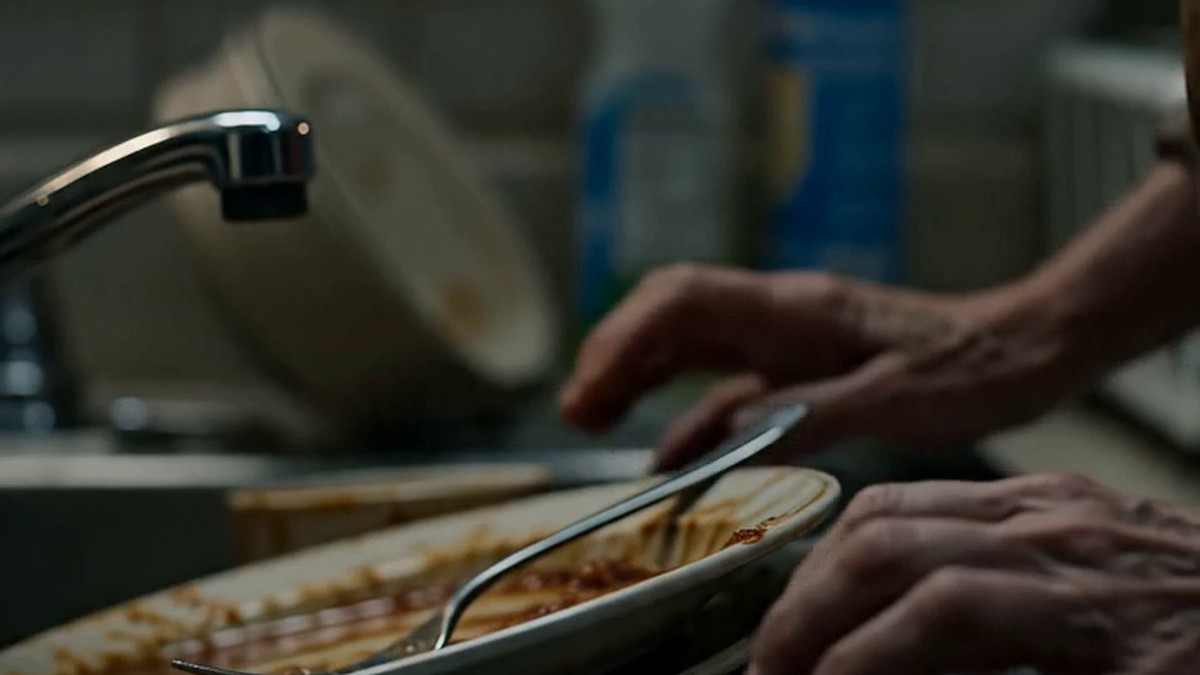
The dishes became my personal form of torture. He absolutely left every single dirty plate, every pan, every spoon in the sink on purpose, like a deliberate display: look, I won’t lift a finger. If I didn’t get to them immediately, he’d launch into a monologue about what a slob I was, how a real woman would never let the kitchen look like a pigsty, how he’d be mortified if anyone dropped by and saw the mess. He never gave me a dime for groceries. I had moved in with essentially one suitcase, and I bought all the food on my cashier’s salary—which, as you can imagine, isn’t exactly Olympic money. Meanwhile, he’d buy himself a new phone or go on a fishing trip with his buddies without blinking. If I mentioned I was short that month, I’d hear, “Well, what did you expect? I never signed up to support you. Live within your means.”
Some words still loop in my head when I can’t sleep. Once I asked him to help carry heavy shopping bags up to the fifth floor because the elevator was broken. He said, “My back hurts. I’m not a pack mule. You chose to buy all that stuff.” His back, notably, worked perfectly fine when he loaded up his heavy fishing gear at four in the morning.
The strangest part was how charming he could be around other people. We’d go to a dinner with his friends, and he’d be all gallantry: holding my chair, calling me “my dear Irene,” praising my cooking. The second the door shut behind us, that ice-cold, disdainful face would slide back into place. And you realize nobody would believe you if you told them, because they only ever saw the mask.
I started blaming myself. Maybe I really was a lousy housekeeper. Maybe I wasn’t trying hard enough. That’s the part that scares me most when I remember—how fast I started to believe the things he said, no matter how wildly unfair they were. Drip by drip, he wore down my confidence until I had none left.
I got sick once, a fever of almost 102, flat on my back. He paced around the bedroom and said, “Great. Now who’s going to cook? Who’s going to clean? Real convenient for you to get sick right now.” I lay there thinking, Lord, is it normal for someone to talk to you this way when you can barely lift your head?
My daughter Olivia sensed something was wrong. She called and said, “Mom, you sound so down these days. Is everything okay?” I laughed it off—just tired from work. I was too ashamed to admit the truth. I was fifty-five years old, a grown woman, and I’d walked straight into the same trap an eighteen-year-old might fall into. Who wants to admit that?
What finally broke me open was a completely ordinary evening. I walked in after a brutal shift, my head pounding, my legs aching. The kitchen was still a wreck from breakfast: a skillet caked with grease, mugs everywhere, crumbs all over the counter, and Victor planted in front of the TV. No shouting, no drama—I just said quietly, “Victor, would it kill you to wash a single dish? I just got home. Give me five minutes to breathe.” He stood up, walked into the kitchen, stared at that skillet, then looked at me, almost smiling. “Irene, that’s why you’re here. To cook, to clean, to take care of the house. If you don’t like it, the door’s open. Nobody’s keeping you by force.”
Something inside me clicked. Not tears, not hysterics—just cold, crystalline clarity. There it was, spelled out in plain language. I wasn’t a partner, I wasn’t loved—I was the help. Someone to humiliate whenever he felt like it, and I was supposed to feel guilty on top of it.
I didn’t argue. I didn’t beg for an apology. I walked into the bedroom, pulled out the same suitcase I’d arrived with a year and a half earlier, and started packing. At first he thought I was just throwing a tantrum, something that would blow over in an hour. Then he saw me folding my clothes with steady hands, and his tone turned silky. “Okay, okay, I’m sorry. I didn’t mean it like that. Let’s talk.”
But I was done talking. I’d stored up enough words, enough wounds, that no single evening could undo them.
I zipped the suitcase, grabbed my purse, and headed for the door. That’s when he stepped in front of me, blocking the hallway. His face had shifted again, not soft now, but tight with contempt. “You’re really going to walk out over a few dirty dishes? Be reasonable, Irene. Where are you going to go? Back to live with your daughter like a refugee?” He let out a short laugh. “You’ll be back by Monday, and you’ll have a lot of groveling to do.”
I set the suitcase down and met his eyes. My voice didn’t shake. “No, Victor. This refugee is going home—to a home where people don’t treat her like trash. You can keep your dishes, your insults, and your very comfortable couch. And just so we’re clear: I’m not lazy. I’m exhausted from carrying you on my back for eighteen months.” His mouth opened, but nothing came out. He was used to me crumbling, not standing my ground.
“My daughter called me a dozen times, worried sick,” I went on. “My grandson asked if I was sad because I never laugh anymore. You want to know when I lost myself? Right here, in this apartment, being told I was worthless every single day. You didn’t break me, Victor. You showed me exactly what I’m worth to someone who sees women as appliances. Now move.”
For a second I saw something flicker in his eyes—not guilt, more like panic that his free maid was actually walking out. He didn’t move. So I pulled out my phone and said, “Either you let me pass, or I call my son-in-law to come up here with me. Your choice.”
He stepped aside, the bluster draining out of him. I walked to the elevator without looking back. In the parking lot, I called Olivia. “I’m coming home, sweetheart. I’ll explain everything. Don’t be scared.” She just said, “Mom, I’ve been waiting for this call. Come home.”
Mike met me at the door, took my suitcase without a single question, and made me a cup of tea. Leo crawled into my lap and said, “Grammy, you don’t have to be sad anymore.” I cried, but they were clean tears, not shameful ones.
Two weeks later, I had to go back to Victor’s apartment for some documents and a few boxes I’d left behind. I asked Mike to come with me, not because I was afraid, but because I wanted a witness. Victor answered the door looking haggard, the kitchen behind him stacked with dishes so high they practically made a monument. He tried the charm again: “Irene, I’ve been thinking. We both made mistakes. Maybe we can start over.”
I looked past him at the mess, at the empty takeout containers, and felt nothing but a quiet, steady relief. “The only mistake I made was staying long enough to let you convince me I was nothing. I’m not nothing. I never was.” I picked up my box, and Mike put a firm hand on my shoulder. Victor’s face twisted, but he didn’t say a word as we left.
That was six months ago. Today I wake up in my own home, surrounded by people who say “thank you” and “please” and “how are you really feeling?” I still work hard, but when I come home, there’s no dread coiled in my stomach. I go for walks with Leo. I planted a little herb garden on the balcony. I even took a watercolor class, something I’d shelved years ago because a certain voice kept telling me I wasn’t talented enough. That voice is gone now.
Here’s the truth I almost forgot: it is never too late to start over. Not at fifty-five, not at seventy, not ever. If someone tells you love means being valued only for what you can do for them—if the words “thank you” and “I’m sorry” aren’t in their vocabulary—run. Leave the dishes, leave the guilt, and walk right back to yourself. I did. And the woman I found waiting for me? She wasn’t lazy at all. She was just buried under someone else’s smallness, and she dug herself out.