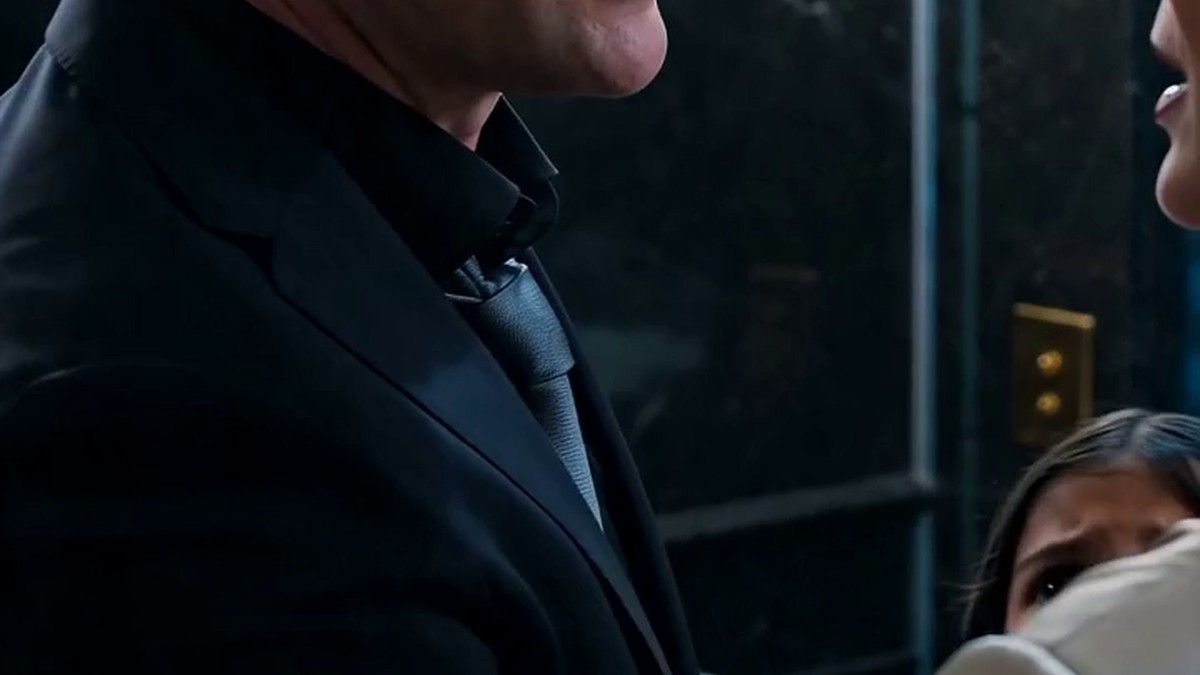
Jack Morgan needed a moment to breathe. The Ashford estate’s charity gala was a glittering cage of champagne flutes, forced laughter, and the kind of old-money arrogance that clung to the walls like cigar smoke. He slipped down a marble hallway, pushed open a heavy door, and stepped into a guest bathroom that smelled of gardenias and cold stone. The lights were low, the floors a chessboard of polished obsidian and ivory. He loosened his tie, catching his reflection in a gold-rimmed mirror—a tired man in a black suit, a fortune he never asked for, and a vague sense that he was sleepwalking through his own life.
A choked, wet sound cut through the silence. Not a faucet drip. A child.
Jack turned. Near the grand vanity, a small girl in a simple pink dress stood on tiptoes at a marble sink. She couldn’t have been more than seven. Dark hair clung to her damp cheeks. Her tiny hands scrubbed a white linen napkin against the basin with a ferocity that made her whole body tremble. Water sloshed over the edge, soaking her sleeves, but she didn’t seem to notice. She was whispering something, a frantic prayer.
“Limpia … por favor, limpia …”
Jack closed the distance quietly, his leather shoes soundless on the stone. He knelt, bringing himself to her level. Up close, he saw the napkin was already pristine—no stain, no mark—yet she worked as if her life depended on it. The raw redness of her knuckles sent a stab of something unfamiliar through his chest.
“Hey, sweetheart,” he said, voice so low it was almost a rumble. “What’s going on?”
She flinched but didn’t stop scrubbing. Her words tumbled out in a desperate rush, half English, half the Spanish of her mother’s kitchen songs. “Si queda limpia, nos dejan quedarnos—if it’s clean, they let us stay. Please, señor, I can do it. Don’t let them put us out. I’ll get it clean, lo juro.”
The plea wrapped around his heart and squeezed. Jack reached out, not to grab the napkin, but to gently encircle her thin wrists with his palms. The scrubbing halted. She looked up, and he saw the same bottomless fear he’d once seen in a younger version of himself, crouched under a table during one of his parents’ vicious fights.
“What’s your name?” he asked, his thumbs tracing a soothing circle on her pulse.
“Luna.” Her eyes were lakes of old sorrow.
Before he could say more, the bathroom door swung wide. Victoria Ashford swept in like a blade, her champagne satin gown rustling with cold disapproval. Behind her loomed Mr. Grimes, the estate’s silver-haired butler, his mustache twitching in disdain. Victoria’s gaze flicked over the wet floor, the scrubbed but empty sink, and the girl frozen under Jack’s protective hands.
“Well, this is charming,” Victoria said, her voice honeyed with venom. She turned the full weight of her attention on Luna. “Where is your mother, child? I told her to remove you from the premises hours ago.”
Luna shrank, a wounded animal. Jack rose swiftly, placing his body between the women and the little girl. His frame blocked Victoria’s view as effectively as a slammed door. The air crackled with unspoken challenge.
“Mrs. Ashford,” he said calmly, “I think the child needs a moment.”
Victoria’s eyes narrowed. “Mr. Morgan, this is a domestic matter and none of your concern. That woman is employed here, and she has been dismissed. Her brat is trespassing.”
Jack felt the girl’s fingers clutch the back of his jacket. He didn’t break eye contact with his hostess. Instead, something molten and resolute settled in his bones. He turned his head just enough to speak over his shoulder, voice gentle but absolute.
“Luna, take me to your mama. Right now.”
The girl’s breath hitched, but then she nodded and slipped out from behind him, darting past Victoria as if the woman were a serpent coiled to strike. Jack followed, ignoring the butler’s sputtered protest and the vicious glare that promised consequences. He let the heavy door swing shut behind them, leaving the ice and gardenias behind.
Luna led him through a maze of service corridors, down a narrow staircase that smelled of bleach and old wood. The opulence thinned into bare bulbs and patched plaster. She pushed open a final door into a cramped basement room barely larger than a closet. There, on a thin cot, lay a woman swallowed by blankets, her face a mask of exhaustion and fever-flush. Dark hair, so like her daughter’s, was plastered to her temples. A half-empty glass of water sat on the floor beside a framed photo of a smiling Luna.
“Rosa,” Luna whispered, touching her mother’s cheek. “Mamá, wake up.”
The woman stirred, and when her glassy eyes focused on Jack’s suit and his kind, worried face, raw panic seized her. She tried to sit up, a tangle of apologies already forming in Spanish—begging not to be discarded on the street, explaining that her daughter was just trying to help, that she would work off any debt.
Jack sank to one knee beside the cot. “Please be still. I’m not here to hurt you.” He kept his voice low, his hands open and visible. “Tell me what happened. All of it.”
Rosa’s story spilled out between shivers. She had worked at the Ashford estate for three years, often bringing Luna when the girl’s school let out early. That afternoon, Victoria had accused Luna of staining a family heirloom napkin during a pre-gala linen inspection—a stain Rosa could not see, even with magnifying glasses. Victoria, furious, had immediately terminated Rosa’s employment and ordered them both to leave the staff quarters by midnight. With no family in the country and her pay held back for “damages,” Rosa, already running a high fever, had collapsed. Luna, overhearing the ultimatum, had seized the napkin and fled to the bathroom, believing with every atom of her small soul that if she could just make the cloth perfectly clean, the nightmare would stop.
Jack listened, his jaw tightening until his teeth ached. The napkin was a lie—a convenient excuse to toss a vulnerable woman and her child onto the curb, likely because Rosa had recently asked for a modest raise to afford Luna’s medication, or perhaps simply because Victoria Ashford enjoyed the cruelty of it. He had seen this poison before.
He stood. “Rosa, I want you to rest. No one is leaving tonight. I’m going to have a conversation with your employer, and I promise you, Luna will never have to scrub a napkin again to save her home.”
Luna looked up at him, hope fragile as spun glass. Jack placed the now-crumpled linen napkin—still spotless—into his breast pocket, then held out his hand to the little girl. “Come with me, mija. You’ve been brave long enough. Let’s show them how brave.”
Hand in hand, they climbed back into the glittering world above.
The ballroom was a sea of expensive perfume and careful smiles. Victoria Ashford was at the center, a crystal flute raised as she toasted the foundation’s “generous donors.” Her husband, Harold Ashford, a portly man with a politician’s smile, stood beside her. When Jack entered with Luna, still in her damp pink dress, the chatter stuttered and died. Every eye latched onto the incongruous pair—the boyish billionaire and the disheveled child.
Victoria’s smile froze into porcelain. “Mr. Morgan, how … quaint of you to bring the help’s child to the party. Did she finish her little laundry project?”
A few nervous laughs twitched around the room. Jack didn’t laugh. He walked directly to Victoria, pulling the napkin from his pocket and holding it high enough for everyone to see.
“I have a question for you, Victoria. Show me the stain. Right now. With all of us as witnesses. You accused this child of ruining a priceless heirloom. So point to the damage. We’ll wait.”
Silence so complete he could hear Luna’s shallow breathing. Victoria’s eyes flickered with the calculation of a cornered snake. She recovered quickly, her tone dripping with condescension. “This is absurd. The stain is on the underside, and you’ve clearly mishandled it. The damage is done. The decision stands—the maid is fired for insubordination, and I won’t have my guests subjected to this white knight theatrics.”
Jack took another step closer, lowering his voice so that only she and a handful of nearby guests could hear, but the menace in it carried to every corner. “Theatrics? I’ll give you theatrics, Victoria. I’m about to call every news outlet that covers my foundation’s donations and explain how the host of tonight’s charity gala tried to evict a sick woman and her child on a phantom stain. You depend on my goodwill to keep your charities afloat. One phone call, and I choke off every dime. Not a single donor in this room will stand with you when they hear the truth.”
Harold stepped forward, his tanned face now ashen. “Now, Jack, let’s not be rash. I’m sure this is a misunderstanding. Victoria, perhaps we could reconsider—”
Jack didn’t let him finish. “There’s no misunderstanding. Rosa will be reinstated with full pay retroactive, and her living quarters will remain hers for as long as she needs them—rent-free, with a year’s salary in escrow to cover medical costs and her daughter’s education. And there will be a public apology to that child, here, tonight.”
Victoria’s composure shattered into a jagged line of fury. “You can’t dictate to me in my own home—”
Luna, who had been hiding half behind Jack’s leg, suddenly stepped forward. Her voice was tiny but clear, cutting through the tension like a bell. “Mi mamá didn’t do anything wrong. She just got sick. That’s not fair. You’re mean.”
The ballroom seemed to exhale. Harold Ashford’s eyes, seeing the judgment of a hundred wealthy faces, made a quick, pragmatic calculation. He moved to his wife and placed a firm hand on her arm. “We will, of course, correct this terrible error. My wife was misinformed by the staff. I’ll personally ensure Rosa and her daughter are given every accommodation, including the severance package Mr. Morgan suggests. Let’s not ruin a wonderful evening with further unpleasantness.”
Victoria’s mouth opened and closed like a landed fish, but no sound came. Harold’s grip on her arm tightened into a subtle warning. The butler, Mr. Grimes, had vanished into the crowd, his role in the theater suddenly abandoned.
Jack looked down at Luna, whose eyes were now wide with bewildered triumph. He knelt and handed her the napkin. “You kept this clean all on your own. Not because the Ashfords needed it to be, but because you loved your mom enough to try the impossible. That’s a different kind of magic entirely. You hold onto that.”
Luna clutched the napkin to her chest, a wobbly smile breaking through the tears.
Later that night, long after the gala had crumbled into whispered scandal, Jack sat in the basement room with Rosa. A doctor had already visited, courtesy of Harold’s desperate damage control. Rosa slept peacefully for the first time in days, an IV drip attached to her arm. Luna was curled up beside her, one hand still gripping her mother’s, the other holding the now-useless napkin like a talisman.
Jack watched them and felt something crack open inside him—a loneliness he’d armored against with boardrooms and art auctions. He realized he didn’t want to leave them in that basement, not under the same roof as Victoria Ashford’s resentment.
The next morning, he made a quiet offer. His estate, forty miles north, had a guest house that had stood empty for years. It needed laughter, needed the smell of home cooking. He offered Rosa a position as caretaker—not a maid, but a partner in creating something new, with benefits, a school for Luna, and no one who would ever threaten them again.
Rosa wept. Luna tackled him in a hug that almost knocked his coffee out of his hand.
A week later, they stood on the porch of the guest house, a golden autumn light painting the hills. Luna, wearing a new dress the color of lavender, ran through the grass, chasing a butterfly. Jack stood beside Rosa, who was still pale but smiling.
“She’s been asking if you’ll teach her to read English better,” Rosa said softly. “She says you tell stories with your eyes.”
Jack watched the girl twirl and laugh, the napkin long forgotten but its lesson carved deep. He had arrived at that gala thinking he was the hero of nothing and no one. But Luna’s desperate plea, echoed in marble and moonlight, had rewritten the script of his life.
“Then we’d better start tonight,” he said, and for the first time in years, the smile on his face felt genuinely his.