Sam Walker never expected a homecoming party, but Margaret Walker wasn’t the kind of mother who let a son slip back into town unnoticed. She’d rented out the entire patio at the Hitching Post, strung up fairy lights, and cornered half of Cedar Ridge into showing up by noon. Sam, still carrying the dust of five years working derricks in West Texas, stood at the edge of the crowd with a beer that was getting warm in his hand.
He’d ducked a dozen handshakes and a few too-personal questions about his love life when Trevor Holt found him by the fence. Trev had barely changed since high school—same easy grin, same thick forearms from splitting firewood, same way of leaning in too close when he had something heavy to drop.
“You heard about Emily?” Trev asked, and the grin was gone.
Sam’s stomach tightened. Emily Braxton. Even the name still hit like the first cold snap of fall. Auburn hair that caught every light, brown eyes that made him forget his locker combination more than once. He’d been a quiet, gangly kid who fixed his truck by feel and never found the guts to speak to her without getting tongue-tied.
“What about her?” Sam said.
Trev stared at the gravel lot. “Car wreck. Two winters ago. Up on Wolf Creek Pass. Her dad was driving—Tom didn’t make it. Em… she’s in a chair now.”
The beer bottle stopped halfway to Sam’s mouth.
Trev kicked a stone. “They’re lining up a big surgery. Might help. Might not. She’s living with her mom off Barrett Road.”
Before Sam could find words, Trev blurted out the rest—fast, like he’d been holding it too long. “Listen, man, I should’ve told you years ago. After prom, I tried to ask Emily out. She turned me down flat. Started asking about you. Said she’d been hoping you’d talk to her all night, but you never did. She was too proud to make the first move herself. I… I never passed it on. I was so pissed she picked you, some invisible kid, that I buried it.”
Sam’s knuckles went white around the bottle. He didn’t say a word to Trev. He set the beer on the nearest table, grabbed his keys from his mother’s kitchen counter, and drove.
The Braxton house was a white clapboard with a ramp built over the front steps. Sam killed the engine and sat in the truck for ten minutes, heart slamming against his ribs like it was eighteen years old again. Finally, he knocked.
Martha Braxton opened the door. Her eyes widened. She remembered him—the quiet boy who fixed her daughter’s bicycle chain once after school. She didn’t ask why he was there. She just led him into the living room.
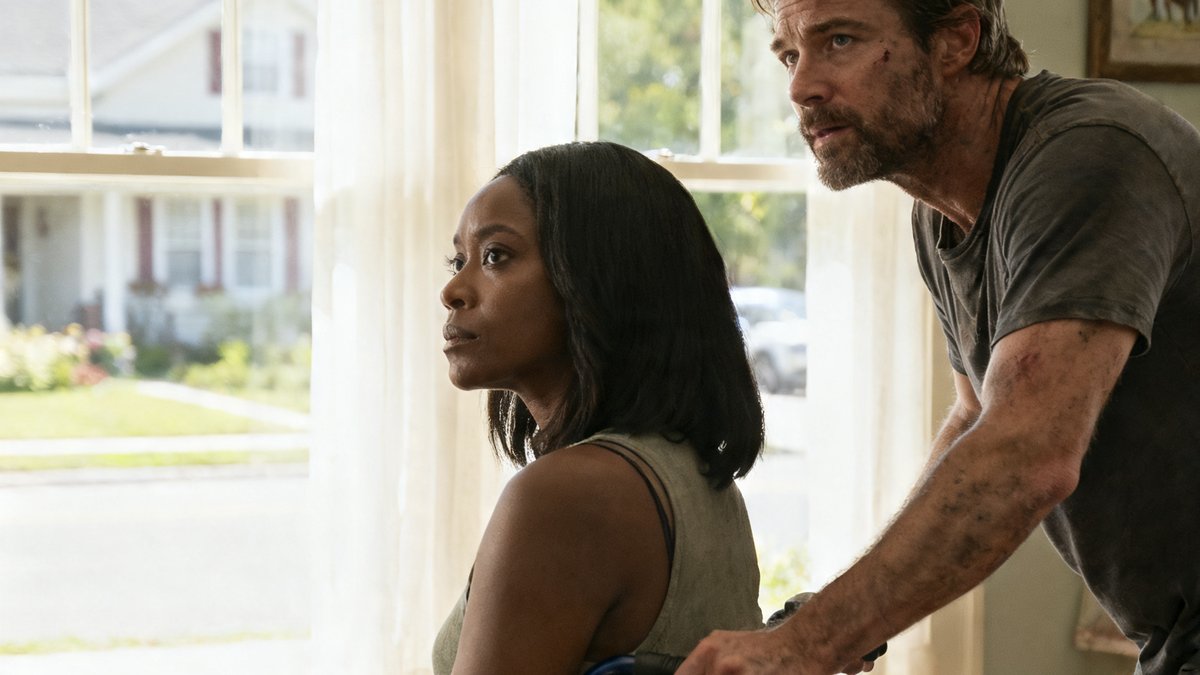
Emily sat by the bay window in a wheelchair, a wool blanket across her lap even though the afternoon was warm. Her hair was chin-length now, her face thinner. But the eyes were unchanged—deep and cautious and burning.
“Sam.” Her voice was flat. “You’re a long way from wherever you’ve been.”
He didn’t move closer. “I just heard.”
She let out a bitter laugh. “And you came running. What, you collect broken things now?”
The words sliced, but he’d earned them. He dragged a footstool over and sat so their eyes met level. “You were never a broken thing to me, Emily. Not then. Not now.”
“Stop.” She turned her face to the window. “Don’t come in here with some eleventh-hour guilt trip.”
“I’m not here out of guilt.” He swallowed. “I’m here because I’ve been an idiot for twelve years. I had a crush on you from the first day of ninth grade. Every time you walked into a room, I forgot how to breathe. But I was convinced someone like you would never look at someone like me. So I acted like you were invisible. And I’ve kicked myself every single day since.”
The room went dead silent. Emily’s hands trembled on the blanket. She didn’t look at him. “You’re just saying that because you feel sorry for me.”
“I’m saying it because I’m tired of being a coward.”
He stood up. “I’m coming back tomorrow. You don’t have to talk to me. You can tell me to get lost. But I’ll be here.”
She didn’t answer. He left, and the next morning he was back with two cups of coffee from the Waffle House and a beat-up copy of a novel he remembered her carrying in biology. She took the coffee.
He came every day that summer. He’d push her chair along the river trail, describing the way the cottonwoods were shedding, the funny shape of clouds, anything to fill the silence she still meted out in small doses. He drove her to PT appointments and learned the names of her medications. When she lashed out, he let the anger roll over him. When she cried, he handed her a tissue and didn’t look away.
Three months in, she finally let him hold her hand while they waited for the surgeon. “What if I never walk again?” she whispered.
“Then I’ll still be here.”
“For how long?”
“As long as you let me.”
The surgery in Denver took six hours. The recovery took a year. Sam bought a house near her mother’s place and installed ramps and a roll-in shower he built himself. He held her shaking legs through water therapy and let her dig her nails into his arms when she stood for the first time without the rails. When she took three halting steps across the kitchen floor, he caught her and they both cried into each other’s shoulders.
They married in the little chapel by the creek, only a handful of guests. Emily walked to him on her own two feet, slow and unsteady but upright. Sam didn’t bother wiping his eyes.
A year later, the other shoe dropped. A specialist in Grand Junction confirmed what the accident had stolen: the internal damage was too extensive. She couldn’t carry a child.
Emily shut herself in the bedroom that night. When Sam finally got the door open, she was sitting on the floor with a photo album open to their wedding day. “You deserve a real family,” she said, not looking at him. “A wife who can give you a child. You can still go find one.”
He knelt and closed the album. “My real family started the day you let me stay. I’m not going anywhere.”
Weeks passed with the subject untouched. Then one evening, Emily set her book down and said into the quiet, “A family doesn’t have to start in a hospital. Somewhere out there is a kid who needs us as much as we need them.”
Sam didn’t need another word.
The county adoption office in Durango was a cheerful place with crayon drawings on the walls. Their social worker, a kind woman named Joan, led them to a sunlit playroom after months of paperwork and home visits. “Take your time,” she said. “There’s no pressure today.”
A few children played with blocks and stuffed toys. Sam’s eyes swept the room and stopped. In the far corner, a small girl sat alone on a floor mat. She couldn’t have been more than four. She cradled a doll with yarn hair and watched the newcomers with quiet intensity.
Her own hair was a cascade of auburn curls, lit like copper in the afternoon light.
Emily froze. Her fingers dug into Sam’s arm.
The girl stood up, walked over with tiny, sure steps, and planted herself right in front of Emily. Big brown eyes searched her face. “Are you here for me?” she asked.
Emily’s legs gave out—not from weakness, but from the weight of the moment. She dropped to her knees and took the girl’s hands, tears spilling freely. “Yes,” she breathed. “We’ve been looking for you a really long time.”
The girl wrapped her arms around Emily’s neck and held tight. Sam stood over them, one hand resting on his wife’s shoulder, not trusting his voice.
That fall, their house filled with the sound of a child’s laughter. The little auburn-haired wonder, whose name was now Lily Braxton-Walker, chased falling leaves in the backyard while Sam carved a pumpkin on the porch. Emily wheeled herself out to watch, but soon she stood up from the chair—she didn’t need it much anymore—and joined the chase.
Sam leaned against the porch railing, listening to Lily shriek with joy every time a leaf eluded her mother’s grasp. The mountain dusk settled around them, cool and fragrant with pine. He didn’t think about the years they’d lost, or the friend who’d stolen his chance, or the road that nearly took her away.
All he heard was the music of now.