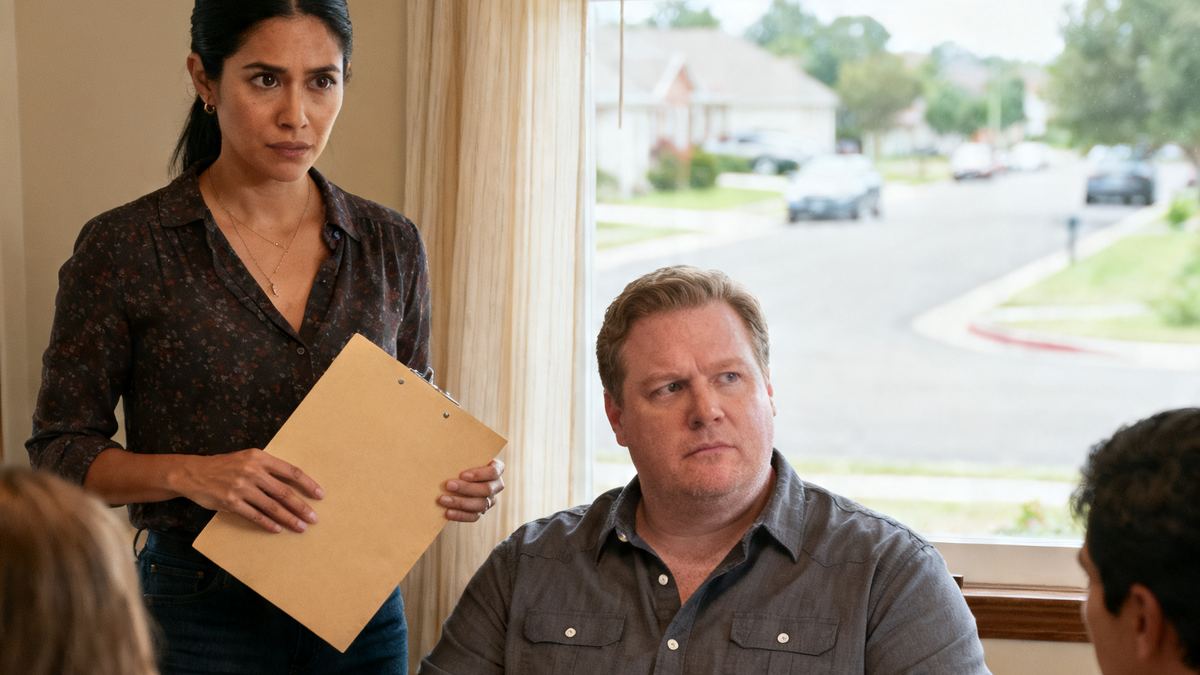
Victoria set the stack of documents on the dining table with a practiced sigh. Outside, a cold Denver rain streaked the windows, blurring the mountains into a gray smear. She spoke as if she were reading a grocery list.
“The house, the savings, your father’s Roth IRA, the life insurance payout… it comes to just over 1.2 million.” She paused and glanced at my older brother Derek, who was perched on the edge of her velvet sofa like a man waiting for a bus. “Your father’s final instructions were clear. Everything goes to Derek.”
A silence thick as wet wool settled over the room. Derek lowered his head, the corner of his mouth twitching upward for half a second before he flattened it. Beside him, his wife Jenna couldn’t stop her heels from bouncing—a sharp, jittery click against the hardwood floor.
Mom reached under the table and pulled out a small wooden box, the same one Dad used to keep his cufflinks in. She opened it. Inside lay his old stainless-steel wristwatch, the one he’d worn every day since I was in middle school. The crystal was scratched to hell, and the leather strap had cracked along the crease where his thumb always rested.
“He wanted you to have this,” Mom said, pushing the box toward me. “Just this.”
I picked up the watch. When my fingers brushed the caseback, I felt a faint groove near the edge—a line so thin it could have been a scratch. But it was too straight. I said nothing. Just nodded.
“Fine.”
Mom blinked. She hadn’t expected me to fold that fast. Neither had Jenna, who practically lunged forward with a pen that still had a price tag stuck to the clip.
“Here you go, Emily.” Her voice was dripping with honey. “This one writes real smooth.”
I read every page of the waiver. Six pages. All of them said the same thing: I, Emily Torres, was voluntarily surrendering any claim to my father’s estate in exchange for one old watch. The relatives scattered around the living room—Aunt Carol, Uncle Mike, a couple of cousins—nursed their coffee and pretended not to see me. No one met my eyes. No one said a word.
Derek cleared his throat. “Em, this was what Dad wanted. I know you sacrificed a lot, but… don’t make this harder than it needs to be.”
His knuckles were white around the leather bag that held the freshly signed property deeds.
I took the pen. Signed my name. The moment the ink stopped, Jenna snatched the papers and clutched them to her chest like a fumbled football.
Mom exhaled. “That’s settled, then. We’re still family.” She patted my shoulder on her way to the kitchen. “Your father loved that watch. It suits you.”
Not “I’m sorry.” Not “This isn’t fair.” Just “it suits you.”
1.2 million dollars for the son. A worn-out Timex for the daughter.
I slid the watch into my pocket and let the weight of it tap against my hip with every step toward the front door.
—
The rain had turned to sleet. I didn’t bother saying goodbye to the relatives.
On the bus ride back to my studio apartment in Aurora, I kept my hand wrapped around the watch. I remembered the last month in the oncology ward—the antiseptic burn in my nose, the plastic chair I’d slept in for nearly eight months, the way the nurses would ask, “Is your brother coming today?” and I’d just shake my head.
I’d sold my Honda Civic to cover the gap when Dad’s insurance stopped covering the private room. I’d drained my savings. Maxed out two credit cards. Derek showed up exactly four times: once on Dad’s birthday, twice when Mom guilted him into it, and once with a real estate agent to “check something” in the garage.
Now he had the house.
But those weren’t the memories that crowded my head as I unlocked my apartment door. What I kept replaying was the moment three weeks before Dad died. He’d gripped my wrist with a strength I didn’t think he still had, unstrapped the watch, and pressed it into my palm. His voice was paper-thin.
“When the time comes… don’t lose this.”
“Why, Dad?” I asked.
He smiled. His eyes were tired but clear. “Some things people hide to keep promises, not money.”
At the time, I thought the morphine was talking. Now, sitting on my secondhand couch with sleet tapping the window, I wasn’t so sure.
I turned the watch over. That hairline groove I’d felt at Mom’s house—it wasn’t a scratch. It was a seam. Near the bottom edge, a tiny screw sat ever so slightly raised, as if someone had been in a hurry when they tightened it.
My hands shook as I found a dime in my jacket pocket and used its edge like a screwdriver. The first screw gave. The second. The caseback lifted with a soft pop.
Inside, tucked between the quartz movement and the steel lid, was a folded square of onion-skin paper, so thin I could see the shadow of my own thumb through it. I eased it out. Unfolded it.
The handwriting was Dad’s—a little shakier than I remembered, but unmistakable.
*Em,*
*If you’re reading this, I’m gone, and they’ve already tried to push you out. I’m sorry I couldn’t fix it while I was alive, but I made sure you’d have what you deserve. Take this watch to the FirstBank branch on 16th Street. Ask for Marta at the vault desk. Show her the watch. She’ll know.*
*I love you more than the whole damn inheritance, kid.*
*— Dad*
I read it three times. Then I read it again, my eyes blurring so much I had to blink the words back into focus. I ended up laughing—a raw, wet sound in an empty apartment—because Dad had spent his last clear days scribbling secret notes while Mom and Derek were out “running errands,” and neither of them had a clue.
I barely slept.
The next morning, I put on my cleanest blouse, tucked the watch and the note into my bag, and took the 15 bus downtown. The sleet had stopped, leaving Denver bright and brittle under a low winter sun. The FirstBank building smelled like floor wax and old paper. I asked for Marta.
Marta was a solid woman in her sixties with bifocals on a chain and the kind of no-nonsense stare that could make a CEO squirm. When I placed Dad’s watch on her desk, she didn’t ask for ID. She just nodded, led me to a private room, and retrieved a long metal box—a safe-deposit box, number 117.
She left me alone with it.
Inside, there was a manila envelope. I slid out the contents.
A deed. A four-unit apartment building over on East Colfax, purchased in my name five years ago. I remembered Dad saying he’d “made a small investment” around that time—he’d been intentionally vague. The property was paid off free and clear. Below the deed, a letter from a property management company that had been handling tenants and maintenance for half a decade, with a healthy cash reserve that had been accruing in a separate account under my name. The current balance: just over $310,000.
But that wasn’t what stole my breath.
Clipped to the back of the deed was a stack of printed bank statements. Dad’s joint account with Derek—the one that was supposed to cover his medical bills, the nursing, the experimental treatments I’d gone into debt for. The statements showed a series of wire transfers. February 3rd. February 17th. March 1st. All within the two months before Dad died, when he’d been too weak to even hold a phone. Each transfer moved exactly $67,000 from the joint account into a private account Derek had opened in Cheyenne.
$201,000, vacuumed out while Dad was lying in a hospital bed, half-conscious. Signed with a forged digital signature.
Dad had known. He must have found out just before he slipped away, and instead of a courtroom battle he didn’t have the strength for, he left me the one thing Derek and Mom would never think to look at.
I sat in that windowless room for a long time, the weight of the watch suddenly lighter on my wrist.
—
Three days later, Mom called to invite me for Sunday dinner.
“Just family,” she said, her tone breezy. “Derek and Jenna are bringing the kids. You should come.”
She was doing it again—pretending nothing had happened, that the paperwork was just paperwork, that I’d keep showing up like a loyal dog. The old Emily would have swallowed it. The new one booked an Uber and arrived with a folder tucked under her arm.
Dinner was roast chicken and scalloped potatoes, all of Dad’s favorites. Derek was sitting at the head of the table—in Dad’s chair—and Jenna was spooning seconds onto his plate before he’d finished firsts. Mom was laughing at something Derek’s five-year-old had said, her wine glass already half-empty.
I walked in and set the folder on the table, right next to the gravy boat.
Jenna noticed first. “What’s that?”
“Digital copies of wire transfers,” I said, keeping my voice even. “From Dad’s account to yours, Derek. About two hundred grand, withdrawn over six weeks. While Dad couldn’t speak. While I was selling my car.”
Derek’s fork stopped mid-air. The color drained from his face in a way I’d only ever seen in movies. Mom’s wine glass hit the table with a crack.
“That’s insane.” Jenna laughed, but it came out like a broken whistle. “You’re just bitter because you got nothing.”
“I got Dad’s watch,” I said. “And inside it, the location of a safe-deposit box he set up just for me. Funny, right? The one thing you didn’t bother to pry open.”
I opened the folder and pushed the top sheet toward Derek. The account number, the routing number, the amounts, the dates. I’d highlighted the forged signature. His signature, too neat to be a dying man’s.
Mom stared at the paper, her mouth opening and closing. “Emily, I didn’t know—”
“You knew enough,” I said. “You knew there was more than a watch, and you still made sure I signed away everything.”
I didn’t yell. I didn’t cry. I just stood there while the silence turned into something unbearable. Derek looked like he was about to be sick. Jenna grabbed his arm, but he shook her off. The kids, mercifully, were in the living room watching a cartoon.
“I’m not going to sue you,” I said finally. “Dad didn’t want that. But I’m also not going to sit at this table and pretend we’re a family anymore.”
I turned to leave. Mom’s voice cracked behind me. “Emily, wait.”
I didn’t wait. I walked out the front door, the same one I’d walked out of a week earlier with a pocket full of nothing but an old watch. Only this time, I could feel the weight of the apartment building deed in my bag, the six-figure cash reserve, the knowledge that my father had seen me—really seen me—when no one else did.
The Uber slid up to the curb. I got in, and as the house shrank in the rear window, I pulled Dad’s watch from my pocket. I strapped it onto my wrist for the first time. The cracked leather was still warm from my hand.
I touched the crystal. Through the scratches, the second hand was ticking smooth and steady, like it had never stopped.