I almost didn’t stop for the penny. It was face down on the cracked sidewalk of South Congress Avenue, dull and scuffed. The lunch crowd pushed past me, AirPods in, eyes on phones. But I thought of Gramps, the way he’d never pass one by. He’d bend down, grunt a little, dust it off on his jeans, and hand it to me. “Don’t ignore the small stuff, kiddo. That’s where the big stuff starts.” I could almost smell the peppermint he always carried. So I knelt, scooped up the penny, and dropped it into my jacket pocket. A guy on a skateboard rolled by and grinned. “My abuela does that too – says it’s good karma.” I laughed, and he disappeared down the block. That tiny moment nudged something loose in me.
Later, I ducked into a coffee shop on East 6th to escape the late June heat. The place was jammed. I found a stool by the window and opened my book, but the noise from a group playing Uno nearby made it hard to focus. Near the register, an older woman in a floral blouse was fumbling with her wallet. Her face flushed. “I’m sorry, dear,” she said to the barista. “I thought I had a ten. It must be in the car.” The barista held her oat milk latte and looked around helplessly. The woman’s order was less than seven bucks, but she was short over two. She started to turn away.
“I’ve got this,” I said, stepping up and tapping my card. She blinked at me, eyes watery. “Oh, you don’t have to, really.” “I want to,” I said. It was nothing – just a couple of dollars. She smiled, the deep kind that folds the skin around her eyes, and carried her drink to a table. I went back to my book and forgot all about it.
Until three Saturdays later at the Mueller Farmers Market. I was picking through a crate of heirloom tomatoes when a tap on my shoulder made me jump. It was the same woman, holding a brown paper bag closed with a ribbon. “I was hoping I’d bump into you,” she said, breathless. “You’re the one from the coffee shop, right? I’m Eleanor.” She handed me the bag. Inside were six lumpy, golden-brown oatmeal raisin cookies, still warm. “I baked these this morning. A thank-you is always better homemade, my Henry used to say.” Her husband, I’d learn later, passed away four years ago.
We ended up sitting on the edge of a planter, talking. She told me she’d been baking from Henry’s old recipe box because it kept the house feeling less empty. I told her about Gramps and the pennies. “Then we’re two peas in a pod,” she said. Before we parted, she asked, “Do you bake? I help run a little baking group Thursday evenings at the rec center on Manor Road. It’s nothing fancy – just a bunch of us trying not to burn the place down. You’d like it.”
I almost said no. I wasn’t a baker. The last time I used an oven, I set the toaster on fire. But her face was so hopeful, and something about that penny still felt lucky in my pocket. So I went.
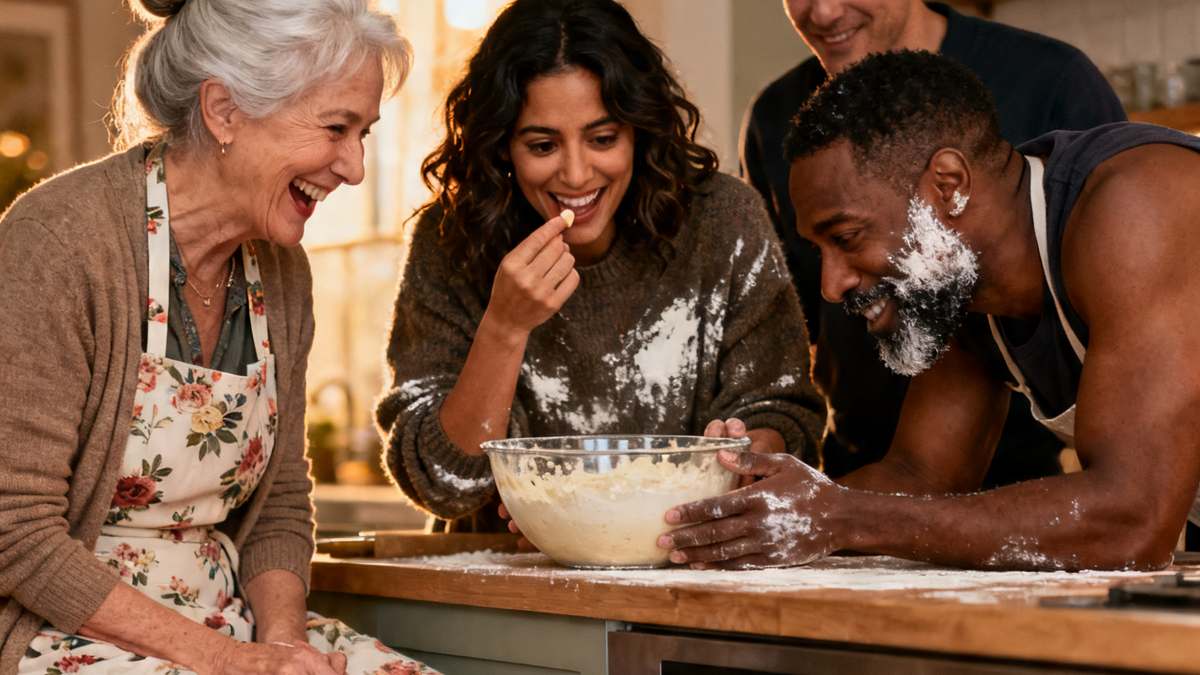
That Thursday, the rec center kitchen smelled like yeast and vanilla. Two long tables held a mess of flour, butter-stained recipe cards, and bowls in every size. About a dozen people, ranging from a college kid to a couple in their eighties, were already laughing and measuring things wrong. Eleanor presided from a stool, not really baking, just coaching and teasing. “Baking is mostly courage,” she said when I stared at the ingredients for banana bread. She was right. My loaf came out lopsided, like a hill after an earthquake. “Tastes better than it looks!” yelled a guy named Marco, and everyone cracked up. We sliced every completed loaf and shared bites, passing around jams and honey. That night, I left sticky-fingered and strangely light.
Soon, Eleanor announced a new idea: the extra breads, muffins, and cookies would go to the volunteers at the animal shelter down the street. “Those folks work miracles with stray dogs, and they deserve something sweet.” Every Thursday after cleanup, a small crew of us would walk over with boxes tied with twine, each one carrying a handwritten note: *For all you do.* No pictures, no social media. Just the smell of fresh pumpkin bread and the sound of tails thumping against kennels. One evening, a shelter worker named Carla told us, “Thursdays are my staff’s favorite day. You have no idea.”
I caught Eleanor’s eye, and she winked. “See? Small stuff,” she mouthed. I thought again of Gramps, and my throat tightened.
By the time autumn painted the trees, the baking club had swelled to over twenty regulars. Somebody built a communal recipe box shaped like a little house. A retired teacher designed cards with space for the story behind each recipe. Stories became the real currency. A blondie recipe came from a great-grandmother in Boerne who made them during the Depression. A sourdough starter travelled across three states in a jar. One card had cocoa smudges because the family always baked with their toddler on the counter. We weren’t just exchanging food – we were exchanging lives.
Then Eleanor had another plan: a pie social in Zilker Park. “Bring one pie, one chair, and whoever you like.” Word spread through Nextdoor and coffee shop bulletin boards. The day was golden, cool. Tables sagged under apple, pecan, blueberry, cherry, and a wild card key lime with a meringue taller than a beehive. A mariachi band from a neighbor’s backyard drifted over. Kids raced around with faces painted like tigers. I watched a man in a suit, who’d clearly come straight from work, shyly sample a slice of chess pie and then write down the baker’s number. People who’d only ever waved now hugged.
A young woman in a faded hoodie approached Eleanor during a lull. “You don’t know me, but my nana used to make a Dutch apple pie like that every Thanksgiving. She passed in March. I haven’t baked since.” Eleanor took her hand. “Come next Thursday. We’ll bake one together.” The woman, whose name I later learned was Drea, did. She showed up the next week trembling but determined. By her third session, she’d brought her nana’s handwritten recipe, and we all helped her crack the apples. The first bite brought tears, but the good kind.
The last Thursday before Christmas, Eleanor gave each of us a tiny red envelope. Inside: a single shiny penny taped to a card. On the front, in her shaky cursive, were my grandfather’s words: “Don’t ignore the small stuff.” On the back, she’d written: “You gave me a little kindness in a coffee shop, and it gave me more Thursdays than I can count. Thank you for seeing me.” I had to blink fast.
That penny lives now in a small jar on my kitchen windowsill, next to the spice rack. Every morning, when the Texas sun hits it, I remember the moment I almost didn’t stop. I remember Gramps, his big laugh, the way he turned a piece of copper into a lesson. And I remember how a simple coffee shop shortcut turned into oat milk lattes, oatmeal cookies, and a family I built one Thursday at a time. Now, I still pick up every penny I see. Passersby probably think I’m cheap. But I know that each one is a starting line, a door that opens onto something bigger.
Small change, it turns out, can make you rich.