I crossed the Missouri state line with the windows down and the radio off, every mile thick with hope. My son Michael had called six hours earlier, his voice cracking like cheap plastic. “Mom… he’s here. Come now.” I was in the car before sunrise, a half-packed bag rattling in the passenger seat, still in my gardening jeans. Fourteen hours from St. Louis to Denver with only gas-station coffee and the image of a tiny face I’d never seen.
The hospital smelled of antiseptic and stale flowers. Room 312. I paused at the door, heart thudding, and there was Michael, thirty-four years old and suddenly a father. His wife Sarah was propped against pillows, her face the color of oatmeal, but smiling. In his arms was a newborn, wrapped like a burrito in a blue blanket. Michael turned, and our eyes met.
“Meet your grandson,” he whispered.
He placed the baby into my arms. The weight of him—barely seven pounds—settled into my elbows as if he’d always belonged there. Dark hair peeked from the blanket, a scrunched little face, fingers curled like tiny seashells. I sobbed so hard my glasses fogged up. “Hello, sweetheart,” I managed. “I’m your grandma. I’m finally here.”
Michael laughed, rubbing his red-rimmed eyes. Sarah reached over and squeezed my hand. We were a perfect little portrait, a family reborn. I didn’t notice the missing details—the room bare of balloons, no “It’s a Boy” sign, no stack of diapers. I was too busy memorizing the soft spot on his head and the way his mouth made a tiny “o” when he yawned.
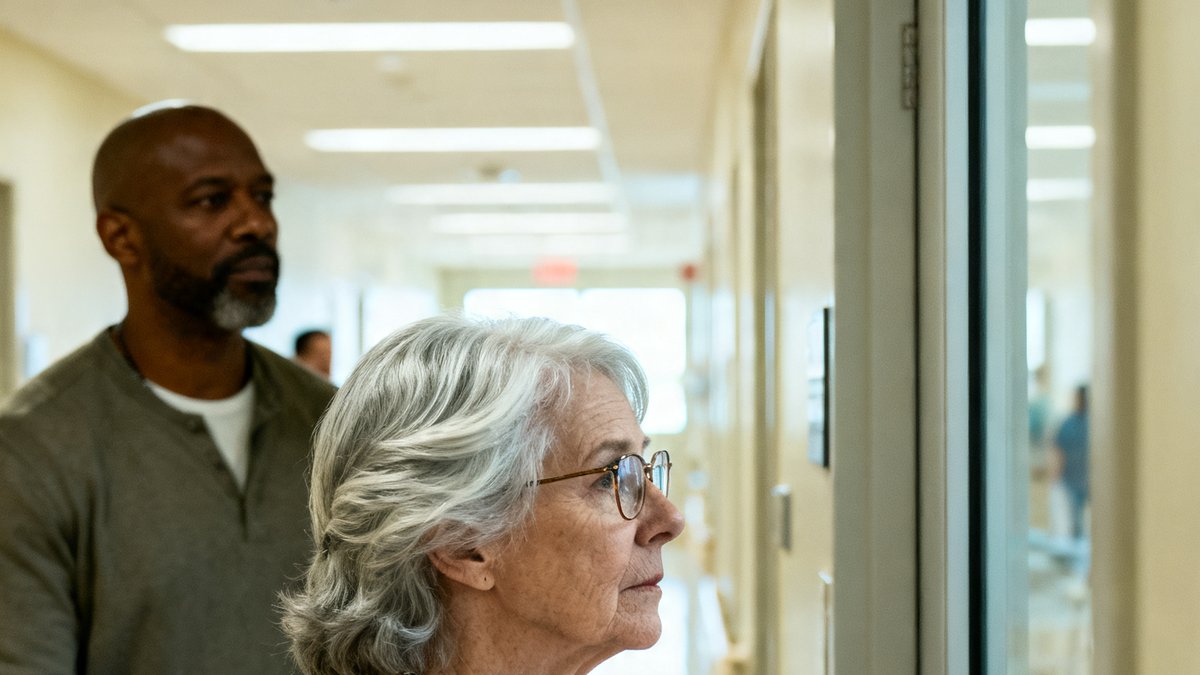
An hour later, still trembling with joy, I wandered to the nurses’ station to ask about the cafeteria. A nurse with tired eyes and a name tag that read *Gina* was tapping on a tablet. I thanked her for taking care of my family and, with a swollen heart, added, “That baby is my first grandchild.”
She looked up. Looked down the hall toward room 312. Then she leaned so close I could smell her spearmint gum.
“Ma’am… the baby you were just holding? That’s not the one your son came in with.”
My mouth opened. Nothing came out.
She pulled back, suddenly pink. “I’m sorry, I just thought—never mind.” A phone rang, and she bolted.
I stood there with the linoleum tilting under my feet. *Not the one your son came in with.* I told myself she’d confused the rooms. Nurses work twelve-hour shifts. Mistakes happen. But when I walked back into 312, Michael’s smile was just a tick too wide. Sarah’s eyes flicked to him first, then me.
“Everything okay, Evelyn?” she asked.
“Fine,” I said. “Just fine.” But my voice wasn’t mine.
That night, I didn’t sleep. I lay on the fold-out chair replaying every strange thing I’d brushed aside for months. No baby shower. No ultrasound photos on Facebook. Every video call, Sarah had positioned the camera from the shoulders up. When I asked for a bump picture, Michael said she was self-conscious. I’d accepted it, because I wanted to believe. Now the nurse’s words gnawed at my ribs.
The next morning, Michael and Sarah left to sign paperwork. “Twenty minutes,” Michael said. I waited exactly four. Then I opened the blue accordion folder on the windowsill. My hands shook, but I didn’t care—something was rotting under the surface, and I needed to dig it out.
Inside: insurance forms, consent sheets, a lactation pamphlet. And then, bound with a brass clip: *Gestational Carrier Agreement.* I read the words three times. The intended parents were Michael and Sarah. The carrier was a woman named *Jenna*. There was a notary stamp, a schedule of payments, and an addendum dated three weeks ago:
*Carrier requests a 24-hour post-delivery bonding period with the newborn, to be concluded by release to intended parents at hospital. This request is made in light of a recent spousal loss and is mutually agreed upon in the spirit of compassion.*
The door opened. Michael froze. Behind him, Sarah let out a tiny sound.
I held up the papers. “Tell me.”
His face cracked like dry earth. We sat down, and the story came out in pieces. Three miscarriages—the first at ten weeks, the second at fourteen, the third at twenty. They’d painted a nursery, picked a name, and then Sarah had to pack it all away while friends texted “When’s the baby due?” without knowing. They stopped talking about it. They stopped allowing hope.
So they found Jenna, a surrogate in Colorado Springs. She’d been their rock—until a month before the due date, when her husband fell in an ice-climbing accident. Jenna still delivered, but after the birth, she’d begged for just one day. One day to hold the child she’d carried, to say goodbye to the last connection to the family she’d lost. Michael and Sarah, raw from years of grief, had said yes.
“We were going to tell you,” Michael said. “After we got home. After…”
“After you’d scripted every line,” I said. “So I wouldn’t ask questions.”
Sarah wiped her eyes. “We were so afraid you’d judge us. That everyone would.”
I understood their pain—I really did. But then a colder thought struck. “Wait. If Jenna had the baby for that day… whose baby did I hold?”
Michael flinched. He looked at the floor.
“The woman next door,” he whispered. “Right before you got here, she started hemorrhaging. The husband ran with her to the OR. A nurse rushed out holding their newborn—the grandmother had fainted in the hallway, no one was there. She asked me to hold him for just a few minutes while they stabilized everyone. And then you walked in.”
I stared at him. “You let me hold a stranger’s baby while I cried like an idiot?”
“You were so happy, Mom. I hadn’t slept in two days. I just… I didn’t know how to stop you.” His voice broke. “I’m so sorry.”
The room was suddenly too small. The walls pulsed. My son—my only child—had spent years burying heartbreak after heartbreak, and when I finally arrived to share a moment of pure joy, he’d handed me a lie because the truth was too tangled. I didn’t know whether to scream or hold him.
Then I remembered: “Where is your real baby now?”
“With Jenna,” Sarah said, her voice hushed. “She’s bringing him back in the morning. She just wanted to say goodbye.”
Morning. It was still the middle of the night. I got up and walked to the window, looking at the parking lot lights. I could feel them watching me, waiting for a verdict.
“What’s his name?” I asked without turning.
“Henry,” Sarah said. “Henry Charles. After my grandfather.”
I turned. “So who was the baby I held?”
Michael swallowed. “We never caught their name. The emergency passed, the father came back, took him. They’re fine now. It was just chaos.”
Chaos. That word was doing a lot of heavy lifting.
The next day, Jenna came. I didn’t meet her then—Michael said she looked like she’d aged ten years overnight. She placed the real Henry into Sarah’s arms, kissed his forehead, and whispered something I’ll never know. Then she left. I stood at the end of the corridor, watching a woman in a gray cardigan walk out with nothing but a tote bag and whatever peace that day had given her.
When I returned to the room, there was a different baby in the bassinet. He was smaller, with a tuft of sandy hair and a nose that curved exactly like my late husband’s. His chin was Sarah’s—a tiny cleft. He yawned, and his whole body quivered.
Michael lifted him. “Mom… this is Henry. Your grandson.”
This time, I hesitated. Then I reached out and took him. He weighed less, or maybe it was just that the weight of the truth made him feel different. But his warmth was the same, and his miniature fingers curled around my thumb. A sob lodged in my throat—not of joy, not of grief, but of something that contained both.
“Hello, Henry,” I said. “It’s about time.”
There was no instant forgiveness. That’s not how trust works. I spent the next three days in a hotel, meeting Henry in the afternoons, letting the jagged edges smooth themselves. We talked—really talked—for the first time in years. Sarah described the night terrors after the last miscarriage, the way she’d wake up thinking she could feel kicking that wasn’t there. Michael admitted he’d forbidden any mention of babies in his presence, that he couldn’t bear another condolence casserole.
“I didn’t want you to look at me with pity,” he said. “I couldn’t survive one more person seeing me as broken.”
I took his hand. “I’ve seen you broken since you broke your arm at eight years old. That’s what mothers are for.”
He cried then, messy and unguarded. I cried too. Henry slept through it all, indifferent.
I asked to call Jenna. That conversation was brief—she was staying with her sister in Boulder, trying to rebuild. She said she’d wanted those twenty-four hours to remember what it felt like to have a purpose, to hold life after death. I said, “Thank you for giving them a chance.” She said, “Thank you for not hating me.” I told her I hoped she’d heal, and she made a sound that was almost a laugh.
Six months later, Henry has Sarah’s stubborn chin and Michael’s ears that stick out just a little. He’s learned to grab my glasses. Yesterday, Michael sent a video of him scowling at a spoonful of peas, and I watched it seven times. Then he called.
“Mom,” he said, “I’m sorry it took a disaster for us to be honest.”
“I’m sorry I wasn’t a safe enough place for your pain,” I replied.
He paused. “You are now.”
I’m back in St. Louis, my guest room slowly turning into a makeshift nursery. The drive from Denver will become familiar. I keep a photo on my fridge: not from the hospital, but from three weeks ago, when I held Henry on my porch. In it, I’m not crying. I’m just looking at the camera, my arm around my son, and there’s nothing hidden between us.
Sometimes I wonder about the other baby, the one I held for those few moments. I don’t know his name, but I hope he’s loved. I hope his mother recovered. I hope his grandmother, the one who fainted, is okay too.
And sometimes, when I’m alone with Henry, I tell him about the chaos of his first days. I’ll explain it fully one day—with gentleness, the way you’d unfold a fragile map. But for now, I just press my nose to the top of his head and whisper, “You were worth every mile.”