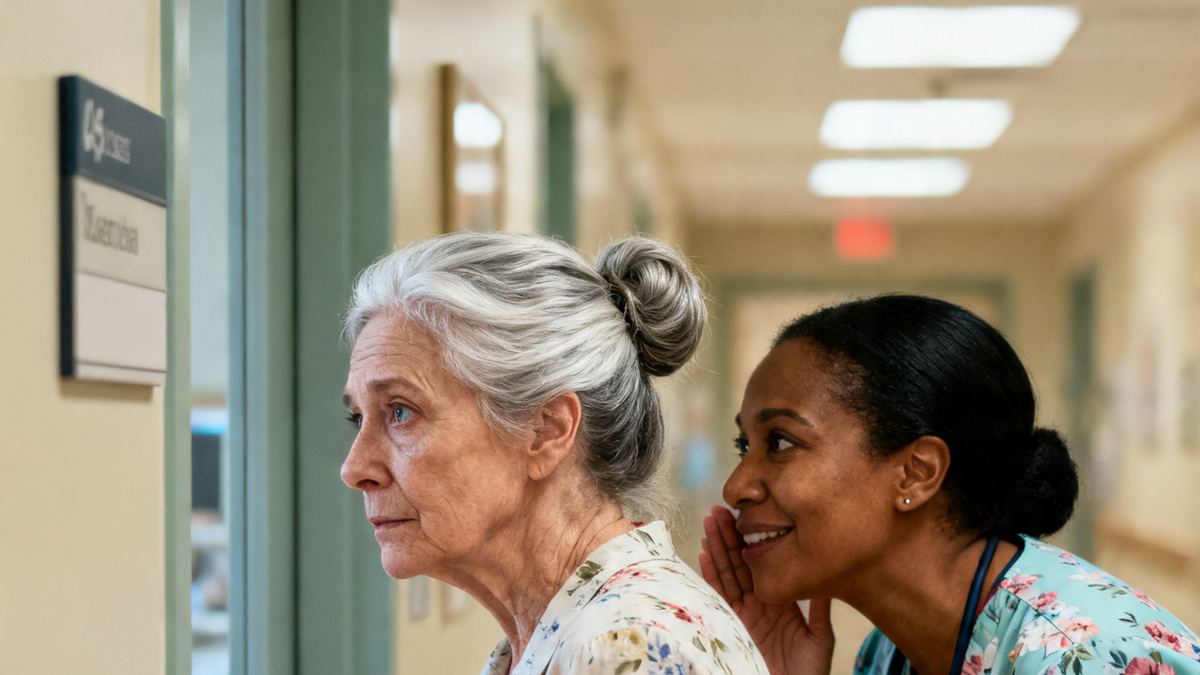
The nurse’s words cut through the hospital hum like a scalpel. “That’s not the baby your son left with.”
I had just crossed half the country to hold my first grandchild. My arms were still warm from the weight of him—the soft spot on his head pulsing under my palm, that newborn smell of powder and possibility. My son Michael stood a few feet away, scrolling through his phone while his wife Sarah dozed.
But the nurse’s whisper froze everything.
I’d arrived in Phoenix two hours earlier, my heart hammering against my ribs the whole drive from Sky Harbor. Michael and Sarah had moved to Arizona three years ago for his job at an aerospace firm, and the distance had felt like a thin, constant ache. When he called at three in the morning, voice cracking, “Mom, he’s here,” I didn’t even check flight prices. I just grabbed my bag.
They’d kept the pregnancy remarkably quiet. No ultrasound photos taped to my fridge, no blurry belly snapshots texted in the ninth month. I’d offered to fly out for the baby shower, to paint the nursery, just to sit in their kitchen and fold onesies. Each time, Michael waved me off. “We want to do this privately, Mom. Just us.” I’d swallowed the hurt, telling myself that young couples needed their cocoon.
But there were other things. Sarah was never in the background of his video calls. When I asked directly, Michael said she was self-conscious about being photographed pregnant. I’d accepted it because it was easier than picking at the seam.
Now, in a sunlit hospital room on a Tuesday afternoon, I’d finally held the baby. Dark hair, furious little fists, a tiny mouth working in his sleep. I’d sobbed into his blanket. Michael had laughed, his eyes rimmed red. We’d been a perfect, ordinary family for about eleven minutes.
Then I’d stepped into the hall to compose myself, and a nurse in floral scrubs had leaned in and detonated my world.
I gripped the cold handrail. “What?”
She glanced toward room 312, then back at me. “The baby your son took out of the nursery—that wasn’t the one he brought to your daughter-in-law’s room. I thought you knew.” Her pager buzzed, and she scurried off, leaving me in the antiseptic silence.
My first instinct was to dismiss it. Hospitals were chaotic. Overworked nurses confused parents all the time. But when I returned to the room, Michael’s smile was a fraction too wide, his voice too cheerful. “Everything okay, Mom? You look pale.”
“Fine,” I said. “Just overwhelmed.”
Sarah opened her eyes and gave me a thin smile. “He’s beautiful, isn’t he?”
I nodded. But inside, the nurse’s words were a splinter. *That’s not the baby your son left with.*
The next day, I started piecing it together in my head like a prosecutor with a reluctant witness. The total absence of pregnancy photos. The canceled visits. The way Michael changed the subject whenever I asked about due dates or names. Something was deeply, deliberately wrong.
On the third afternoon, Michael and Sarah went downstairs to sign discharge paperwork, leaving me alone in the room with their hospital folder. I knew it was a betrayal. I opened it anyway. Consent forms, insurance documents, a few Polaroids of the nursery—and then a sheaf of pages with a banner heading: GESTATIONAL SURROGACY AGREEMENT.
I sat down hard on the vinyl chair.
The intended parents: Michael James Callahan and Sarah Diane Callahan. The gestational carrier: Rachel Miriam Torres.
The document spelled out everything. Embryo transfer dates. Legal parentage. Compensation. And a separate addendum, handwritten and witnessed, stating that Rachel Torres had requested and been granted one uninterrupted day with the infant prior to final placement.
My hands were shaking so badly the paper rattled.
The door swung open. Michael froze in the doorway, the color draining from his face. Sarah peered over his shoulder and let out a small, defeated sound.
“Tell me the truth,” I said, my voice flat as a table. “All of it.”
Michael sank onto the edge of the bed. Sarah stayed by the door, arms wrapped around herself. For a long moment, the only sound was the distant beeping of a monitor down the hall.
“We lost three pregnancies,” Michael finally said. “The first at ten weeks. The second at fourteen. The third…” He stopped, and Sarah finished. “The third we made it to twenty-two weeks. We’d already named her. Lily.”
Her eyes brimmed, but she didn’t cry. I understood then that these two had cried out everything they had months, maybe years ago.
“After Lily,” Sarah continued, “I couldn’t do it anymore. Telling people I was pregnant, then calling them back to say I wasn’t. The pity. The advice. Every time someone said ‘it’ll happen,’ I wanted to scream. So we stopped telling anyone.”
Michael rubbed his jaw. “We found Rachel through an agency. She’s a mother of two already, a widow. Her husband died in a motorcycle accident three weeks before the scheduled C-section. She still carried our son to term, but after the birth, she asked for a day with him. Legally, we could have said no. But she’d just lost her husband, Mom. She was saying goodbye to this baby she’d grown inside her for nine months. We said yes.”
A lot of things were clicking into place now—the secrecy, the isolation, the frantic edge in Michael’s voice whenever I mentioned visiting. But one thing still didn’t fit.
“The nurse,” I said. “She told me the baby you left with wasn’t the one I held. What did she mean?”
Michael and Sarah exchanged a look so heavy it could have cracked the floor. Then Sarah whispered, “The baby you held, Diane… he wasn’t ours.”
My heart lurched. Michael talked fast, as if speed would soften it. “Twenty minutes before you arrived, there was a medical emergency in the room next door. A first-time mother hemorrhaged. The father ran with her to the OR, and her own mother fainted in the corridor. The staff asked me to hold their newborn while they stabilized everything. You walked in, saw me holding a baby, and started crying. I hadn’t slept in two days, Mom. I just… I let you believe.”
I stared at him. “You let me believe another woman’s child was my grandson.”
“I’m sorry,” he said, and the word was small and useless.
“Where was your son?” I asked. “The real one?”
“With Rachel,” Sarah said. She wiped her eyes with the back of her hand. “She was in a private room on the maternity floor, holding him in this rocking chair, just looking at him. When our day was up, she walked in here, kissed his forehead, and put him in my arms. She said, ‘Thank you for letting me love him long enough to let go.’”
I looked away. I wanted to be furious, and part of me was. But under the anger was something more complicated: a grief for the three babies who never made it, for the young woman who’d lost her husband and then handed over a child she’d carried through that loss, for my son who’d been so terrified of more disappointment that he’d walled off his own mother.
Sarah stood up and walked to the bassinet by the window. I hadn’t even noticed it there, a small plastic crib on wheels. She lifted a bundled infant—smaller than the one I’d held earlier, with lighter hair and a delicate chin that was pure Sarah. She brought him to me.
“Mom,” Michael said, his voice cracking, “this is your grandson.”
I took the baby. He was so light, so impossibly fragile. He squirmed and made a tiny, disgruntled noise, then settled against my chest. His hand, no bigger than a walnut, curled around the collar of my blouse.
“What’s his name?” I managed.
“Henry,” Sarah said. “After my grandfather.”
I touched his cheek. “Hello, Henry.”
The room was quiet for a long time after that. Michael kept apologizing, and I kept not forgiving him, because forgiveness wasn’t a faucet you could just turn on. But I didn’t leave. I sat in that vinyl chair with my grandson in my arms, and I stayed.
Six months later, I flew to Phoenix again for Henry’s baptism. Sarah’s mother hosted a lunch afterward at their house, with too many sandwiches and a cake that leaned slightly to the left. Rachel wasn’t there, but Sarah had a photo of her on the mantel—a serious-eyed woman with braids, holding Henry in the hospital, her face a map of things I couldn’t name. I sent her a card afterward, thanking her for my grandson and saying I’d like to meet her someday, if she ever wanted.
Michael caught me staring at the photo. He was wearing a shirt with a spit-up stain on the shoulder, his hair grayer than it had been during those secret months. He didn’t say he was sorry again. He just stood beside me and said, “He laughed today. A real one, not gas.”
“I know,” I said. “You sent me the video.”
“Right.” He paused. “You’re still here.”
I knew what he meant. After the lies, after the nurse’s warning, after the contract and the three lost names I’d never get to say aloud. I looked at the mantel, at the photo of Rachel holding a baby she’d loved and given up, and I thought about all the ways a family can crack and still hold together.
“I’m here,” I said, “because Henry is mine, too. And because you’re still my son, even when you’re a complete idiot.”
Michael’s mouth twitched. It wasn’t a smile, but it was close.
In the living room, Henry started fussing, and Sarah called for backup. I squeezed Michael’s arm once and walked toward the sound.