The Maison Étoile boutique was the kind of place where the air smelled of money and the lighting was designed to make ordinary people feel small. On a busy afternoon, with well-dressed clients drifting between silk scarves and crystal displays, a little girl walked through the front door holding the hand of an older woman—her grandmother.
The girl’s name was Emma. She was eight years old, and the moment she stepped inside, her eyes locked onto something in the window display and never let go.
A red dress. Full, radiant, catching the light like a living flame.
Emma drifted toward it the way children drift toward things that feel like magic. She reached out—barely a touch, just the tips of her fingers grazing the fabric—and that was enough.
“Don’t touch that.” A saleswoman materialized from nowhere, sharp as a slap, and batted Emma’s hand away. “That dress costs more than your family makes in a month.”
Emma pulled her hand back and looked at the floor.
“I just wanted to see it…”
“The displays aren’t a playground.” The woman’s voice was flat and dismissive, the kind of tone reserved for people she’d already decided didn’t belong. “There are other stores. Stores more appropriate for your situation.”
Emma’s grandmother straightened her spine and reached for the girl’s hand. Her cheeks burned. She began guiding Emma toward the door—quietly, the way people leave places that have made them feel ashamed.
They didn’t make it out.
A man stepped forward from across the boutique. He’d been standing near the back, watching everything in silence. He wore a charcoal-gray suit, well-fitted, the kind of clothing that said he understood the language of this place perfectly. His expression was calm, but his eyes were not.
“Excuse me,” he said, addressing the saleswoman directly.
She turned with a practiced smile. “Of course, sir.”
“I’d like the little girl to try on that dress.”
The smile held, but something flickered behind it. The woman glanced at Emma—a quick, cutting look.
“Certainly,” she said. Then, quieter, just barely audible: “Though it’ll be a waste of everyone’s time.”
The man looked at her.
“I’ll also be purchasing the dress.”
Emma’s head snapped up. Her eyes went wide.
“Really?”
He smiled at her—a real one, the kind that reaches all the way up. “Really.”
A few minutes later, Emma disappeared behind the dressing room curtain. The boutique carried on around them—the soft clink of hangers, murmured conversations, the tap of heels on marble. The man stood quietly, hands folded in front of him. The grandmother watched him with careful eyes.
Then the curtain moved.
Emma stepped out.
The boutique went still. Not gradually—all at once, like a held breath. Even the ambient noise seemed to pull back, leaving something raw and exposed in the center of the room.
The man’s bag slipped from his fingers and hit the floor.
His face broke open.
Tears came without warning, without sound at first—just streaming down his face while he stood frozen, staring at this child in a red dress.
“It’s impossible,” he whispered.
The grandmother moved toward him. “Sir—are you alright?”
He wasn’t. He took one step toward Emma, then another, like a man walking toward something he was terrified to believe in.
“You have her eyes,” he said. “Her exact smile. The same way of tilting your head—like you’re listening to something the rest of us can’t hear.”
Emma tilted her head. “Whose?”
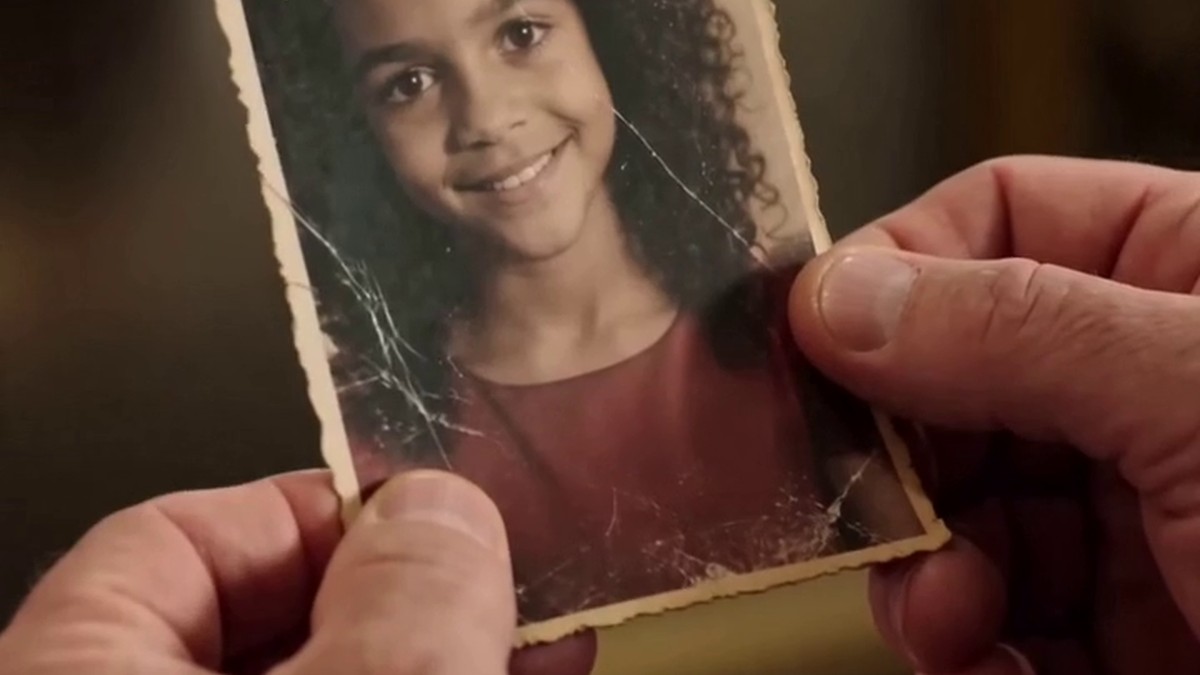
He reached into the inside pocket of his jacket and withdrew a photograph. Old, worn at the edges, handled so many times the surface had gone soft. He held it out.
In the image, a young woman stood beside a lake, smiling. She wore a red dress. The same red dress. The resemblance to the child standing in front of him wasn’t a passing similarity—it was a family echo, unmistakable and unmistakably strong: the same dark eyes, the same crooked smile, the same way she stood with one shoulder slightly higher than the other.
Emma studied the photo with the grave attention children bring to things they sense matter enormously.
“She’s beautiful,” she said softly.
The man’s voice fractured when he spoke.
“She was my daughter.” He stopped. Started again. “She disappeared nine years ago. I’ve been searching ever since, but the police closed the case as a runaway. I never stopped believing she was out there somewhere.”
The grandmother had gone perfectly still. She reached for the photograph with a trembling hand, and when she saw the face, all the color left her own.
“That’s my daughter,” she whispered. “That’s Isabel.”
The man looked up slowly, confusion and something almost like hope warring across his features. “Your daughter? She’s my daughter too.”
For a moment neither of them could speak. Then the grandmother pressed a hand to her chest, her composure unraveling stitch by stitch.
“Nine years ago, my daughter left this house pregnant. She never came back. One morning I found Emma—newborn, wrapped in a blanket—on my doorstep. There was a note.” She stopped to steady her voice. “It said: Take care of her. Someday she’ll know the truth.”
The man stared at her. “I never knew Isabel was pregnant. We had only just begun to get to know one another again, after I’d been absent for so much of her childhood. She never told me. And then she vanished.”
The boutique had ceased to exist around them. There were no other customers, no saleswomen, no bright display lights. There was only this—two people standing in the wreckage of a decade, a child between them not yet understanding what she meant to both.
The man’s eyes moved to Emma’s neck.
A small pendant hung there on a delicate chain. A rose, no bigger than a thumbnail, worked in gold.
He recognized it the way you recognize something from a dream—with a lurch, with absolute certainty.
“May I see that?” His hands were shaking when he reached out.
The grandmother nodded slowly. “I never understood that locket. I was too afraid to show it to anyone, afraid of what it might lead back to. I just… kept it on her, hoping someday it would make sense.”
He lifted the locket gently and opened it.
Inside was a photograph so small it might have been easily missed. But he knew it immediately. It was the same image he carried in his wallet—the same lake, the same smile, the same red dress.
“I had this made for her,” he said, his voice barely a whisper now. “For Isabel’s eighteenth birthday. I designed it myself. She must have put it on the baby—on Emma—so that one day someone would know.”
The grandmother sat down. Just sat down right there, because there was nothing else to do.
—
The DNA test came back two weeks later.
Emma was his granddaughter.
The locket became the key. The grandmother, who had never dared to ask about its origin, finally gave the investigator the name of the jeweler engraved on the clasp. The man—whose resources had funded private searches for years—now had a fresh lead. The jeweler remembered the custom order from over a decade earlier, a design he’d never repeated. It pointed to a small city two borders away.
But the investigation almost stalled there. The trafficking network that had taken Isabel was still active, and any wrong move would spook them into moving their victims again, deeper underground. For four tense months, law enforcement worked with international agencies to trace Isabel’s last known connections without alerting the ring. There was one terrifying night when a surveillance operation nearly blew up because a local informant got cold feet; the authorities had to extract a key witness in a hurry, hoping the traffickers wouldn’t realize what was slipping through their fingers.
It held. Just.
Four months after the day in the boutique, they found Isabel alive.
She was in a secure medical facility two countries away, held under a false identity. She was frail, ill from years of neglect and fear, but conscious and alert—the same fierce spirit that had once let her fight her way out of a moving vehicle long enough to give birth in a charity clinic and leave her baby on her mother’s doorstep before they pulled her back into the darkness.
The reunion happened in a hospital room, late in the afternoon when the light through the window was going amber. Emma walked in wearing the red dress.
Isabel saw her daughter from across the room and couldn’t move. Couldn’t speak. Just sat there with tears running silently down her face, looking at this child she had only held for hours before giving her away to save her life.
Emma crossed the room and climbed carefully onto the bed beside her mother.
“I know who you are,” she said.
Isabel pulled her close, pressed her face into her daughter’s hair, and finally—after nine years—allowed herself to fall apart.
The grandfather stood in the doorway and watched the two of them together. He thought about a boutique, a curtain pulling back, a child in a red dress. He thought about all the ways a single moment can contain everything that was lost and everything still possible.
He understood then that the dress had never just been a dress.
It had been a thread. Thin and red and impossibly strong—the kind that holds even when you can’t see it working, even when it’s buried under years of silence and sorrow and unanswered questions.
It had pulled a broken family back toward each other through nine years of darkness, finding the seam between a photograph and a locket, between a stranger’s grief and an old woman’s shame, between a child reaching for something beautiful and the world finally letting her have it.
Every year after that, on Emma’s birthday, she put on the red dress.
Not to remember the pain. But to remember the moment the thread held—and proved that some things, no matter how long they’ve been lost, are still out there waiting to be found.