“Thief!”
The word sliced through the music, a blade of pure venom. The string quartet screeched to a halt. Crystal goblets paused mid-air. A hundred heads swiveled toward the center of the ballroom.
Kneeling on the gleaming marble was a young housemaid, trembling. Tears carved silent tracks through the dust on her cheeks. She clutched a worn fabric pouch to her chest like a shield.
Eleanor descended from the dais, silk gown hissing against the floor. “I knew it. I knew someone’s been stealing from this house.” Before the young woman could draw breath, Eleanor ripped the pouch from her hands and turned it upside down.
Diamonds scattered like ice. A rope of pearls slithered across the white stone. Gold bracelets clattered, spinning to a stop inches from polished shoes. The guests gasped in elegant horror.
But then something else fell.
Old photographs, faded and creased at the corners, fluttered down. A small silver locket skittered across the marble and came to rest against the toe of an immaculate leather oxford.
Arthur Whitmore.
The family patriarch.
Sixty-five years old, silver-haired, iron-willed. The man whose name hung over every door in the estate. He bent down and picked up the locket first. Flipped it over. The inscription on the back was tiny, almost worn away by time, but still legible. *Elena & Arthur, forever.*
His fingers tightened until the silver bit into his skin.
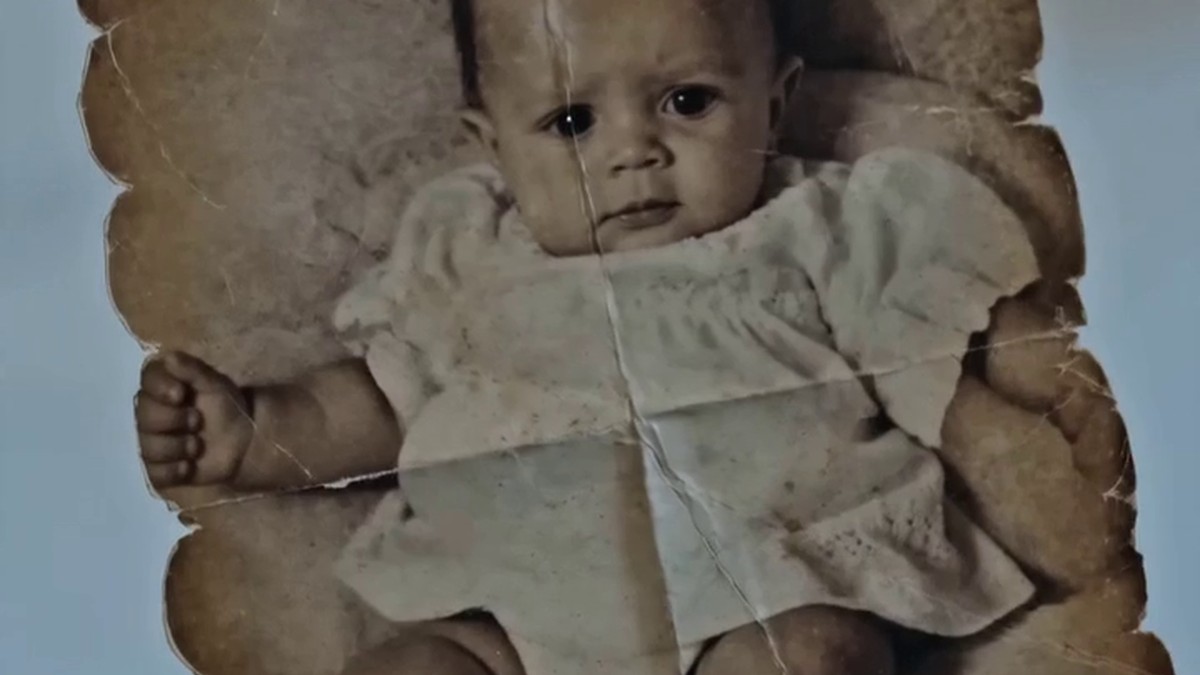
Then he picked up the nearest photograph, which had glided to a stop beside his shoe. A young woman—a face he had not seen in thirty years but could never forget—lay in a narrow clinic bed, dark hair plastered to her temples, cradling a newborn against her chest. The baby’s hand was a tiny starfish on her hospital gown. On the back, in faded blue ink, someone had written: *Sophia. June 12, 1994. Our daughter.*
The blood drained from Arthur Whitmore’s face.
His hands began to shake.
The room fell utterly still. Even the chandeliers seemed to hold their breath.
Arthur raised his eyes. He looked at the maid—really looked—and saw the same shape of the eyes, the same curve of the mouth, the same gentle defiance he had only ever seen in one other face. A face he had lost decades ago and never stopped searching for.
A tear slipped down his weathered cheek.
“Dear God,” he whispered.
The young woman stared back, bewildered, her hands still half-raised to protect herself.
Arthur held the photograph out toward her, the locket still gripped in his other fist. His voice cracked as he asked the question that stopped every heart in that room.
“This child… is this you?”
She looked down at the picture, then back at him. Slowly, almost imperceptibly, she nodded.
The air left his lungs. The marble floor seemed to tilt beneath his feet. Because in that one small movement, Arthur Whitmore understood that the woman his family had just publicly destroyed—right here on the glossy stone, before the cream of high society—was the very person he had spent the last three decades praying to find.
Eleanor’s laugh was a brittle, ugly thing. “Oh, this is absurd. You’re not actually buying this little theater? She’s a thief. A maid caught with thousands of dollars in stolen jewels. The photographs and that cheap trinket are clearly just another piece of her con.”
The maid shook her head, her voice barely a thread. “I… I don’t know how the jewelry got in there. I’ve never seen it before. I only carry my mother’s things. This pouch and the keepsakes inside were all the orphanage gave me when I turned eighteen.”
“Your mother?” Arthur’s voice was a wounded rasp.
“She died giving birth to me. I grew up in a foundling home in Santa Carla. They told me my father was dead too, so they put my mother’s surname on my paperwork. Vasquez. I came here looking for work. I never meant to cause trouble.”
Arthur took a step toward her, ignoring the outraged hiss from Eleanor. “What was your mother’s name?”
The maid swallowed. “Elena. Elena Vasquez.”
The name hit him like a physical blow. Elena. The daughter of the groundskeeper at his family’s summer villa. The woman he had loved with every fiber of his being when he was young and foolish. The woman his family had torn him away from, shipping him abroad with the ink still wet on his university acceptance. Soon after, they told him with cold finality that Elena had vanished, that the child she carried had died in a slum clinic on the far side of the border. He had wept for a month. And then he had spent the next thirty years burying the grief under power and money.
But now the truth was screaming at him from a faded clinic photograph and a silver locket. The baby in Elena’s arms had survived. Had grown. Had somehow found her way to his own doorstep, only to be branded a criminal.
Eleanor’s face hardened. “Security. Have this girl arrested immediately. And someone call the police. I will not be made a fool in my own home.”
Two burly men in suits stepped forward. The young woman flinched backward.
“Stop.”
Arthur’s voice was not loud. But it carried the weight of sixty-five years of command. The guards froze mid-step.
He turned to face Eleanor. His own grandniece, entrusted with managing the household while he grieved his late wife. The ever-eager relative who had insisted on hosting tonight’s charity gala. The woman who had come to him just this morning to report a few pieces of jewelry missing from the safe that only she and Arthur could open.
But something else clicked in Arthur’s memory. Three days ago, Eleanor had lingered in his study, looking at staffing reports. She had asked too many questions about the new housemaid with no local family—what was her name, where had she come from, why had no one checked her background. He had dismissed it as her usual pettiness. Now the pattern was brutally clear.
“You planted them,” Arthur said. His voice was quietly lethal. “You put the jewels in her bag.”
Eleanor’s eyes flickered, a crack in the porcelain. “That’s an insane accusation. I have no idea what you’re talking about.”
“You learned her name. You learned she carried a pouch that bore the Vasquez name. A name that once meant everything to me. You must have seen the resemblance, or at least the danger. So you decided to remove the problem before I ever knew she existed.”
He advanced a step, and Eleanor actually backed into the edge of the buffet table. Glasses rattled.
“You staged a theft from a safe that only you and I can open. You waited for the gala, when the house was full of witnesses, and then you ‘discovered’ the jewels in her bag. The jewels you put there. The timing gives you away—you reported them missing this morning, but the pouch has been in the servants’ hall all day. Anyone could testify to that. You counted on a fast arrest before I ever saw her face.”
The ballroom was a frozen tableau. A hundred guests barely breathed.
Eleanor’s mouth opened and closed. Then her lips twisted. “She’s nothing, Uncle. A beggar’s orphan. Even if what you’re imagining is true, it’s ancient history. You’ve built an empire. You can’t let some charity-case maid taint the Whitmore name. I was protecting us.”
Arthur looked at her for a long, terrible moment. “You were protecting your inheritance.”
He turned his back on her and walked to the maid. He extended his hand. After a heartbeat, she took it, her fingers ice-cold and trembling.
“What’s your name?” he asked gently.
“Sophia. Sophia Vasquez.”
He helped her to her feet. Then he turned to address the entire room, holding up the locket and the annotated photograph for all to see.
“Thirty years ago, I loved a woman named Elena Vasquez. We were going to be married. My family stole that from me. They stole her life. They told me she and our child were dead. Tonight, God has seen fit to give me proof—in silver, in ink, and in the face of this woman—that my daughter survived.”
He looked at Sophia, tears openly streaming now, and his voice broke with a joy that was almost too large to hold.
“I have a daughter.”
Sophia’s face crumpled, and she fell into his arms, sobbing.
He held her tight, one hand cradling the back of her head, and over her shoulder he spoke to his security team.
“Escort Ms. Eleanor Whitmore off the property. Immediately. She will receive nothing. She is no longer family. And summon my attorney. I have thirty years of apologies to make up for, and a new will to write.”
Eleanor shrieked and tried to protest, but the guards were all too happy to obey Arthur’s command. She was dragged from the room, her screams fading down the marble hallway.
Arthur pulled back, cupping Sophia’s face in his hands. “I am so sorry. For everything you lost. For every second you didn’t know you were loved.”
She shook her head, laughing through tears. “I always felt someone was out there. I used to talk to your picture.”
He laughed, a sound of astonishment and release. Around them, the guests began to applaud, the sound breaking the tension like a wave. Someone uncorked champagne. The quartet tentatively struck up a hopeful waltz.
Arthur Whitmore did not notice any of it. He simply stood with his daughter on the marble floor, holding on to the person he had searched for across three decades of silence, and promised himself that he would never let go again.