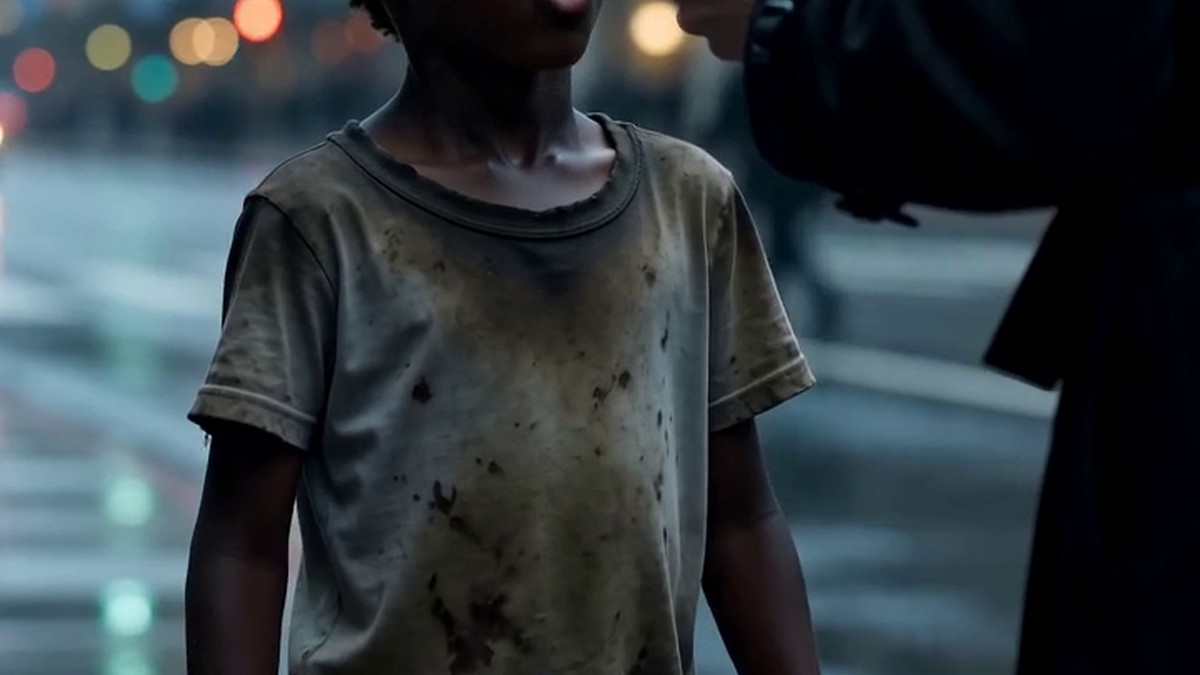
The city swallowed everyone whole. A river of strangers flooded the sidewalk, heads down, hearts locked away. No one saw the boy.
He ran. His small body weaved through the nightmare of legs and briefcases. His shoes, a size too big, slapped the pavement in a frantic rhythm. Soot streaked his cheeks like dark tears and his clothes hung from him, threadbare and gray. But his eyes—wide, burning with a light that refused to die—stayed locked on the silhouette gliding away.
“Ma’am! Please, wait!”
The words clawed out of his throat, ragged and desperate. A few people turned, but the woman in the black trench coat did not. She walked with a cold, elegant precision, her auburn hair swept into a flawless chignon. A queen of ice.
The boy dodged a stroller and stumbled. For one heart-stopping second, he thought he’d lost her. Then he saw the coat pause.
The woman stopped. Slowly, as if the air itself had thickened, she glanced over her shoulder. Her eyes, the color of winter moss, found the tiny figure gasping for breath. She looked… puzzled. Curious. Distant.
“What do you want, child?” Her voice was soft, but it carried the chill of a polished stranger.
For a moment, the boy just stared. His tears balanced on the edge of his lashes, trembling like rain on a petal. Then, with a courage that seemed too big for his bones, he raised his filthy hands.
The photograph was a ghost of its former self. Torn edges, faded to sepia, trembling between his small fingers. In the image, a young woman with the same black coat cradled a newborn in her arms, her face a portrait of exhausted bliss.
“She looks like you,” the boy whispered. “They told me… she’s my mother.”
The woman took the photograph. Her fingers touched the worn paper, and for a long moment she didn’t speak. She turned it over. On the back, in faded ink, was a line written in a careful, feminine hand: *Samuel, born March 14th. My whole world.*
Her breath caught. The hand holding the photo began to tremble. She looked from the writing to the boy’s face, then to the image, then back again. Doubt warred with wild, impossible hope.
“This photo… where did you get it?” Her voice cracked through the chill, the ice thinning.
“The man who took me gave it to me when I was little,” the boy said. “He said my mother was dead. He used it to prove she was real, as some kind of cruel joke. But I always knew you weren’t dead. I just knew.”
The woman pressed a hand to her mouth. She studied him—not with a stranger’s curiosity, but searching. “My baby had a tiny birthmark,” she said, almost to herself. “Behind his right ear. Shaped like a crescent moon. Do you… do you have it?”
The boy’s hand flew to his ear, pushing back his dusty hair. There, faint against the skin, was a small crescent-moon mark. He’d never thought much of it; the man had called it a stain.
The woman’s composure shattered. A raw sob escaped her as she fell to her knees on the dirty concrete, her pristine coat pooling around her like discarded armor. “My baby,” she breathed. “It’s really you.”
She reached out, and with the tenderness the world had never shown him, she touched his chin. She traced the curve of his jaw, seeing past the scar on his eyebrow, the small chip in his front tooth—marks of a hard, unloved life that made her chest ache. She wasn’t recognizing him by those; she was grieving them.
“I looked for you,” she wept, wrapping her arms around him. “Every day, every shelter, every hospital. They told me there was a fire—that you were gone. They said you died in the nursery fire at the clinic. I never believed them. I always felt you were alive.”
He melted into her embrace, ten years of loneliness dissolving. “I ran away from the man who took me,” he choked into her collar, which smelled of violets and regret. “He’s gone now; the police caught him two weeks ago for other crimes. That’s how I ended up on the streets. But I kept the photo. I kept hoping.”
She held him tighter, her tears washing the soot from his cheeks. Around them, the city surged on, but time itself cracked open and rewound a decade of grief. She pulled back just enough to wipe his face with the sleeve of her expensive coat, unmindful of the stains.
“Samuel,” she whispered, her voice finding a steady core. “I named you after my father. He would have loved to see you.”
He smiled then, a fragile, sunlit thing. “I know. It’s on the back of the picture. I learned to read it.”
She laughed through her tears, the sound a broken melody. She stood, still unsteady, and held out her hand. He slipped his small, calloused palm into hers, and that single grip rewrote everything.
“We’re going home, Samuel,” she said. “Not the home you’ve known. A place with warm food, and a bed that’s yours forever. And walls—I live in a little apartment near the river. The windows catch the sunrise. You’ll see it tomorrow.”
He didn’t know what a sunrise by the river looked like. He’d always been too busy hiding, too busy running. But as they walked, her coat draping over his shoulders to cut the wind, he let himself imagine it: a sky full of pink and gold, a glow that touched his face like a promise.
The crowd parted for them as if sensing the shift. A mother and her son, forged by fire and found in the cold. The boy pressed the photograph against his heart—no longer a relic of loss, but a ticket to the life he’d been chasing.
At the corner, she stopped and crouched once more, so their eyes were level. “I will never leave you again,” she whispered. “No one will ever hurt you. I swear it.”
He nodded, and the weight of all his stolen years slid off his shoulders. The streetlights flickered on above them, one by one, as if the city itself was finally waking up.
And as the woman wrapped her arm around her son and led him toward the waiting car, the portrait of hope bled into their skin—a picture no longer torn, but whole.