The restaurant La Toscana was the kind of place that made ordinary people feel small before they even walked through the door. Tucked into the most coveted block in the city, it was all gleaming crystal and candlelight, white tablecloths pressed to perfection, and a guest list that read like the city’s social register. That particular evening, every table was occupied — executives in tailored suits leaning over wine glasses, socialites laughing in jewelry that could fund a small country, celebrities pretending not to notice each other.
Weaving between them all was Verónica Salazar, the restaurant’s owner and its undisputed queen. She wore a black dress that cost more than most people’s monthly salary and a diamond necklace that caught the light each time she turned her head. She had built La Toscana from nothing, and she protected it the way a hawk protects its nest — fiercely, without apology, and without exception. Her reputation was simple: perfection or nothing. She had removed guests for laughing too loudly. She had turned away a city councilman once for wearing the wrong shoes. Nobody questioned her. This was her domain.
The front door opened slowly.
An elderly woman stepped inside, her white hair pinned back neatly despite the weariness that lined every inch of her face. She held the hand of a boy — eight years old, his clothes faded and worn at the edges, the kind of worn that comes not from a bad week but from years of making do. Both of them carried the particular stillness of people who have traveled a long way and are bracing themselves for what comes next.
They didn’t make it three steps.
Verónica spotted them from across the room. Her expression didn’t shift gradually — it hardened all at once, like water turning to ice. She crossed the floor with the kind of purpose that parted the air around her.
“Get these disgusting beggars out of my restaurant.” Her voice carried. It was meant to.
The room went silent. Not gradually — instantly. Glasses stopped mid-lift. Forks hovered. Every conversation died.
She pointed at the child. Her finger didn’t waver.
“Both of you make me sick.”
The boy dropped his head. His small shoulders pulled inward, as if he could make himself disappear. The old woman’s grip on his hand tightened, and she breathed in slowly — the breath of someone who has rehearsed a moment a thousand times and is finally living it.
“You haven’t changed at all,” she said quietly.
Verónica’s eyes narrowed. “Excuse me?”
The woman stepped forward. Her voice was steady, but her eyes were full — brimming with something that had been held back for a very long time.
“You didn’t even recognize your own son.”
The words landed like a stone dropped from a great height.
Verónica stood completely still. The noise of the room — the distant clink of glasses, the hum of the kitchen — seemed to fall away entirely.
“My… son?” The word came out wrong, misshapen, like a word in a foreign language she had once known. Then the armor reassembled itself. “That is absurd. I don’t know who put you up to this, but I have no son. I never had a child. Whatever you think you’re doing here, I suggest you leave before I call someone to help you along.”
She took a step back, putting distance between herself and the old woman as deliberately as she might straighten a misaligned table setting. Her chin lifted. Her voice dropped to the register she used when a matter was closed.
“I said leave.”
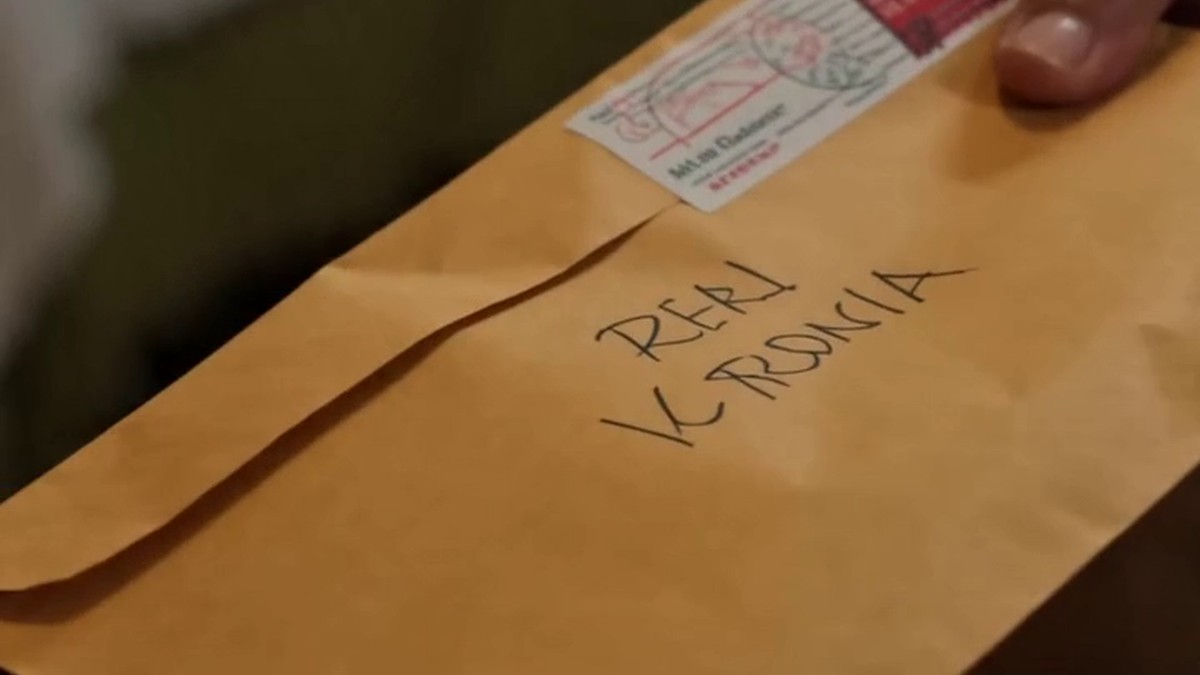
The elderly woman did not move. She reached into her worn handbag and drew out an envelope — yellowed with age, the paper soft and fragile at the edges. She held it out without a word.
Verónica looked at the envelope. She looked at the door. She looked at the room full of people watching her with their careful, wealthy eyes. For a long moment she did not move. Then, with a deliberateness that was itself a kind of resistance, she crossed the distance and snatched it from the old woman’s hand.
Inside was a hospital maternity bracelet, the kind placed on newborns in the delivery room. Her full name was printed on it in faded ink. Below her name, a single word: Boy.
Beneath the bracelet was a letter. The handwriting was her mother’s.
*Forgive me, my daughter. The doctors told you the baby had died at birth. That was a lie. Your husband paid to have the truth buried. He was afraid that a child born outside the boundaries of what his voters would accept would end his political career before it truly began — a scandal he believed he could not survive. The baby had a rough first month, and that fear only made him more ruthless. I found out too late to stop what he had done. But I found the boy, and I raised him in secret, and I am glad to tell you he grew strong. He is healthy. He is whole. The medallion I kept with him from the beginning — I took it from your hospital room the day they told you he was gone, because I knew even then that the truth would have to find its way back to you somehow. Before I leave this world, I need you to promise yourself something — that one day you will find him, and you will ask for his forgiveness.*
The letter slipped from Verónica’s fingers. It drifted to the marble floor without a sound.
She did not weep immediately. For a moment she simply stood there, very still, the maternity bracelet in her palm, her face doing something complicated and private that had no name. The wall held — and then it didn’t. The grief that came out of her was not the polished, controlled kind she might have permitted herself in private. It was something broken open, raw and heaving, eight years of loss she hadn’t even known she was carrying pouring out of her in the middle of her own restaurant.
She looked at the boy again through her tears. That was when she saw it — a small silver medallion hanging around his neck on a thin chain. Her breath stopped. She knew that medallion. She had bought it during her pregnancy, in a small jewelry shop she’d wandered into one afternoon, months before everything had been taken from her. She had bought it for the child she was told never came home. Her mother had kept it with him all along — a thread connecting them across eight years of silence.
She took a step toward him. Then another.
“What’s your name?”
The boy’s voice was barely a sound. “Mateo.”
He glanced up at her, cautious, with eyes that had already learned to brace for disappointment. “My grandmother told me my mom was a good person. She said my mom just never knew I existed.”
Something inside Verónica Salazar — something that had been rigid and armored and defended for years — gave way completely. She sank to her knees on the marble floor in front of him, right there, in front of every person in the room.
“Forgive me,” she whispered.
Mateo studied her face with a child’s careful, unguarded honesty. “Are you… are you really my mom?”
She pulled him into her arms and held him with the desperation of someone who has just understood what they almost lost forever.
“Yes. And I have spent eight years missing you without knowing what I was missing.”
Behind them, the old woman pressed her hand to her mouth and let her own tears fall.
“I didn’t come here for money,” she said to no one in particular, and to everyone at once. “I only came so this boy could meet the mother he always dreamed of.”
The room was very quiet. Near the window, a woman had stopped pretending to look at her menu. A man in an expensive suit stared at the tablecloth, his jaw tight, his eyes somewhere else. No one moved. No one spoke.
Verónica rose to her feet. She turned to face the room — her room, her kingdom, the place she had built every rule around — and she felt the full weight of what she had said twenty minutes ago.
“A few minutes ago,” she said, her voice unsteady but clear, “I called beggars the two most important people in my life.”
She looked down at the boy beside her. His hand was in hers now, small and warm and real.
“Mateo.” She said his name like she was testing the sound of it, learning it, committing it to memory. “From today, this restaurant is your home too. You will never again walk through a door and feel like you don’t belong.”
The boy looked up at her. And for the first time since he had stepped inside, he smiled — a small, tentative, genuine smile that broke across his face like light through a crack.
A few people near the back of the room began to applaud — not the reflexive, social kind, not the sound a crowd makes to mark the end of a performance, but the quieter, more reluctant kind that escapes people when they have seen something they were not prepared to see. It did not fill the room. It did not need to.
The old woman took Verónica’s free hand in both of hers and held it.
“Your mother would have been proud,” she said. “She never stopped loving either of you.”
Verónica pressed her lips together and nodded, unable to speak. Her husband — the man who had bought his way into office on the back of this lie and buried his own son to protect it — was a problem that would keep until morning. She knew what she needed to do. She had his letter now. She had a witness who had raised his child for eight years. He would not be untouchable for much longer. But that was tomorrow. Tonight belonged to something else.
Later that night, long after the last guests had gone and the candles had burned low, Verónica sat in a corner booth with Mateo asleep against her shoulder. His silver medallion glinted faintly in the last of the light — the same medallion her mother had slipped from a hospital room eight years ago, keeping it safe for a reunion she had always believed would come. Verónica held him carefully, the way you hold something you almost didn’t get the chance to hold at all.
She had built La Toscana to be perfect. Flawless. Untouchable.
She understood now, for the first time, that the only thing she had ever truly been missing was this — a small boy with her eyes, a worn medallion, and a grandmother brave enough to walk through a door that was never supposed to open.