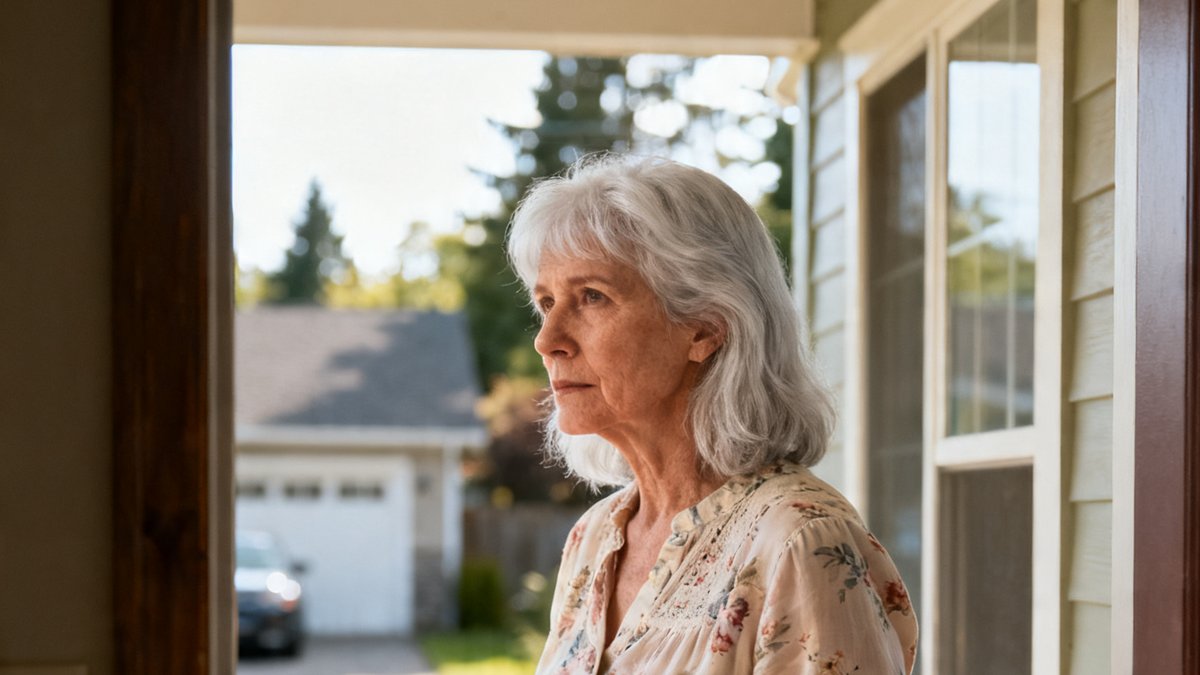
The afternoon I heard my son’s wife call me a meddling old bat through the kitchen window, I was standing on their front porch holding a tuna casserole and a bag of unsolicited wallpaper samples. I froze. Then I set both down beside the welcome mat, walked back to my Subaru, and drove home without starting the ignition for a solid five minutes.
His name is Kyle. Her name is Jenna. They had closed on a fixer-upper in Beaverton three months earlier, and I had been over there every weekend since. I showed up with paint swatches, with coffee and donuts, with my late husband’s toolbox. I rearranged their furniture while they were at work, left sticky notes on the fridge about which contractor had gone to high school with my cousin, sat in their living room scrolling Pinterest boards and narrating my finds aloud while they exchanged looks I pretended not to see.
I told myself I was helping. I was their mother. That was the whole job.
The afternoon before the casserole, I had arrived unannounced—again—to find them arguing in the half-stripped dining room. Jenna was crying into a dust rag, and Kyle’s hands were shaking as he pried up baseboards. Something about a plumbing quote that had tripled. I stepped in with “Here’s what you need to do,” and Jenna said nothing. She just wiped her face and walked out. Kyle set the crowbar down and said, very quietly, “Mom. I can’t. Not right now.”
He’d never spoken to me like that in his twenty-nine years.
I sat in my own living room that evening with the TV off and the ceiling fan ticking, and the silence pressed against my chest like a stack of bricks. I was furious. I had helped them with the down payment, hadn’t I? I had put his lunch in dinosaur-shaped containers for five years at that elementary school. I had held his hand in the emergency room, walked him through his first breakup, taught him how to shave. And now he didn’t want my input on the guest bathroom tile?
I replayed the scene over and over—the set of his jaw, the way his voice didn’t crack. He had actually meant it.
The next morning I called my sister, but Grace was no comfort. “Linda,” she said, “you’ve been nesting in that house more than they have. Leave them alone.” I hung up. I called my church friend, Beverly, who was seventy-four and wore purple sneakers and never offered advice unless you asked. She invited me over. I went.
Beverly poured iced tea into two tall glasses and listened to the whole torrent—the wallpaper books, the Tupperware, the casserole left rotting on the porch because neither Kyle nor Jenna ever brought it inside. When I finally stopped talking, she took a sip and said, “Honey, do you remember when your own mother-in-law used to come over and alphabetize your spice rack?”
I blinked. Marge. Back in the nineties, Marge would let herself into our little house in Portland with a key I’d never given her, rearrange the pantry, fold the towels a different way, and leave Post-it notes on the refrigerator: *You might want to use less butter in that chicken.* I used to slam cupboards after she left. I’d complain to Kevin for hours. And he would say, “She means well, she just doesn’t know when to stop.”
Beverly didn’t say anything else. She just refilled my tea.
That night I sat on my bed and spoke to the ceiling. “Kevin,” I said, “you’d laugh if you were here. I’ve turned into your mother.” And then I cried for a while—not the pretty crying, the kind that leaves your eyes swollen and your throat raw. Because I finally saw it: every recommendation I’d made, every “just trying to help,” had landed on them the same way Marge’s had landed on me. Not as love. As trespass.
I didn’t drive to Beaverton for the next two weeks. I didn’t text asking for progress photos. I left their group chat on mute. I signed up for a watercolor class at the community center, something I’d thought about for years and always pushed aside. I started painting lopsided flowers and gray skies and the view from my porch. I walked in the mornings. I let my phone sit on the counter while I cooked.
It was brutal. The worry didn’t just vanish—it churned in my stomach at odd hours. I pictured pipes bursting, wallpaper peeling, Jenna walking out on Kyle because he couldn’t handle the stress. I wanted to fix it all. But I knew, now, that rushing in would only push them further away. So I bit my tongue. I prayed a lot. I drank a glass of cheap merlot with Beverly on her patio and talked about everything except the house.
Three weeks in, Kyle called. Not a text—a call. I stared at his name on the screen for two rings before answering.
“Hey, Mom.” His voice was lighter than it had been. “Jenna and I were wondering if you’d like to come for dinner Friday. Just dinner. No tools.”
I almost said, “Do you need me to bring anything?” The old impulse rose in my throat like a reflex. But I swallowed it. “I’d love that,” I said. “What time?”
When I pulled into their driveway that Friday, the old Toyota was gone, replaced by a sleek little Honda I didn’t recognize. The porch light was on, and Jenna opened the door before I knocked. She looked tired but calm, her hair pulled back in a loose braid, paint smudges on her forearms. “Hi, Linda,” she said, and she smiled. Actually smiled.
Inside, the dining room was finished. The walls were a buttery yellow I had definitely not suggested. The buffet table that had been buried in a corner was now the centerpiece, laid with mismatched plates and a ceramic pitcher full of sunflowers. Kyle was in the kitchen stirring a pot, wearing an apron Kevin had given him years ago. “We did that one thing you mentioned,” he said, pointing toward the wainscoting in the hallway. “But we—”
“—picked a different trim,” I finished. “It looks wonderful.”
And it did.
We ate spaghetti and meatballs. Jenna talked about her new job. Kyle showed me a scar on his thumb from a box cutter accident I hadn’t been called about, and I nodded instead of gasping. When I eventually asked, tentatively, if they needed help with the upstairs bathroom, Jenna said, “Maybe next month. We want to figure out the layout ourselves first.” And Kyle looked at me—not with annoyance, but with something gentler. As if he were checking to see if I understood.
I did.
After dinner, they walked me to the car. The night was cool and smelled of cut grass. Jenna gave me a quick hug, the first genuine one in months, and Kyle held the driver’s door open. “Thanks for coming, Mom,” he said. “And thanks for… you know. Giving us some room.”
I drove home with the radio off, the streetlights sliding over the windshield. On the passenger seat was a small Tupperware container—leftover meatballs, the lid pressed down tight, this time because they’d wanted me to take them. I didn’t cry again until I was already in my own kitchen, standing at the sink with my watercolor paintings drying on the counter. And I wasn’t sad. I was looking at a purple, lopsided iris I’d painted on a Tuesday when I’d wanted desperately to drive over and check on them, and I realized that for the first time in my adult life, I had trusted them enough to do it all without me.
That’s the thing nobody tells you about raising children: the real finish line is the moment they don’t need you, and the real victory is the moment they come back anyway. Not because they have to. Because there’s a woman waiting who knows how to sit in silence, a warm plate of food, and a door that’s always open—just not pushed.