The first time I heard it, I was elbow-deep in oatmeal. Six-fifteen in the morning, and my kitchen already smelled like a daycare—banana mush, coffee grounds, and the faint, sweet stink of Play-Doh from yesterday’s abandoned art project.
The chime went off. Not my phone. The intercom.
My granddaughter Danielle’s voice crackled through the little speaker mounted by the back door. She was already in the driveway. I could hear the engine of that beat-up Kia running.
“Nana, you up? I’ve got them.”
Then a second voice, tinny and distant, on her car’s Bluetooth. Her friend Chloe.
Danielle wasn’t talking to me anymore.
I wiped my hands on a dishtowel and pressed the button to let her know the back door was open, but the intercom has a quirk. Once triggered from outside, it stays hot for a good thirty seconds. I heard everything.
“I mean, it’s not like she’s got a packed schedule,” Danielle was saying, her tone light, conspiratorial. “Honestly, Chloe, she just putters around that bungalow all day. It gives her something to do. Better than yelling at game shows, right?”
A laugh. Not a mean laugh. Just… easy. The laugh of someone stating a simple, obvious fact. The sky is blue. Water is wet. And Nana has nothing but time.
My hand froze on the towel.
*Putters around.*
I looked at the table. Two plastic plates, cut-up toast, scrambled eggs going cold. My sixty-nine-year-old fingers, knobby and stiff, had been scrambling those eggs at 5:50 a.m., after pulling on a pair of jeans with one hand while checking the baby monitor with the other. My knees ached from yesterday, lugging Max, the three-year-old, up and down the steps of the public library for story time because it was raining and his stroller had a flat tire I hadn’t had a free hour to fix.
*Putters around*, she said.
My mind flicked back to the last two years, ever since Danielle’s no-good boyfriend, Devon, walked out, leaving her with a mortgage on a house in Maumee and two kids under six. I’d sold my condo in Sylvania and bought this little 1950s bungalow in the Old West End of Toledo just to be ten minutes away. I’d told myself it was for the quieter streets, the giant oak in the backyard. But we both knew the truth.
The deal had been simple, made over coffee and a box of tissues: “Just until she gets back on her feet.” I’d be the anchor. Morning drop-off at six-fifteen so Danielle could make her nursing shift at Mercy Health by seven. School drop-off for Lily, six, at eight. Then a whole day with Max, who was in that phase of life where his primary hobby was trying to electrocute himself or swallow a LEGO.
Then pick up Lily at three. Homework with a first-grader who would rather dissect an earthworm than write her letters the right way around. Dinner. Baths. Pajamas. Danielle would stumble through my back door at five after eight, a blur of pale-blue scrubs and exhaustion, kiss their damp heads, and buckle them into car seats for the five-minute drive home. They’d be asleep before she hit her own driveway.
Thirteen hours. Monday through Friday. Sometimes a Saturday if she picked up an extra shift.
I’d sacrificed my Tuesday water aerobics class at the YMCA because it was the only time Max napped and I didn’t have the energy anymore to make the drive. I’d rescheduled a cardiologist appointment twice because Danielle had a mandatory staff meeting and couldn't give me a solid time she’d be back. My dear friend Barbara stopped calling to suggest our Thursday coffee at the Hungarian bakery on Consaul Street. She told me once, gently, “Evelyn, you’ve just evaporated on us.”
I’d told myself it was temporary. That I was the glue holding a fractured little family together. That being a great-grandmother meant this was just the season of my life now. The season of eternal, aching fatigue, of knees that popped when I stood up, of a life reduced to the radius of a playground and a pediatrician’s office.
But to her, it was puttering.
She saw my sacrifice as a pastime.
The back door swung open. Danielle, her hair in a frantic topknot, a travel mug of something steaming in her hand, ushered in Lily with a glittery backpack and Max, who was still in his dinosaur pajama pants.
“Morning, Nana, you’re a lifesaver,” she said, already half-turning back to the door. “Max was up at four with a nightmare, so he might be a beast by noon. They had a donut in the car. Love you!”
Two quick air-kisses, a pat on Max’s head, and she was gone, the Kia crunching down the gravel alley before I could even get out a full sentence.
I stood there, holding the dishtowel, looking at Max, who was already reaching for the butter dish with a sticky hand, and Lily, who was complaining that her sock was “bumpy.” A cold knot had formed in my chest, right behind my sternum. It wasn’t anger. It was something deeper and more hollow. A sudden, dizzying perspective shift, like looking through the wrong end of a telescope and seeing how small you truly were.
The knot stayed there all day. Through Max’s screaming tantrum over a banana that was peeled the “wrong” way. Through the frantic search for Lily’s library book that was, of course, under the driver’s seat of my ten-year-old Buick. Through a microwave dinner I barely touched.
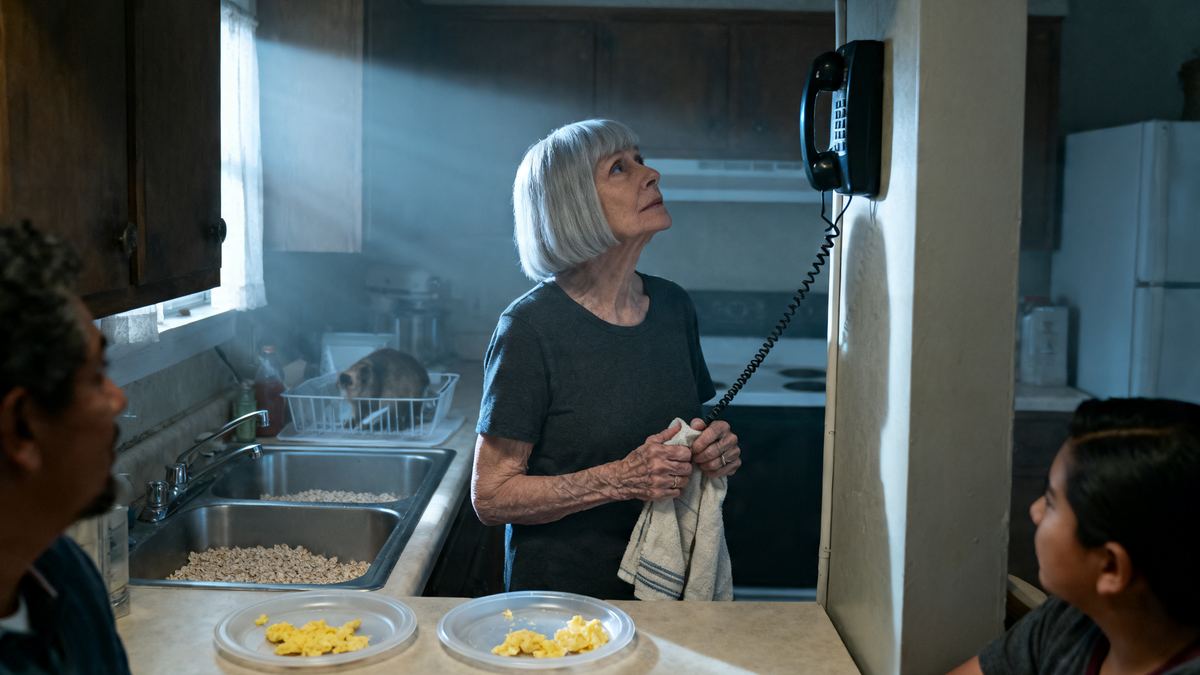
She came at five after eight, same as always. The house was quiet. Toys stacked, dishes done. I was sitting at the kitchen table with a cup of peppermint tea gone cold, the two plastic plates with their uneaten breakfast still sitting in front of me. I’d left them there on purpose. A little museum of my morning.
Danielle breezed in. “Hey, Nana. Wow, it’s quiet. Good day, I hope?”
She saw the plates. She saw my face.
“What’s wrong?”
I pointed to the intercom on the wall. “That thing,” I said, my voice sounding thin and old even to my own ears, “doesn’t shut off right away when you talk. This morning, I heard you. And Chloe.”
The color didn’t just drain from her face; it seemed to fall away, leaving a younger, more frightened woman standing in my kitchen. A girl I’d raised after her own mother, my daughter, passed away.
“Nana,” she started, her voice catching. “That was just girl talk. I didn’t mean—we were just being stupid—”
“I putter,” I said, interrupting her quietly. “That’s what I do. I have *all this free time*. Well, let me tell you what my day of puttering looks like.”
I didn’t yell. I just recited it. A dead-eyed inventory of my life. The 5:50 a.m. alarm. The scrambled eggs cooked with arthritic fingers that I keep meaning to get seen by a specialist but can never find the time. The total disappearance of my friends, my movement, my quiet. My health, slowly being traded for the privilege of being invisible.
“You know what hurts the most?” I said, finally looking her in the eye. “It’s not the work. It’s not my back. It’s that you think the woman who built her entire life around the hollow space you and your kids left behind is just killing time. Like my hours have no weight. Like my rest isn’t a physical need you’re consuming.”
Danielle’s face crumpled. She cried. She said she was sorry, that she was just trying to sound blasé and cool to Chloe, that she was an idiot, that she was exhausted and takes me for granted, that she’s a terrible person.
And I let her. I sat there, stone-faced, until she ran out of words.
“I need Tuesdays and Thursdays,” I said, finally. “My days. Not my days to catch up on your laundry or pre-cook your meals. My days to be a sixty-nine-year-old woman with a book and a pool and a friend. Without a toddler on my hip. You figure it out. Your mother would have figured it out.”
Mentioning my late daughter wasn’t a low blow. It was the truth. It was the elephant in the room that had been standing there for two years.
“Okay,” she whispered, wiping her nose with the back of her hand. “Okay. I’ll figure it out.”
The next three weeks were a new kind of hard. A cold, stilted truce. She’d pick them up right at 5:30 on the dot, not a minute late. She hired a neighbor’s high school daughter to cover Tuesdays. We were polite. Excruciatingly, devastatingly polite. I still loved those children with a ferocity that burned in my chest, but a wall had gone up between me and Danielle. The raw honesty had carved a canyon, and we were just standing on opposite cliffs, shouting pleasantries across the void.
One Thursday evening, my first free one in months, I was in my backyard, just sitting in an old wicker chair with a cup of tea, watching the fireflies wink on and off under the oak tree. The silence was a physical relief, a balm. But it was also lonely. It was a silence filled with the ghost of the chaos I both resented and longed for.
Then, a soft knock on the back gate. Not the intercom. An actual knock.
It was Danielle. She was alone. No scrubs. Faded jeans and a sweatshirt.
“Can I come in?” she asked, her voice thick with unshed tears.
I unlatched the gate. She walked in, sat in the other old wicker chair with a graceless thud, and stared at the fireflies with me.
For a long minute, neither of us spoke.
“I put Max in daycare part-time,” she finally said. Her voice was small, but something else was laced through it. A hard-won note of conviction, maybe. “A center near the hospital. It’s terrifyingly expensive. I’m going to have to pick up that Saturday shift for good. Devon’s mom is going to help on a few weekends, believe it or not.”
I just listened.
“I was so scared of failing, Nana,” she continued, her voice breaking. “Of not being able to do it all on my own. And I leaned on you until there was nothing left of you, and I didn’t even see it. I just… I told myself the story I needed to believe, so I wouldn’t drown in guilt every morning. The story that you were fine. That you were happy. That your life was simple and easy and my chaos was a gift to you. It was a lie, and we both know it.”
A tear slipped down her cheek. She didn’t wipe it away. She turned and looked at me, her eyes reflecting the last violet light of the sunset.
“I can’t give you back the last two years,” she said. “But I can stop stealing the next ones.”
Something in my heart, that tight, cold knot, shifted. It didn’t melt. It didn’t disappear. But it moved. It made room.
I reached over and placed my hand, gnarled and steady, on top of hers. We didn’t hug it out. We didn’t say it was all okay. But we sat there in the dusk, two women worn thin by life, and just watched the yard go dark.
The Friday after that, at 6:10 a.m., the intercom chimed. Lily’s voice, cracked with the sleepiness she’d never quite shake at this hour, sang into the speaker.
“Nana? It’s just me and Maxie today. Mommy says she’ll see us at five-thirty sharp and not to fight you about the crusts on our bread.”
A pause. A scuffle. Then Danielle’s voice, softer, closer to the mic, not a Bluetooth echo but a real, present thing. “And, Mom… I’m coming in for coffee. A real cup, before my shift.”
The intercom went silent. I stood in my kitchen, still barefoot, the old linoleum cool under my feet, and for the first time in a very long time, I wasn’t steeling myself for the storm. I was just waiting for my girls to walk through the door.