The morning air in our little Colorado mountain town still had that sharp November bite when I pulled up to Chelsea’s house at 6:52. The porch light was on, throwing a yellow pool across the frost-bitten lawn. I could see movement through the front window—a small silhouette hopping on one foot.
My grandson Gus, seven years old and already wearing his backpack, yanked the door open before I could even knock.
“Nana! I lost my other sneaker!”
Behind him, three-year-old Maya sat in the middle of the hallway in her unicorn pajamas, methodically taking books off the bottom shelf. My daughter Chelsea appeared from the kitchen, coffee mug in one hand, phone pressed to her ear with the other, mascara wand still in her fingers.
“Mom, thank God—I have that presentation at eight and the sitter canceled again,” she said, not really to me, more in my general direction. She kissed the air near my cheek, grabbed her laptop bag, and was gone. The Subaru backed out of the driveway before I’d even gotten Maya’s sneakers on.
Sixty-five years old, and this was my life now.
I used to have a rhythm up here in Crested Butte. Retirement had a shape I’d carved out carefully after Harold passed. Coffee on the back deck looking at the peaks. Water aerobics at the rec center at ten. Book club the first Wednesday of every month. A part-time volunteer shift at the wildflower festival office in summer. I’d earned that quiet. Two years ago, when Chelsea and Tom moved back from Denver with the kids, I thought I’d be the Sunday dinner grandmother. The one who shows up with cookies and leaves before bath time.
Somehow I became the thirteen-hour safety net.
It wasn’t supposed to go this way. But Chelsea’s marketing firm kept promoting her, Tom’s construction business had him on job sites from six to six, and daycare for two kids cost more than their mortgage. “Just for a few months,” Chelsea had said. That was two years ago.
So my days went like this: arrive before seven, get Gus to elementary school by 8:15, then keep Maya entertained, fed, napped, and not climbing the bookcases until pickup at 3:30. Then homework, snacks, the meltdown over the wrong-color cup, dinner, baths. Chelsea or Tom would roll in sometime after seven, sometimes closer to eight-thirty. I’d hand them two clean, fed, pajama-clad children and drive home in the dark, too tired to eat my own dinner.
The water aerobics membership expired. I didn’t renew it. My book club stopped texting to ask if I was coming. The wildflower office found another volunteer.
My lower back ached constantly. My right hand had started going numb some mornings. I told myself this was just what grandmothers did. You sacrifice. You show up. You don’t complain, because young people have it harder than we ever did, with their student loans and their housing costs and their hundred-mile commutes.
Still. I was disappearing inside their schedule, and I wasn’t sure anyone noticed.
The thing that cracked everything open happened on a Tuesday.
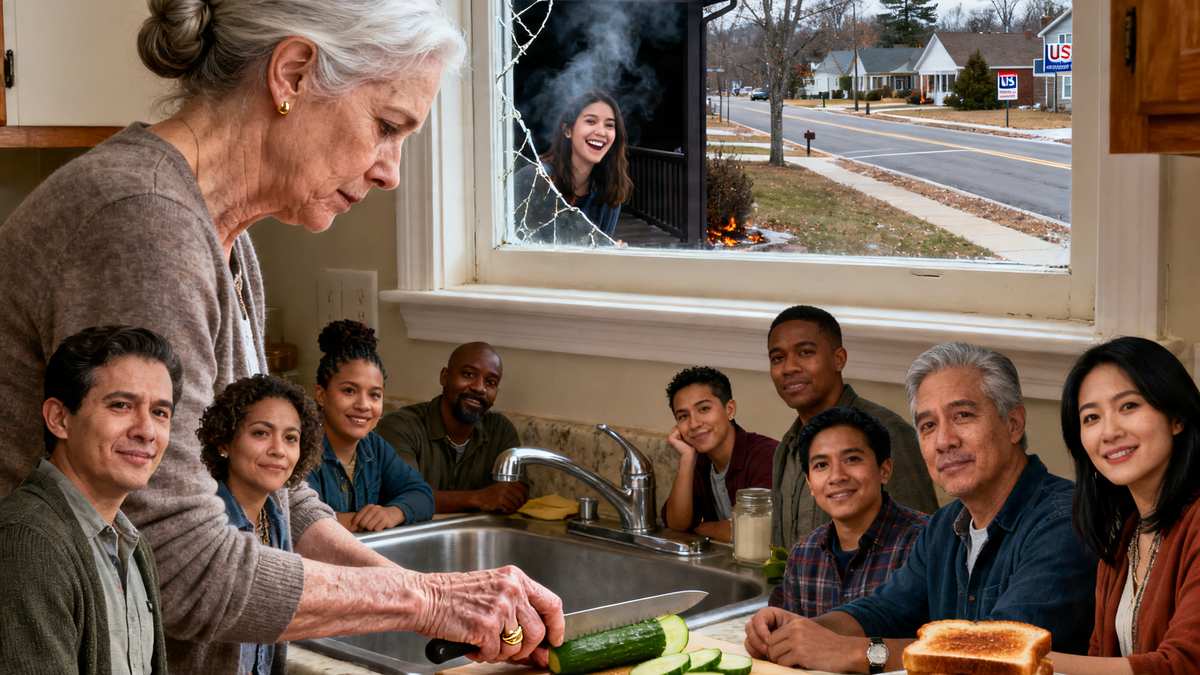
I’d had the kids since 6:55 that morning. Gus had a spelling test meltdown, Maya had refused her nap and then passed out on the kitchen floor at 4:47, and I’d burned the grilled cheese because I was trying to unclog the bathroom sink at the same time. By six-thirty I was running on fumes, my shoulder blades burning, chopping cucumbers with a hand that wouldn’t stop tingling.
I heard Chelsea’s car pull in a little before seven—early for once. Then her footsteps on the porch. Then her voice, loud and casual, through the front window she hadn’t realized was cracked open.
She was on speakerphone with her friend Jenna. I know Jenna’s voice from the PTA barbecues.
“Honestly, Jen, it’s kind of perfect,” Chelsea was saying. “My mom just sits at home otherwise. She literally does nothing all day. At least this gives her a purpose, you know? Keeps her busy.”
A laugh. Light. Effortless.
“Right?” Jenna’s voice crackled through the speaker. “My mother-in-law’s the same way. She’d just watch HGTV until she died.”
“Exactly. So really, I’m doing her a favor.”
The knife stopped moving in my hand. A cucumber slice sat half-cut on the board.
Nothing all day.
The 6 a.m. alarm I set so I could stretch my back before driving over. The forty minutes of convincing Maya that pants are not optional in November. The spelling words I quizzed until my throat was dry. The pediatrician appointment I’d taken Maya to last month because Chelsea had a “can’t-miss” conference call. The physical therapy evaluation I’d canceled three times because it conflicted with school pickup.
Nothing all day.
I set the knife down. My hands were shaking, and not from the nerve thing.
Chelsea came through the door, still laughing at something Jenna had said, tapping to end the call.
“Hey, Mom. How were the monsters today?” She was already scrolling through something on her phone. “Did Gus finish his spelling packet? Tom said he’d—”
“I heard what you said to Jenna.”
She looked up. Blinked. “What?”
“Just now. On the porch. About me doing nothing all day. About how this gives me purpose.”
The color drained from her face in a way I’d never seen before. Like watching a window frost over from the inside.
“Mom, that—I didn’t mean it like that. It came out wrong. You know how Jenna and I talk. We were just—”
“You were just telling the truth when you thought I wasn’t listening.” My voice came out steadier than I felt. “That’s when the truth comes out, sweetheart. When no one’s supposed to hear.”
Gus looked up from his spelling worksheet at the kitchen table. Maya stopped arranging her cucumber slices into a smiley face. The room went very still.
I picked up my purse from the counter. I am not a dramatic woman. I did not slam anything or raise my voice. But something in the way I moved must have scared Chelsea, because she stepped backward.
“For two years,” I said, “I have lived inside your schedule. Not mine. Yours. I have canceled doctors. I have pushed through pain. I have loved your children like they were my own second chance at motherhood, and I have never asked you for a single thing except to be seen.” I pulled my coat from the hook. “Thirteen hours a day is not nothing. It’s my body. It’s my remaining years. And I will not let you call that empty time.”
Chelsea’s eyes were wet. She opened her mouth, closed it, opened it again.
“Mom, please. I’m sorry. I’m so sorry.”
“I believe you. But sorry doesn’t un-ring the bell.”
I kissed Gus on the head. Squeezed Maya’s small warm shoulder. Then I walked out to my car and sat in the driver’s seat for ten full minutes before I could turn the key.
The next three weeks were quiet in a way our family had never been quiet.
The kids still came. I wouldn’t punish them for something their mother said. But I set terms. Monday, Wednesday, Friday—I was theirs. Tuesday and Thursday—mine. No negotiation. No guilt. No last-minute “emergencies” that were really just poor planning. Chelsea would have to figure it out. Tom would have to leave the job site early. They’d have to do what parents everywhere do and *make it work*.
The first Tuesday, I went to the rec center and got in the warm pool with the other silver-haired women and moved my aching shoulders in circles while the instructor called out encouragement. I cried a little, and the water hid it.
Chelsea was stiff with me now. Polite in a formal way. We’d lost something—the easy rhythm, the assumption that everything was fine because no one said otherwise. Gus asked me last Friday why his mom and I “talked like strangers now.” I told him grown-ups sometimes need time to remember how to be friends.
The truth didn’t destroy us. But it drew a line.
Last night, Chelsea called. Not a text—an actual phone call. She said she’d found a part-time daycare spot for Maya, two days a week. She said she’d been thinking about what I said. She didn’t apologize again, but something in her voice was smaller than before. Less certain.
“I forgot you had a life before us,” she said quietly. “I forgot you were a whole person. Not just my mom. Not just their grandma.”
I sat on my back deck, watching the last light drain from the peaks. The aspens behind the house had gone bare. A magpie landed on the railing, cocked its head at me, flew off.
“I’m still figuring out what I want that life to look like now,” I said. “But I know it can’t look like it did.”
“Okay,” she said. And then, after a long pause: “Would you want to come for dinner Sunday? Not to watch them. Just to eat. With us.”
The magpie was gone. The mountains were going purple in the dusk. My shoulder ached a little less than it had that morning. I told her I’d bring dessert. Not because anyone asked me to. Because I wanted to.
It’s not the same as it was. I don’t think it will be for a while. But the crack Chelsea papered over with easy laughter and careless words—that crack was always there. At least now we can both see it. At least now we might actually decide whether to fix it together, instead of pretending the paint is still smooth.