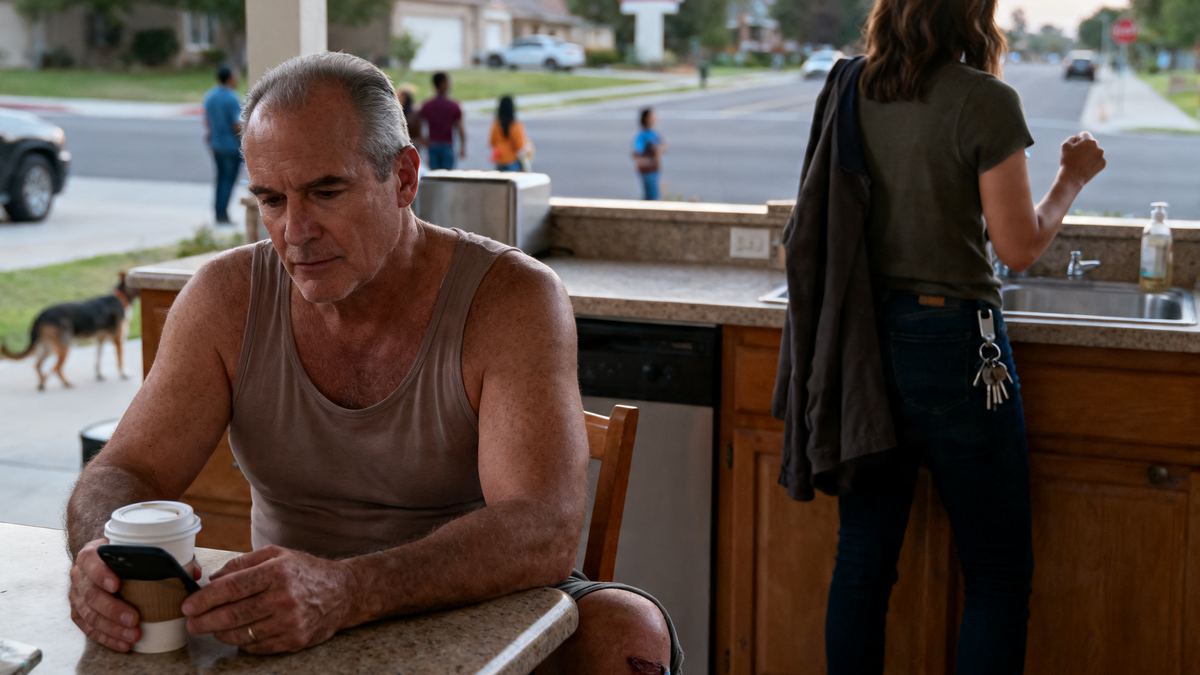
Mike couldn’t remember the last time he’d slept more than two hours. Three months since the plant closed, three months of staring at the ceiling while Sarah got ready for work, and every morning the same look on her face—half pity, half frustration. This morning, he’d given up on sleep entirely. He sat at the kitchen table in his undershirt, coffee gone cold, scrolling through job listings that didn’t want a fifty-three-year-old maintenance guy with a bad knee.
Sarah set her mug in the sink a little too hard. The clink cut through the silence. “Okay. That’s it.”
He didn’t look up. “What’s it?”
“You.” She pointed at him with a dish towel. “You can fix a furnace with a paperclip. You rebuilt our transmission in the driveway. I haven’t called a repairman in twenty years, Mike. You know what people pay for that?”
“I’m not starting a business, Sarah.”
“Why not? ‘Husband for an hour.’ Handyman. Same thing.” She grabbed her jacket, keys jingling. “I need the car at the bank until five. Before that, it’s yours. Drop me off, take those flyers you printed to the grocery store bulletin board, and do something. Anything.”
She kissed the top of his head and left. He heard the engine turn over. By noon, he had three voicemails.
The first job was out in Crestwood Hills, the part of Millbrook where the driveways were longer than his whole block. The woman who answered the intercom had a voice like clinking ice cubes. She led him into a foyer with a ceiling two stories high and a crystal chandelier still in its crate, massive and glittering under bubble wrap.
“It’s Murano,” she said, one hand stroking a fluffy white cat that gave Mike the same appraising look as its owner. “Real Venetian glass. My husband brought it back from Milan. Handle it like it’s a newborn.”
Mike studied the crate. He’d hung a dozen fixtures in his life. He spotted the tiny gold sticker on the underside of one arm before he even lifted it—*Made in China*. He said nothing.
An hour later, the new chandelier sparkled exactly like the thousand-dollar imitation it was. The woman handed him a crisp hundred-dollar bill and gestured toward the hallway. “The old one—take it to the dump on your way out. It’s just in the way.”
The “old one” was a solid brass piece, five arms with etched glass shades. Early nineties, maybe, but quality. He wrapped it in a moving blanket and set it gently in his trunk.
He was driving toward the next address when his phone rang. A woman’s voice, shaky. “I know you’re busy, but can you come now? There’s a cat behind my wardrobe and I can’t move it. He’s been back there since Tuesday.”
Mike glanced at the clock. He had two hours. “I’ll be there in ten minutes.”
Mrs. Kowalski’s apartment smelled like lavender and old books. She was seventy if she was a day, with thin hands that wrung a kitchen towel nonstop. In the corner, a fat orange tabby sat on the windowsill like a king surveying his territory.
“That’s Morris,” she whispered. “He’s the problem. When my neighbor passed, I took in his cat, Toby. Morris won’t let him out of that space. Toby hasn’t eaten since I brought him home. I hear him crying at night.”
Mike peered behind the massive oak wardrobe. A pair of yellow eyes blinked back, terrified. He crouched low, making soft clicking sounds with his tongue, the same sound he’d used with strays as a kid. The eyes didn’t move.
“Morris, you need to stay right there,” Mike said. The orange cat flicked his tail.
He talked for twenty minutes, not to the cat, just talked—about nothing, about the weather, about how he’d found an old socket wrench set at a yard sale once. His voice was low and steady. Finally, a small gray head poked out from under the wardrobe. One paw. Then another. Toby crept across the floor and pressed his body against Mike’s shin, trembling.
Mrs. Kowalski’s hands stopped twisting the towel. “Oh, thank heaven.”
While Toby ate an entire can of tuna and used the litter box for the first time in three days, Mike fixed the loose handle on her kitchen drawer and replaced the gasket in her whistling kettle. She tried to press a twenty into his palm. He closed her fingers around it.
“Tell you what,” he said. “I’ll take Toby tonight. I might know somebody who needs him.”
Tears welled up in her eyes. “Morris will be so relieved.”
The third call was an apartment on the south side, one of those red-brick buildings from the seventies where the hallways still smelled like somebody’s dinner. A woman opened the door before he could knock. She was in scrubs, hair pulled back tight, and she was already pulling on a jacket.
“Denise,” she said, shaking his hand. “I have to be at the hospital by three, my shift starts early. The curtain rods are in the front room. All of them need installing. I’ll be back by seven. Leo’s here, he’s ten. He won’t bother you.”
Mike was about to protest—leaving a stranger alone with her kid?—but then a boy appeared in the hallway behind her. He was small for his age, with dark hair and braces on both legs, leaning on forearm crutches.
“Hi,” the boy said. His voice was careful, rehearsed. “I’m Leo. I can show you where the tools are.”
Denise kissed his forehead. “Be good.” Then she was gone.
For the first hour, Mike worked in the living room, measuring and drilling and trying not to stare at the sagging furniture and the pile of medical bills on the coffee table. Leo sat on the couch and watched, asking a thousand questions about the drill, the anchors, why some screws were longer than others. Mike answered every one.
Somewhere around the second window, the boy said, “Mom didn’t have to take me, you know. She could’ve said no. She was just my aunt.”
Mike’s hand stilled on the drill. He turned.
Leo kept his eyes on the window. “My real mom, she left when I was three. Right after the surgery that didn’t work. She dropped me at the hospital and never came back. Mom—Denise—she came and got me. Sold her car to pay for the braces I’ll need forever. I’m not supposed to know that part.”
Mike set the drill down carefully. “Your mom sounds like a keeper.”
Leo’s chin quivered, but he smiled. “She doesn’t even date. Says there’s no time. I think she’s lonely.”
Mike thought about that for a minute. Then he went to his trunk and brought back the brass chandelier wrapped in the blanket. Leo’s eyes went wide.
“What’s that?”
“Something I think this room is missing. Help me hold it up.”
They hefted it together, the boy balancing on his crutches while Mike lifted. The ceiling in that living room was ordinary textured plaster, but the moment the chandelier’s glow would hit it, the whole place would feel different. Leo laughed. “It’s way too fancy.”
“No such thing.”
When Denise walked in at seven, she stopped in the doorway. The chandelier was hung, its bulbs warm and golden. Mike had replaced a broken switch plate and tightened the wobbling ceiling fan. The new curtain rods were straight and level.
Her mouth opened. “I can’t… Mr. Carver, that isn’t in my budget. I can’t pay for that.”
“It was free,” Mike said. “A lady in Crestwood was throwing it away. I just installed it.”
She shook her head, tears threatening. “I can pay you for the rods, but that’s it. I’m sorry.”
Mike looked at Leo, who was beaming up at the fixture. “We worked out a deal. I told Leo I know a cat who needs a boy. Seems fair.”
Leo gasped. “Seriously? Mom, can we? He’s all alone and he’s gray and he’s been hiding from a mean orange cat for three days and—”
Denise blinked. “A cat?”
“I’ll be back in an hour,” Mike said.
By eight o’clock, Toby was in Leo’s lap on that thrift-store couch, purring like a rusty motor. The cat had stepped out of the carrier, given one long look at the boy, and jumped up as if he’d lived there for years. Denise sat beside her son, one hand absently stroking the cat’s ear, her other hand wiping her eyes with the back of her wrist.
Mike only charged her half the agreed price. She argued. He said the chandelier’s installation was a bonus, and the cat delivery was on the house. She gave up and hugged him—a quick, fierce hug that made his throat tight.
He pulled into the bank parking lot at five after nine. Sarah was waiting under the streetlight, purse over her shoulder, looking tired. She slid into the passenger seat and studied him for a long moment. Then her eyebrows rose.
“You look different,” she said. “Like—you again.”
Mike shrugged. “Busy day.”
He pulled out of the lot, but then he reached inside his jacket and carefully withdrew a tiny, squirming gray kitten. The thing was so small it could fit in his palm, ears still a little too big for its head.
Sarah gasped. “Mike! Where did you—”
“Back alley behind the apartment building. Almost got hit by a delivery truck. I couldn’t leave it.”
The kitten let out a squeak and Sarah immediately took it, cradling it against her chest. It burrowed into her scarf, purring so loudly it sounded like a tiny engine. She looked from the kitten to her husband, and her eyes softened in a way he hadn’t seen in months—maybe years.
“You’re the best man I know,” she whispered.
She leaned over the console and kissed him, the kitten a warm, furry knot between them. Mike put the car in gear and drove home with one hand on the wheel and the other resting on Sarah’s knee. In the back seat, his tool box rattled softly. And up front, for the first time since the plant went dark, he didn’t dread what he’d face at the door.