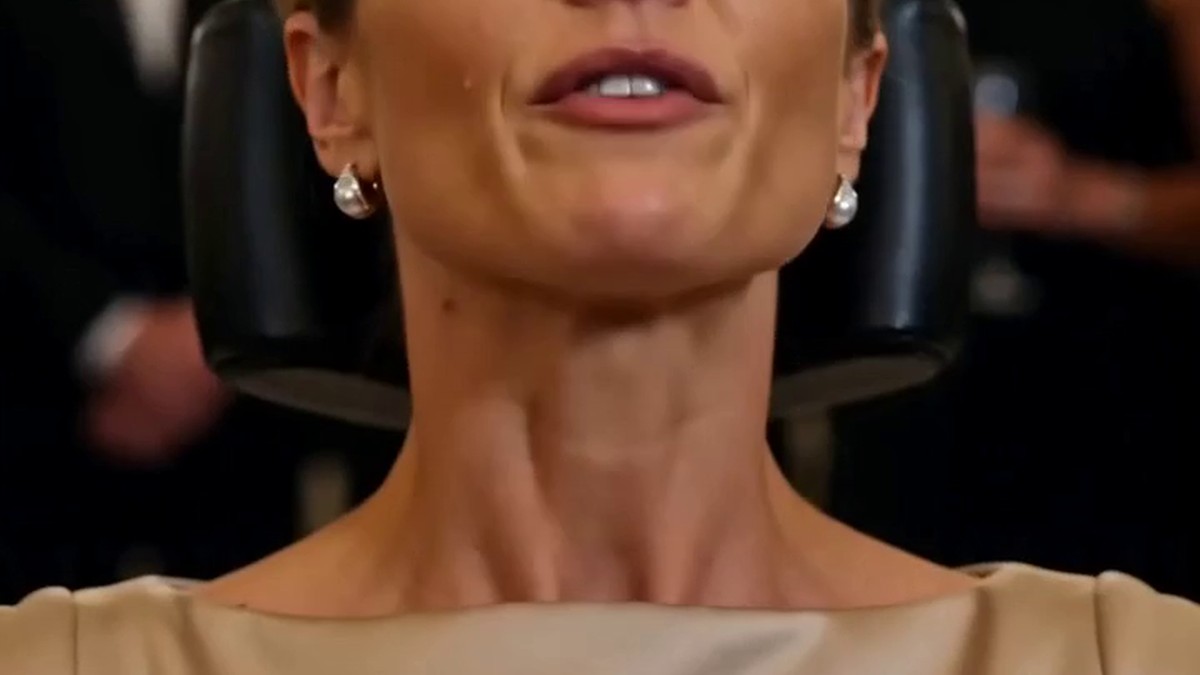
The grand ballroom blazed under the cold fire of a dozen crystal chandeliers. Every surface gleamed—champagne flutes, polished marble, diamonds at women’s throats. The clink of silver against porcelain mingled with the low hum of polite, moneyed conversation. Elegance was the price of admission, and every guest had paid in full.
At the room’s center, the opulence cracked.
A young woman in a simple beige dress sat in a wheelchair. No jewelry. No elaborate hairstyle. Just dark, tear-filled eyes—but for one microsecond they flicked to the delicate watch on her wrist, a gesture so slight it might have been a trick of the light—then back to the man who had summoned her. He stood over her like a monument of disappointment, his tailor-made black suit and silk tie costing more than most people’s yearly salary, his face carved from contempt.
“You should never have appeared in front of my associates.” His voice was a blade wrapped in velvet—quiet, surgically cruel. “You know your place.”
The silence that followed was absolute. A hundred guests held their breath, champagne forgotten. Waiters froze with trays mid-air. The girl’s chin trembled, and the tears she’d fought for years finally won.
“I only wanted to see you happy, Father,” she whispered, the words fracturing as they left her lips. “Just once.”
He didn’t flinch. If anything, his jaw tightened with fresh annoyance. In his world, emotions were like bad investments—liabilities to be cut loose. He took a breath to finish the humiliation, to dismiss her like a broken centerpiece.
But someone else moved first.
From the edge of the human circle, a waitress in a crisp white blouse and black skirt stepped forward. Her name tag read “Elena.” Her posture didn’t bend. Without a hint of hesitation, she planted herself between the millionaire and his daughter—a human shield woven from nothing but years of silent service and a sudden, ferocious conviction.
“She deserves love, not to be hidden away like something you’re ashamed of,” Elena said. Her voice didn’t boom; it settled over the room like a stone dropped into still water—impossible to ignore.
The man’s head swiveled toward her, his expression teetering between disbelief and incinerating anger. His eyes swept down her uniform and back up, cataloguing her insignificance.
“You are nothing but an employee,” he spat, the words dripping with the entitlement of someone who had never been told no. “Know your place, or find yourself on the street by morning.”
Elena didn’t blink. She met his stare with a stillness that made his wealth look flimsy, his power paper-thin.
“And you,” she said, each syllable steady as a heartbeat, “are just a rich man with no heart. All this,” she gestured vaguely at the chandeliers, the banquet, the glittering crowd, “can’t buy you a single moment of actual dignity.”
A collective gasp rippled through the guests. Someone dropped a fork. The air itself seemed to recoil, charged with the electricity of an unforgivable truth spoken aloud. Millionaire and waitress stood locked in a battle of wills—one armed with a bank account, the other with something far more dangerous: complete moral clarity.
The man’s mouth opened, but nothing came out. For the first time in decades, he was stripped of retort. Silence sharpened the seconds into shards of glass.
Beside him, the girl in the wheelchair shattered. A raw sob tore out of her chest, not from the earlier cruelty—or not only from that—but from the sheer, overwhelming relief of being defended. Of someone—anyone—finally seeing her as worthy. Tears carved hot trails down her cheeks, and her thin shoulders shook. But even as she wept, her fingers curled around the armrests with a grip that was anything but weak—a grip that held something back as fiercely as it held on.
Through the sobs, a new sound emerged. Soft at first, then growing. Not crying—a quiet, broken laugh.
The girl in the wheelchair lifted her head.
Her eyes, still glistening, had changed. The hurt was there, raw and deep, but beneath it something else had kindled: resolve. She wiped her cheeks with the back of her hand, and when she spoke, her voice filled the room more completely than any chandelier light.
“You’re both right,” she said, looking first at Elena, then at her father. “Elena is right that I deserve love. And you, Father…” She paused, letting the word hang in the air like a verdict. “You’re right that I shouldn’t have had to appear in front of your associates.”
The man’s brow furrowed, a flicker of confusion warring with his ingrained arrogance. “Finally a moment of sense—”
“You shouldn’t have any associates,” she cut in. “Not anymore.”
She straightened in her chair, spine as rigid as the metal frame, and suddenly she didn’t look fragile. She looked like a judge pronouncing sentence.
“Today is my twenty-fifth birthday, Father. Or had you forgotten while you were busy erasing me from every guest list?” She let the question land. “Mother didn’t forget. When she died—in the same car accident that left me in this chair—she left everything in a trust. The company, the estate, the holdings. All of it.”
A ripple of unease passed through the guests. The man’s face tightened, but confusion still dominated his anger. “What trust? I’ve managed this empire for fifteen years. I built—”
“You managed,” she corrected, her voice calm and cold. “Mother’s family founded the business. You were brought in to run it, and you did well—well enough to forget who really owned it. The trust was explicit: full legal control transferred to me, irrevocably, on my twenty-fifth birthday. You knew that, Father. You sat through the reading of the will. You just assumed I would never be strong enough to claim it. You spent fifteen years trying to make sure of that—hiding me, humiliating me, making me feel so small I’d never dare take what’s mine.”
The man’s face drained of color. “That’s—the trustees would have fought you. You’re a crippled, sheltered girl. I would have known if you—”
“As of seven o’clock this morning, the transfer was complete,” she said. “I didn’t need your permission. The trustees are bound to honor the original terms. I’ve been preparing for this day for fifteen years, Father. Every cruel word you spoke, every party you left me out of, I turned into a lesson. I waited. I learned. And I called my own lawyers five hours ago. They’ve been in contact with the trust’s administrators ever since.” Her lips curved into a small, fierce smile. “You should have checked your messages. Or did you just assume I’d never find the courage?”
The man’s mouth worked silently, and for the first time, fear broke through the arrogance. He had gambled everything on her continued weakness. He had lost.
“I didn’t come here tonight to ruin your party,” Isabella said, turning to address the stunned crowd. “I came to host my own. Ladies and gentlemen, welcome to the first official event under my leadership. I apologize for the earlier unpleasantness—change of management can be messy.”
Gasps erupted, no longer muffled. Several phones appeared, thumbs scrambling to text lawyers and spouses. The man—her father—lurched a step forward, color rising up his neck like a warning flare.
“You ungrateful little—” he started, but Elena was already there, a hand on the wheelchair’s handle, a barrier of quiet refusal.
“Security,” Isabella said, her voice never rising. “Please escort this gentleman out. He’s no longer affiliated with the company, and he’s trespassing.”
Two uniformed guards materialized from the edge of the room—discreetly summoned by a text she’d sent while the guests were still processing Elena’s courage. They flanked the sputtering man with professional indifference.
“This is a lie! I built this empire! I gave my life to it!” he roared, struggling against the hands that guided him toward the marble exit. His dignity, the one constructed from numbers and acquisitions, evaporated with every step. He looked small. Pathetic. A man who had gambled on cruelty and lost everything in a single evening.
Isabella watched him go, and she didn’t cry. The tears that tracked her face were already drying, leaving behind clean salt lines—like the trails of a storm passing. She was still trembling slightly, but her voice held steady.
When the grand doors thudded shut behind her father, the silence returned. But this time it wasn’t fearful. It was expectant.
She turned and found Elena’s eyes, wide and overwhelmed but still fiercely steady. Isabella nodded at her.
“What’s your full name?” she asked softly.
“Elena Vasquez, ma’am.”
“Elena Vasquez.” Isabella tested the name, then smiled—a real smile, tired but warm. “You had no idea who I was when you stepped forward. You risked your job for a stranger in a wheelchair. That’s not just bravery. That’s dignity without wealth. Something my father never understood.”
Elena swallowed hard, her professional composure cracking just enough to let gratitude shine through. “I just couldn’t stay silent anymore.”
“Then don’t.” Isabella reached out and took Elena’s hand, her grip surprisingly strong. “I need people who will tell me the truth. Who will stand up when it’s hard. Starting today, you’re not a waitress. You’re my personal assistant—and my first hire as CEO.”
Around them, the frozen tableau of guests began to thaw. Someone, then another, started to applaud. The clapping spread, hesitant at first, then swelling into a genuine ovation not for wealth, but for a different kind of inheritance—one constructed from resilience, from the courage of a stranger, from the long-delayed justice of a daughter’s love.
Elena, overwhelmed, could only nod. Her white blouse was still a uniform, but now she wore it like armor.
Isabella—heiress to the empire her mother had founded, survivor of an accident and a childhood of calculated neglect—turned back toward the party that was now truly hers. The chandeliers still blazed, but their light no longer felt cold. It felt, for the first time in her life, like a spotlight she had every right to claim.
She lifted her glass of water, tapped it with a spoon for attention, and spoke words that would echo in boardrooms for years: “To dignity. The one currency that actually matters.”
And the room, wealthy beyond measure, drank to that.