He Tended an Abandoned House for 20 Years. When the Owner’s Son Showed Up, the Whole Town Learned the Truth.
My name is Mae Sullivan, and for the better part of twelve years I’ve run the Sunrise Diner on Main Street in Pine Hollow, Ohio. If you want to know anybody’s business in this town, you just pull up a stool and listen. But the one thing nobody could ever figure out was why Russell Hayes spent every spare minute caring for the old Vance place on Sycamore Road.
The house squatted under a giant sugar maple, its windows dark and hollow, the wraparound porch slumping like a tired old dog. After Eleanor Vance passed, the whole property went to seed. Eleanor had been a third-grade teacher, the kind who hugged your kid when he scraped his knee and taught him to read with patience nobody else had. Her husband died young, and her only son, Matthew, took off for California after a screaming fight when he was barely twenty. As far as anyone knew, he never called, never wrote, never looked back. When Eleanor took her final breath, the house simply stayed empty, forgotten.
Until Russell appeared. He was a retired school-bus driver, sixty-eight years old, with a bad heart and a wife who’d been gone for two decades. No kids, no close relatives. He started showing up a month after Eleanor’s funeral with a push mower and a toolbox. It seemed harmless at first—just a neighbor helping out. But he didn’t stop. Week after week, he mowed the lawn, painted the fence, patched the roof, and cleaned the gutters. Every spring he whitewashed the trunk of that big maple. Every winter he brushed snow off the porch steps so the wood wouldn’t rot.
You can imagine the gossip. At first folks chuckled and called him eccentric. Then they got suspicious. Brenda, the post-office clerk with the world’s sharpest tongue, said it loudest: “No man paints another person’s porch for free. He’s after that house. You wait and see.” Others whispered that maybe Russell had been sweet on Eleanor all those years ago. But whenever somebody asked him directly, he’d just wipe his hands on his overalls and say, “A house ain’t guilty for bein’ forgotten. It just needs somebody to remember it.”
I once cornered him at my diner counter when he was nursing his usual black coffee. “Russell, you’re going to drop dead of a heart attack climbing around on that roof,” I said. “It’s not even your house.”
He took a long breath and stared out the window. “Not everything that ain’t yours on paper is a stranger to your conscience, Mae.” I didn’t have a good answer for that.
The first real crack in the mystery came in October when two high-school kids broke into the house on a dare. They were digging through the dusty living room, and one of them knocked a framed photograph of Eleanor off the mantle, shattering the glass. Russell must have ears like a hawk, because he strode through the back door less than five minutes later. He didn’t yell. He just bent down, picked up that photo, and wiped the glass with his sleeve. The boys were frozen, scared stiff.
“You know who this is?” he asked quietly. “This lady taught half the parents in this town how to read. Maybe even your own mommas. She doesn’t deserve to have her picture broken.” Those kids slunk out of there and later came back with a new lock for the door. But the story only made the gossip louder. People couldn’t make sense of a man who defended a dead woman’s portrait like it was his own family.
The truth finally came rolling into town on a muggy May morning. A stranger showed up at my diner. Tall, with salt-and-pepper hair, a tired face, and expensive shoes that looked completely out of place in Pine Hollow. He sat at the counter and asked, “Can you tell me how to get to the Vance house? Eleanor Vance?”
I froze with the coffeepot in my hand. “And you are?”
He swallowed hard. “Matthew Vance. Her son.”
I set the pot down. This was the ghost. The son nobody had seen in over twenty years. I told him to finish his coffee and I’d drive him out there myself. As we bumped along Sycamore Road, he stared out the window with the lost look of a man who was afraid to see what he was about to see.
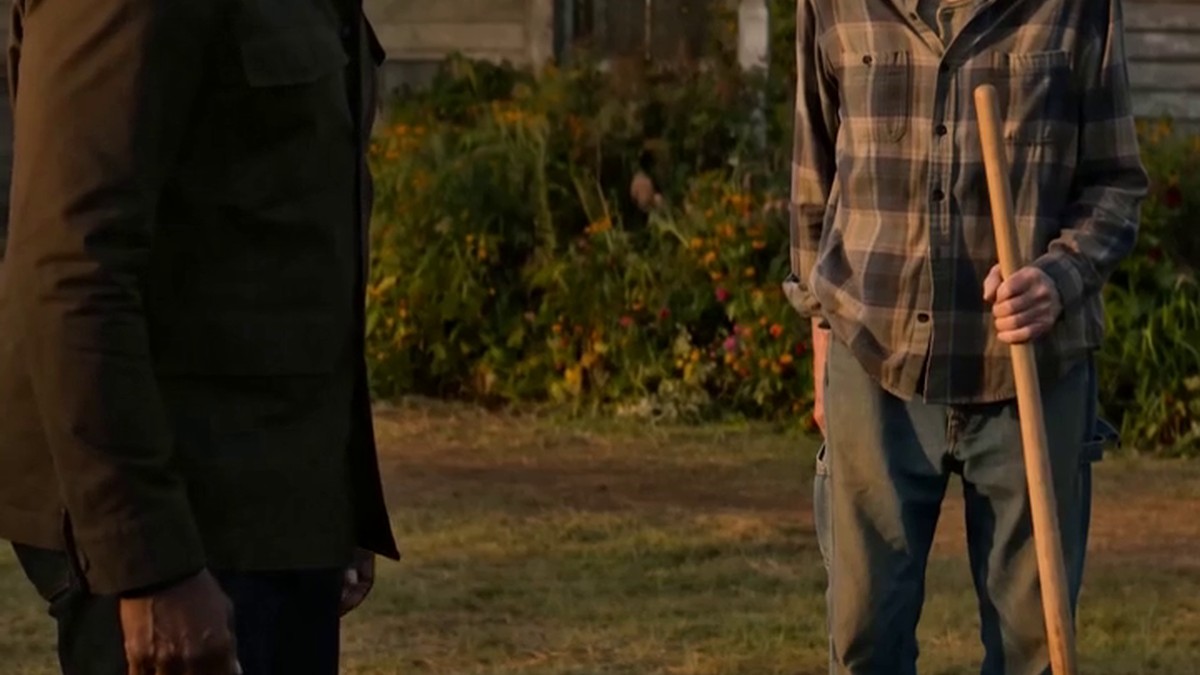
When we pulled up, he let out a choked sound. The yard was pristine. The picket fence stood ramrod straight. The porch had a fresh coat of white paint, and the maple’s trunk gleamed in the sun. And there was Russell, mowing a neat strip around the old well. He saw the car and stopped dead, the mower still humming. Slowly, he killed the engine.
Matthew stepped out, his eyes already wet. “Does somebody live here?”
“No,” I said quietly. “Russell just takes care of it. He’s been doing it for years.”
Matthew turned to the old man. “You did all this? Why? Who are you?”
Russell took off his cap and twisted it in his hands. He looked suddenly, deeply tired. “Because I made a promise to your momma a long time ago. Let’s go inside. You need to see something.”
The interior of that house was spotless—not lived-in, but loved. A lace doily rested on the coffee table. Eleanor’s portrait hung on the wall. Russell walked to an old secretary desk, opened a drawer, and pulled out an envelope tied with a faded yellow ribbon. “She left this for you,” he said.
Matthew’s hands were shaking as he unfolded the letter. Eleanor’s careful cursive filled the page. She wrote that she didn’t blame him for staying away. She understood that sometimes people run not from home, but from the heaviness in their own hearts. She mentioned their terrible fight, how they’d both said things they shouldn’t have, and how her door was never locked. Not for a single day. “You are my son, and I have never stopped loving you,” she wrote. “When you’re ready, come home. Even if I’m not here to open the door, the house will be waiting.”
Matthew wept—deep, gut-wrenching sobs that shook the whole room. When he could finally speak, he looked at Russell, his face raw and broken. “Thank you for this. But why would you do all of this for a woman you weren’t related to?”
Russell eased himself onto a creaky wooden chair. “Almost thirty years back, I was driving the school bus for the county. Winter morning, black ice on Old Mill Road. I lost control. The bus flipped onto its side. There were eighteen children inside, and your mother was the chaperone that day. She didn’t scream, didn’t panic. She crawled through broken glass and pulled kids out. She wrapped a scarf around a little girl’s leg to stop the bleeding. When the paramedics got there, she was the last one to leave that bus. Afterward, the investigation said it was my fault. I sat in my house for a week with the lights off, thinking my life was over. I was ready to swallow every pill in my cabinet. Then your mother marched right up to my door, sat down across from me, and said, ‘A mistake doesn’t own your whole life unless you run from it, Russell. You face it, you make amends where you can, and you keep breathing.’ She saved me that night. She kept coming back to check on me. She made me whole again.”
He paused, his voice cracking. “Years later, when she got sick, I helped out—carried her groceries, chopped her firewood, drove her to doctor’s appointments. Before she passed, she squeezed my hand and whispered, ‘Russell, don’t let the house fall down before Matthew comes back. I know he will, someday. Not to see me, maybe, but to see home.’ I gave her my word. So I kept it.”
Matthew covered his face with both hands. “She waited all those years, and I never came. I was too stubborn, too angry, too ashamed.”
Russell put a calloused hand on his shoulder. “Son, you’re here now. That’s the only part she cared about.”
Matthew stayed in town. For days he walked through the rooms, touching the things his mother had preserved: his old Little League jersey, a hand-carved wooden sailboat, a stack of birthday cards. In the back of a bedroom closet, he found a small cedar box. Inside was a photograph he’d never seen: a much younger Russell standing beside his mother, with a tiny Matthew grinning between them, all posed in front of a yellow school bus. On the back, in his mother’s handwriting, were the words: “People who pull each other out of the wreckage become family—not by blood, but by what they’ve survived together.”
He stared at that photo for a long time. Then he found Russell out on the porch, rocking slowly. “I want to pay you back,” Matthew said. “For the paint, the wood, the shingles—all of it. You gave years of your life to this house.”
Russell shook his head, a faint smile tugging at his lips. “A debt of the heart can’t be settled with a check, son.”
Matthew swallowed. “Then let me do something else. Let me restore this house. Really restore it. Not to sell, but to make it a home again. A place where her spirit can rest and where… where you’re always welcome.”
Russell’s eyes crinkled. “Now that’s a proposition I can agree to.”
All that summer, Matthew worked alongside Russell. They replaced the porch floorboards, fixed the sagging roof, planted her favorite peonies along the fence line. The whole town watched the transformation. Brenda from the post office actually showed up one afternoon lugging a bucket of white paint. She couldn’t quite meet Russell’s eyes. “I’m sorry for flapping my gums all those years,” she mumbled. “I had no idea what you were really doing.”
Russell just chuckled. “In a small town, Brenda, talkin’ is practically a public service. No harm done.”
The most powerful moment came in the fall, when Matthew was cleaning out the old fireplace and found a loose brick. Hidden behind it was a tiny velvet pouch—and inside, a silver locket he’d given his mother for her birthday when he was ten. He sat on the hearth and cried again, but this time it was the kind of crying that heals something in you.
It’s been several years now. Matthew didn’t move back permanently, but he comes from Chicago with his wife and kids every Christmas and for a full month each summer. The house glows with life again: window boxes spilling with geraniums, a swing on the porch, the sound of children’s laughter bouncing off the big maple. Russell doesn’t mow anymore—Matthew insists on hiring a local teenager for that—but Russell still walks over most afternoons, carrying a thermos of sweet tea. He sits on that porch, rocking gently, and watches the bluejays squabble in the tree.
One evening I stopped by with a cherry pie and found him alone on the porch, the sun setting behind him. “Russell, does it feel different now?” I asked.
He looked at the house, its windows glowing warmly, and smiled. “Yeah, Mae. It doesn’t feel like it’s waiting empty anymore. It just feels like it’s waiting for the next visit.”
That story didn’t just change Matthew—it taught our whole town a lesson that’s stuck harder than pine sap. You never know the hidden covenants a person carries. That old man wasn’t trying to steal a house or chase a ghost. He was repaying a kindness so deep it had saved his entire life. A house may belong to someone on paper. But the memories, the forgiveness, the love that fills it? Those belong to anyone with a heart big enough to remember.