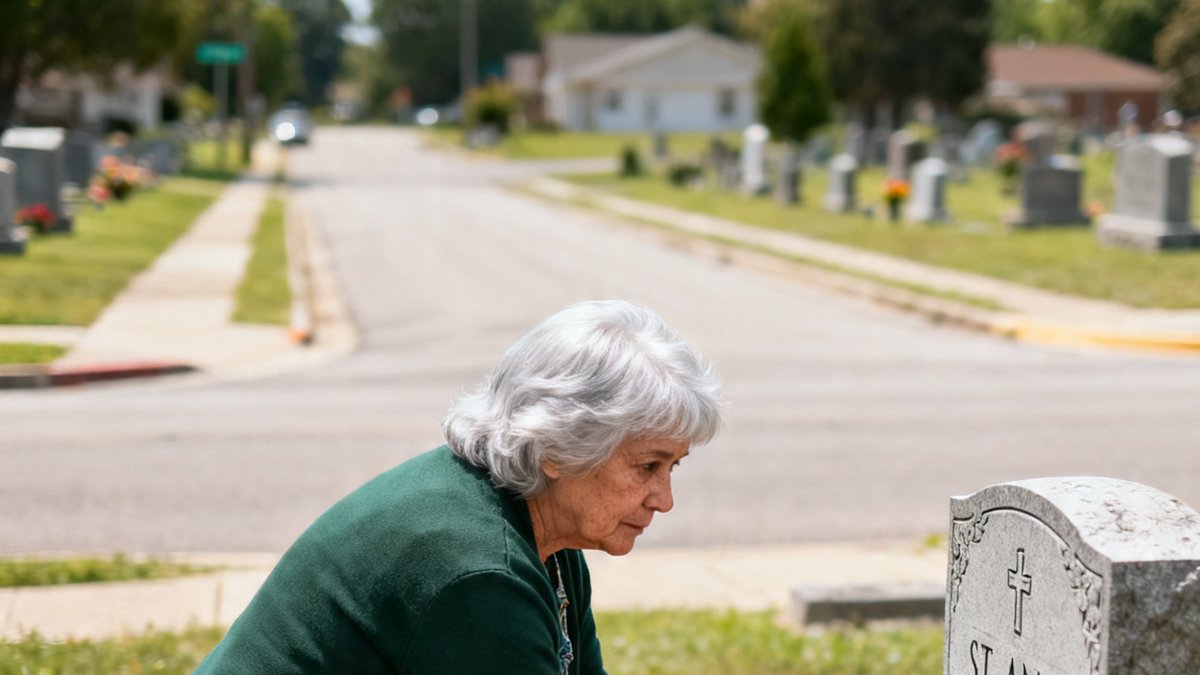
It was a sticky July morning, the kind where the cicadas in the oak trees at St. Anne’s Cemetery already sound frantic by nine a.m. I parked my old Buick in the shade of the big sycamore, grabbed my pruning shears and a bottle of water from the passenger seat, and walked up the gravel path. Just like I’d done every Sunday since Frank died.
I was early. Usually I had the whole place to myself except for the groundskeeper on his riding mower way down by the pond. But that morning someone was already standing at Frank’s headstone. A tall guy in a dark-green polo shirt, early thirties maybe, with a shaved head and a sharp jawline. He was bent over, adjusting something. I slowed down, curious. Nobody else ever visited Frank except our sons, Kevin and Danny, and Danny lived in California now.
The guy straightened up, saw me, and froze like a kid caught stealing. He shoved his hands in his pockets, turned away fast, and started walking toward the back gate. Not running, but not strolling either. By the time I reached the grave, he was already disappearing beyond the old stone wall.
And there, propped against the granite base, was a small glass candle holder with a fresh white candle inside. Next to it, a simple bunch of white carnations tied with a length of navy-blue ribbon. I picked up the ribbon. Embossed in gold letters, it read: “Dad – Michael.”
I stared at that word. Dad. The cicadas suddenly sounded like a roar in my ears. My hand shook. I sat down on the stone bench across from the plot and read it again. I read it about thirty times. Michael. I didn’t know a single Michael in Frank’s life. And the word “dad” wasn’t the kind of thing you used lightly with my husband. He was a quiet man, a man who fixed wiring in old factories, who drank his coffee black and never missed a Sunday football game, sure, but he wasn’t the sentimental type who collected honorary sons.
I sat there until my back started to ache. I thought about walking into the cemetery office, asking if anyone had seen the guy. But what would I say? Some stranger left a candle? No. Something ugly was twisting in my chest, and I needed to figure it out myself.
Frank and I had been married thirty-eight years. We met in October 1979 at a union hall dance in Kensington. I was twenty-two, a shampoo girl with a mouth too loud for my own good. He was twenty-five, an electrician working out of the Local 98 hall, built like a refrigerator and so shy he looked at his shoes when he asked me to dance. We got married six months later. My mother said it was too fast. His mother said he’d better bring me home for Sunday dinners.
We raised two boys in a row house on Torresdale Avenue. I opened a little salon on the first floor, Joan’s Cut & Curl. Frank kept working until his hands gave out. We took the kids down the Shore every August, went camping in the Poconos, argued about money and who forgot to pay the water bill. It was a loud, normal life. No big secrets. No big lies.
At least I thought so.
Frank passed away in May of last year. Pancreatic cancer. Four months from the diagnosis to the end. He died in our bedroom, holding my hand. I thought I knew every corner of that man.
When I got home that Sunday, I called Kevin. He lives in Cherry Hill now, works in insurance. “Hey, Mom. You okay?”
“Yeah. Listen, do you remember your dad ever mentioning anyone named Michael? A friend, a coworker, anything?”
“Michael?” He paused. “No, not that I remember. Why?”
“Just going through some old paperwork,” I lied. “No big deal.” I wasn’t ready to drag my sons into something I didn’t understand yet.
That night I went into the closet we’d shared for thirty years. I hadn’t touched the bottom drawer of his dresser since the funeral. It was still full of his things: his union card, a beat-up Timex, a stack of receipts for furnace parts. Then, in the very back, I found a manila folder I’d never seen before. Inside were bank statements from an account I didn’t know existed. A Wells Fargo checking account in his name only, with a balance of zero—closed now. But the statements showed one consistent pattern: monthly transfers. Four hundred dollars, then later five hundred, to a woman named Christine Harlow. Address in Bristol Township. The transfers went back twenty years, starting in 2004. The last one was one month before he died.
I sat on the floor with those papers and felt my whole life shift, like a heavy piece of furniture sliding across a hardwood floor by itself. Twenty years. My husband had been sending money to another woman for two decades while we worried about our mortgage and I cut corners on grocery bills so the boys could have braces. Where did that money come from? Overtime he never told me about? Side jobs he’d kept off the books?
I didn’t sleep. At dawn I went online and searched for Christine Harlow in Bucks County. One profile matched the age—she’d be in her early sixties now—and the town. I stared at the map. It was a forty-minute drive.
It took me nine days to get in the car.
I pulled up to a small split-level house with peeling white paint and a bird feeder in the front yard. When I rang the bell, a woman opened the door. She was slight, with silver hair cut short like my own, wearing jeans and an apron that smelled faintly of cinnamon. Her face went pale the second she saw me. She knew who I was even before I introduced myself.
“Mrs. Miller?” she said, her voice barely above a whisper.
I nodded. She stepped back and let me inside without another word.
We sat in her kitchen. A plate of apple muffins sat on the counter, untouched. On the refrigerator, held by a magnet shaped like a cheesesteak, was a photo of a young man—that same jawline, those same dark, deep-set eyes. Frank’s eyes.
Christine didn’t look at me. She traced circles on the table with her fingertip. “Michael is thirty-two,” she finally said. “He was born in 1992. I never told Frank until the boy was ten. I didn’t want to cause trouble. I was young, and I made a choice to raise him alone.”
“But then something changed,” I said. It wasn’t an accusation. It was a question I had to ask.
“Michael got sick.” Her voice cracked. “Leukemia. The treatments were brutal, and the bills were… beyond anything I could handle. I had to go to Frank. I told him I didn’t want his marriage. I didn’t want him. I just wanted his son to live.”
She finally looked up. Her eyes were wet. “He never missed a payment. Not for twenty years. He told me you couldn’t know. He said, ‘She doesn’t deserve to suffer because of my mistake.’”
That word—mistake—landed like a slap, even though she said it gently. But I didn’t correct her. I was too busy trying to hold myself together. Because the man who had been so careful, so quiet, had also been a man who, when his secret son was dying, had stepped up without ever letting me feel the weight.
I left half an hour later, the muffins still uneaten.
All week, I walked around my house talking to Frank in my head. Why didn’t you tell me? I would have understood. I would have been furious, broken, devastated—but I would have understood. And then I’d catch myself: maybe I wouldn’t have understood. Maybe he knew I’d leave him, or that I’d never look at him the same way. So he took the path of silence.
The next Sunday, I drove to the cemetery again. I brought fresh flowers—zinnias from my garden, nothing fancy—and placed them next to the little glass candle that had long since burned out. I kept the ribbon in my pocket.
As I stood up, I saw him. Michael. He was near the old oak, maybe thirty feet away, hands jammed into his jacket pockets. He was waiting for me to leave, just like before. But this time he didn’t bolt. He just watched, his face unreadable.
I caught my breath. He had Frank’s eyes, yes, but also Frank’s nervous habit of rubbing a thumb against his forefinger. I saw it even from a distance.
I took a step toward him. Then another. I didn’t know if I was going to yell, cry, introduce myself, or turn and walk away. I only knew that this stranger and I were standing on the same patch of grass, breathing the same heavy summer air, both of us carrying the same man inside our chests.
He didn’t move. I kept walking.