Lily was finally asleep, a warm, damp weight against my chest, but I couldn’t put her down. Not yet. The rocking chair on the porch creaked its familiar complaint, and beyond the railing, the Blue Ridge mountains sank into that bruised-purple hour when the hollows fill with mist and the whip-poor-wills start up. I should have felt peaceful. Instead, I was still replaying Dr. Cynthia Whitmore’s visit like a splinter I couldn’t dig out.
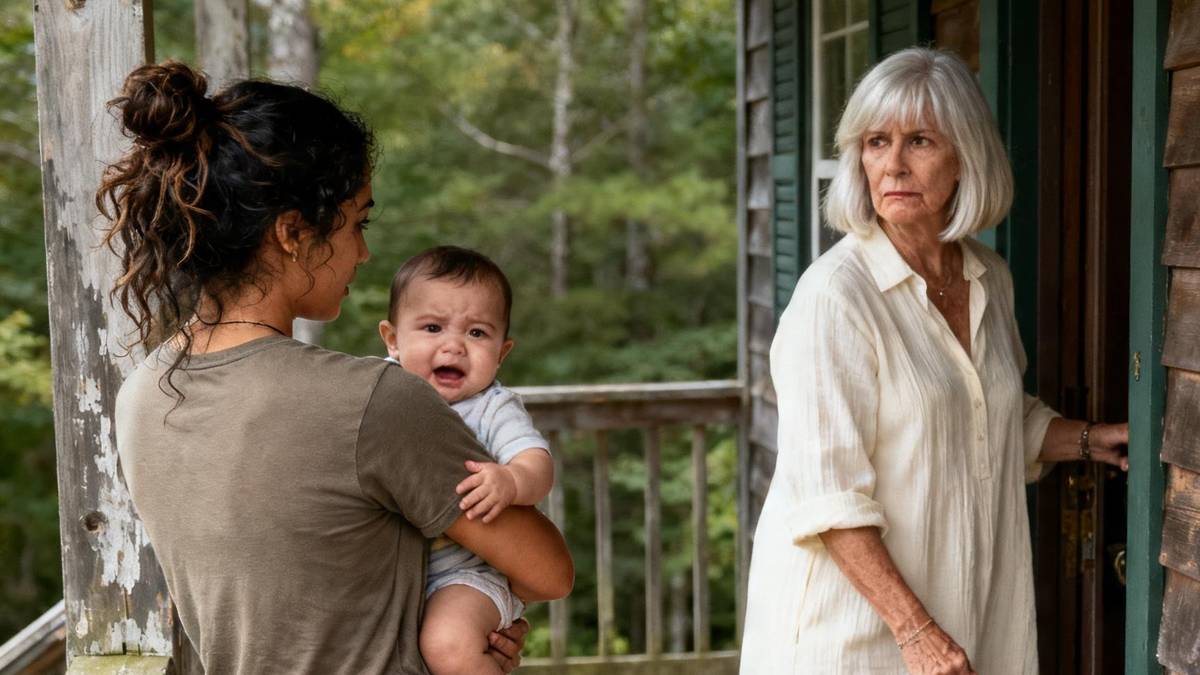
She’d arrived at noon, crisp as a new dollar bill in a cream-colored linen dress that probably cost more than our whole porch furniture. My mother-in-law, professor of Victorian literature at Duke, author of three monographs on George Eliot. She’d swept into the cabin, glanced at the stack of unopened mail on the sideboard, the coffee mug I’d been reheating since six a.m., and said, “Oh, Sadie. You’re still in your pajama pants?”
I’d counted to three while Lily squirmed and fussed. Then I’d said, “She’s teething. I’m operating on about forty minutes of sleep. Can I get you some iced tea?”
She’d waved a hand. “No, no, don’t trouble yourself. I see you haven’t gotten around to the dusting.”
The thing about Cynthia is that she never raises her voice. Her criticisms arrive wrapped in a sort of academic regret, as if she’s merely observing a failed experiment. I grew up in this same mountain town, just outside Boone, raised by my grandmother Mae in a creaky farmhouse that smelled of woodsmoke and yeast. Mae ran a little roadside jam stand and taught me how to tell a king snake from a copperhead. When she died three years ago, right before Lily was born, I felt the ground tip sideways. Now I was standing in the very house she’d left me, trying to keep a baby alive with no mother, no grandmother, and a husband who commuted to Asheville every dawn.
Cynthia settled into the wingback chair and crossed her ankles. “How’s my little Lily?” She pronounced it with a theatrical softness, as if the name were a line from a poem she’d only half-approved of.
“She’s been fussy. I was up walking her most of the night.”
“Mmm. Travis told me you still haven’t found a nanny?”
“We’re looking. But it’s—expensive.”
Cynthia smoothed a nonexistent wrinkle on her sleeve. “I do understand the constraints. When Travis was small, I had my parents to help. Of course, I was already working on my doctorate. I never had a talent for the domestic.”
She said it the way someone might admit they can’t whistle. Light, incurious. I remembered, right then, a story Travis once told me about how his mother would lock her study door when he came home from school, and leave a note that said *Please do not disturb unless bleeding*. He’d laughed when he told it, but his eyes hadn’t.
Lily started to cry again, a thin, reedy wail. I lifted her from the bassinet and began to rock her, bouncing on my heels. Cynthia watched with the detached interest of a birder observing a species she hadn’t yet catalogued.
“You know,” she said, “I gave you that copy of *Middlemarch* when Lily was born. I thought it might be a comfort. Have you had a chance to open it?”
I had. It was still on the nightstand, the bookmark stuck on page six. I’d been too exhausted to focus on sentences that ran half a page. “A little. It’s been a tough few months.”
“Tough,” she repeated. “Well, I do hope you’re not letting yourself go completely. A mind needs nourishment, even in the trenches, so to speak. I’m sure my son didn’t marry a woman who only talks about diaper brands.”
There it was. The jab wrapped in intellectual gauze. I stopped bouncing. Lily squirmed and hiccuped against my shoulder.
“Cynthia,” I said, my voice too calm, “when Travis was a baby, did you read *Middlemarch* while he was cutting teeth?”
She blinked. “Heavens, no. My parents took him to the coast that summer. I had a paper to finish. To be blunt, I’ve never been the sort of grandmother who wants to babysit. I’m a scholar first. I don’t regret that.”
“Then what kind of grandmother *are* you?” I asked. “The kind that shows up to inspect the house and leaves without ever holding her?”
Lily chose that moment to let out a shuddering sigh and go quiet. The silence between us stretched like a wire pulled tight. Cynthia’s mouth tightened, just slightly. She stood, collected her handbag—a vintage leather satchel that probably cost more than our monthly mortgage—and said, “I can see you’re overtired. We’ll talk another time.”
She didn’t look at the baby. Not once.
I let her go. Then I sat down on the porch floor, right there with Lily in my lap, and cried until the wooden planks were damp under my knees.
That evening, after I’d put the baby down, I called Travis at the office in Asheville. He answered on the second ring, a little breathless. “Hey, Sade. Everything okay?”
“No,” I said. “Your mother was here. She basically told me I’m not interesting enough to read a novel, and she’s not interested in being a grandmother beyond the title. I can’t do this alone anymore, Trav. I’m losing my mind. My teeth ache. My back aches. I haven’t hiked the ridge trail in eight months. I smell like spit-up and I’m starting to forget I used to know the names of all the wildflowers on this mountain. I need help. Real help. Not a lecture on George Eliot.”
There was a long pause. I heard the hum of the strip mall next to his office, the distant clatter of a semi on the highway. Then he said, “She called me already. Told me you’d been ‘confrontational.’ I asked her, ‘Did you offer to hold the baby?’ She said no. So I told her, ‘Then you don’t get to call yourself a grandmother.’”
My throat tightened. “You said that?”
“I said that, and a few other things. I’m sorry, Sade. I should’ve seen it sooner. She’s been pulling this act since I was a kid. She actually said to me once that she’d rather read about life than live it. It’s not you. It’s her. I’ll be home in an hour. We’ll figure out a nanny. We’ll get you into the dentist. We’ll make it work, I promise.”
I closed my eyes and let the dial tone fade. For the first time in weeks, the knot in my chest loosened a fraction.
A month later, things looked different. We’d hired a neighbor, Betty, a seventy-two-year-old retired school bus driver with a laugh like a crow, who came three mornings a week for ten dollars an hour. The first day she arrived, she kicked off her sneakers, scooped Lily out of my arms, and said, “Go on now. Git. Take a walk before I change my mind.” I stumbled out onto the trail behind the house with my legs shaking, and cried again—this time from relief.
I started small. Fifteen minutes up to the ridgeline where the galax leaves gleamed in the underbrush, where I’d once followed my grandmother Mae on her endless foraging walks. She’d point out Solomon’s seal, bloodroot, the way the black cohosh stalk bent just so after a rain. “You pay attention to the little things, Sadie-girl,” she’d say. “They’re the ones that keep you anchored.” I’d been forgetting.
One afternoon, about two weeks after Betty started, I came back from a longer hike, hair damp with sweat, and found a package sitting on the porch swing. A flat, brown-papered parcel with a Raleigh postmark and Cynthia’s handwriting on the address label.
I almost tossed it in the bin out of spite. Instead, I tore it open. Inside lay a children’s book—an old, slightly foxed copy of *The Secret Garden* with a silk ribbon marker. Tucked into the front cover was a note on heavy cream stationery.
*Sadie, I am not good at this. I don’t know how to be the grandmother you want, and I won’t pretend. But I do know how to teach a child to love a book. If you’ll permit it, I’d like to read this to Lily, chapter by chapter, when she’s old enough to sit still for five minutes. No powdered milk required. — C.*
I read it three times, looking for the hidden barb. All I found was a tiny ink smudge in the corner, as if she’d held the pen there a moment too long. I didn’t know if I could trust it. But the book was real, its spine softened, its pages smelling of someone else’s attic. I set it on the mantlepiece next to Mae’s old jam jar.
That evening, I sat on the porch with Lily bundled in a quilt on my lap, her eyes tracking the last flickers of light over the mountains. She’d just started to smile—not gas, not reflex, but the real thing, a gummy sunrise that took my breath away. I thought of Mae, how she’d held my hand on this very porch when I was eight and my mother had decided not to come for Christmas. “We got each other,” she’d said, and then she’d made hot cocoa with a candy cane stirred in until it melted. I would be that for Lily. Whatever form “family” took—whether it was Betty with her crow laugh, a book from a reluctant professor, or just the two of us and the mountains—I’d anchor her in the little things.
A whip-poor-will called from the hollow, and Lily’s eyelids drooped. I rocked her gently, the chair’s rhythm settling into the old boards. The mist was rising again, wrapping the ridges in a soft, blue haze. I didn’t go inside. Not yet. I just sat there, breathing in the pine and the damp earth, and let the quiet hold me together.