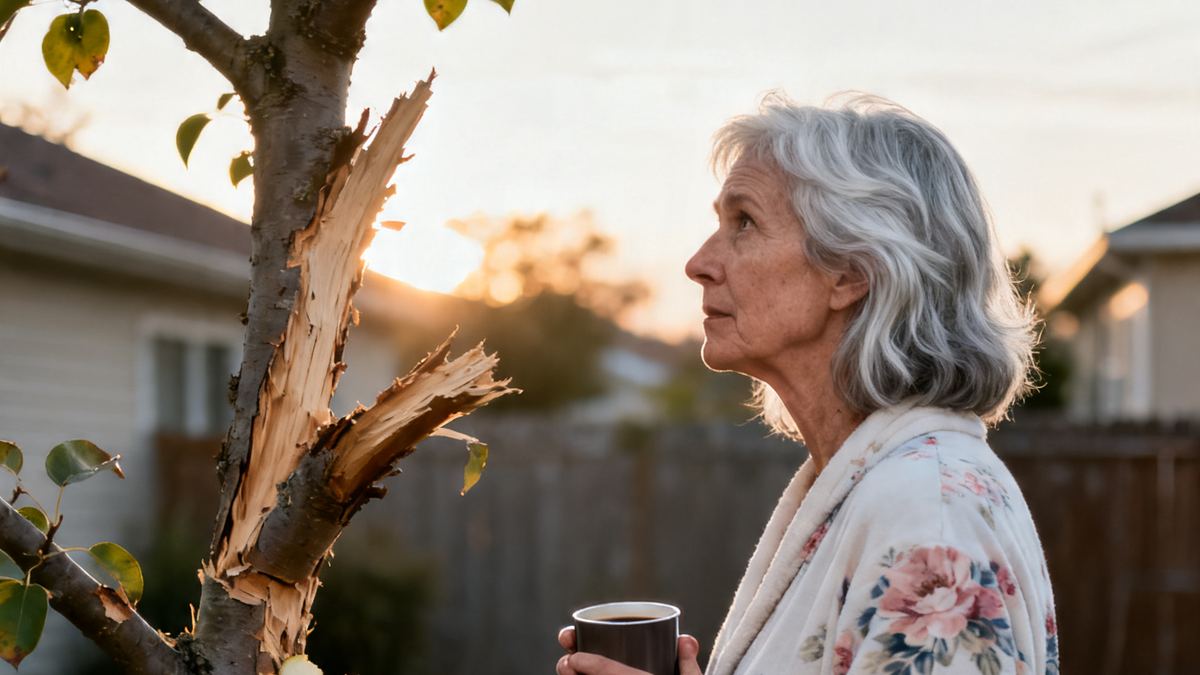
Teresa woke to a yard that looked like a battlefield. Not a single pear dangled from the old Bartlett tree Frank had planted. The grass was littered with fruit—dozens of them, smashed into the turf, rolled against the fence, some split open to the pale flesh. A low branch hung by a strip of bark. The dew made the carnage gleam. Her first thought wasn’t about the pears. It was that someone had put their hands on the last living thing Frank had touched.
She stood on the back steps in her robe and slippers, coffee going cold in her mug, looking but not really seeing. Then she set the mug down, walked inside, and pulled the memory card from the little game camera she’d hidden in the barberry bush three months ago.
Frank had planted the tree the spring after his numbers stopped improving. He’d come home from the oncologist with that deliberate calm he wore like armor, handed her a potted whip from the nursery, and said, “We’re putting it in the south corner. Best light.” She’d wanted to scream about soil bacteria and lifting restrictions, but he was already digging with a trowel, slow and steady, sweat beading above his lip on a sixty-degree day. They finished together, her hands over his on the slender trunk. “Give it time,” he said. “One day it’s going to bury you in fruit.” He died that October.
The tree produced nothing for three years. She’d stand by it some evenings, furious at its bare branches, then guilty for the fury. Then came a spring so thick with white blossoms that bees made the whole yard hum. By September, the branches bowed with pears like green teardrops. She couldn’t keep up. She filled bags for the mail carrier, left crates on the porch with a “free” sign, let the neighborhood kids climb the lower limbs with their parents watching from the sidewalk. It became a living landmark, and for Teresa, it was a quiet kind of Frank still in the world.
Then Cheryl moved in next door. The first sign was the dumpster that sat in the driveway for two weeks, swallowing the previous owner’s rosebushes and lilacs. Then came the black Lexus with vanity plates that read PRSTN. Cheryl herself strutted out in a blinding white pantsuit to supervise a crew laying sterile white gravel where the flower beds had been. By week three, she was at Teresa’s front door.
“I’m Cheryl,” she said, eyes scanning past Teresa into the yard. “We need to have a conversation about that tree.”
Teresa smiled, the automatic, neighborly kind. “The pear tree? It’s a beauty, isn’t it?”
“It’s an eyesore. Branches drooping over my property line. The fruit is going to draw rats.”
“I keep it pruned. Anything that falls on your side, you’re welcome to take.”
“I don’t want your pears. I want it gone. It’s lowering property values.”
The smile left Teresa’s face. “That tree isn’t coming down.”
Cheryl’s lips went thin as razor wire. “Then I’ll make sure you regret it.”
She didn’t elaborate. Just turned on her heel and clicked back to her perfect gravel.
After that, Teresa felt eyes on her every time she stepped outside. She’d catch movement in Cheryl’s kitchen window, the blinds swaying. The complaints to the HOA started: an anonymous tip about “vermin attraction,” a form letter about “unapproved vegetation.” An inspector came, took one look at the healthy, well-maintained tree, and dismissed the case. Cheryl’s rage went quiet, and that’s when Teresa’s late husband’s voice crept back into her head—*If you think you need to check the lock twice, just do it. You can always laugh about it later.* She ordered a motion-activated trail camera, the kind deer hunters use, and strapped it to a shrub pointing at the side gate and the tree’s trunk. She felt ridiculous. Then she didn’t.
The morning of the slaughter, Teresa sat at her kitchen table, laptop open, video file loading. The time stamp read 2:34 a.m. A figure in dark clothes squeezed through the gate. Cheryl. She wore garden gloves and carried a long pole with a metal hook on the end. The infrared made her look like a ghost, but every motion was unmistakable. She hooked a branch and yanked, shaking loose cascades of pears. She grabbed handfuls and hurled them across the lawn. She stepped into Teresa’s yard, stomped fruit under her sneakers, then deliberately snapped a two-inch limb over her knee as if it were a stick of kindling. Before she left, she scooped up broken branches and tossed them back over the fence like trash.
Teresa watched it twice. On the third viewing, she made screen captures.
She didn’t call the police at first. Instead, she drove to the print shop and had three of the crispest shots blown up to poster size—Cheryl’s face clear as day, the hook in the branches, the sneaker crushing a pear. At home, she mounted them on a big sandwich board and wheeled it to the sidewalk. She wrote in bold marker: *“Wondering who destroyed my late husband’s tree? Here she is.”*
By eight-fifteen, a woman walking her golden retriever stopped and pulled out her phone. By nine, a cluster of neighbors had gathered, murmuring. By ten, Cheryl burst out of her front door in yoga pants, face blotchy red.
“Take that down right now!” she screamed, jabbing a finger at the board. “That’s defamation! I’ll sue you for every cent!”
Teresa pulled out her phone without a word, tapped the screen, and held it up. The video played, the hook jerking, the branch snapping. Cheryl’s eyes went wide, like a deer seeing headlights too late.
“I—that’s not—you can’t prove that was me!”
But the crowd had already formed a silent jury. Terry from two doors down folded his arms and said, “We all called the cops, Cheryl. They’re on their way.”
The police arrived ten minutes later. Teresa handed over the memory card and gave a statement. Three neighbors corroborated past threats they’d overheard. Cheryl tried to spin it as a misunderstanding, but the footage left zero room for doubt. By the end of the month, she’d been found guilty of criminal mischief and trespassing. The court ordered her to pay restitution for the damage and the arborist’s care, plus community service—and the judge tacked on a requirement to plant three new fruit trees in the neighborhood park as a public apology.
That fall, the old Bartlett didn’t bear much. A handful of pears clung to the remaining limbs, small but perfectly sweet. The scar where the branch had torn healed into a dark knot. Teresa canned what she could and shared the jars anyway, leaving one on the porch for the mail carrier with a note that said simply, “From Frank’s tree.”
Winter came and went. The next spring, the blossoms returned thicker than ever, and by late summer, the tree was so heavy with fruit that she had to prop the branches with lumber. Kids rang the doorbell again, and she let them pick all they could carry.
She never mentioned Cheryl again, not even when the disgraced neighbor sold her house at a loss and moved away two years later. But sometimes, on quiet evenings, Teresa would stand under the tree, one palm flat against the trunk, and think about what Frank had said about roots. He was right. You could snap the branches. You could stomp the fruit into the dirt. But what someone planted with love—that always found a way to keep growing.