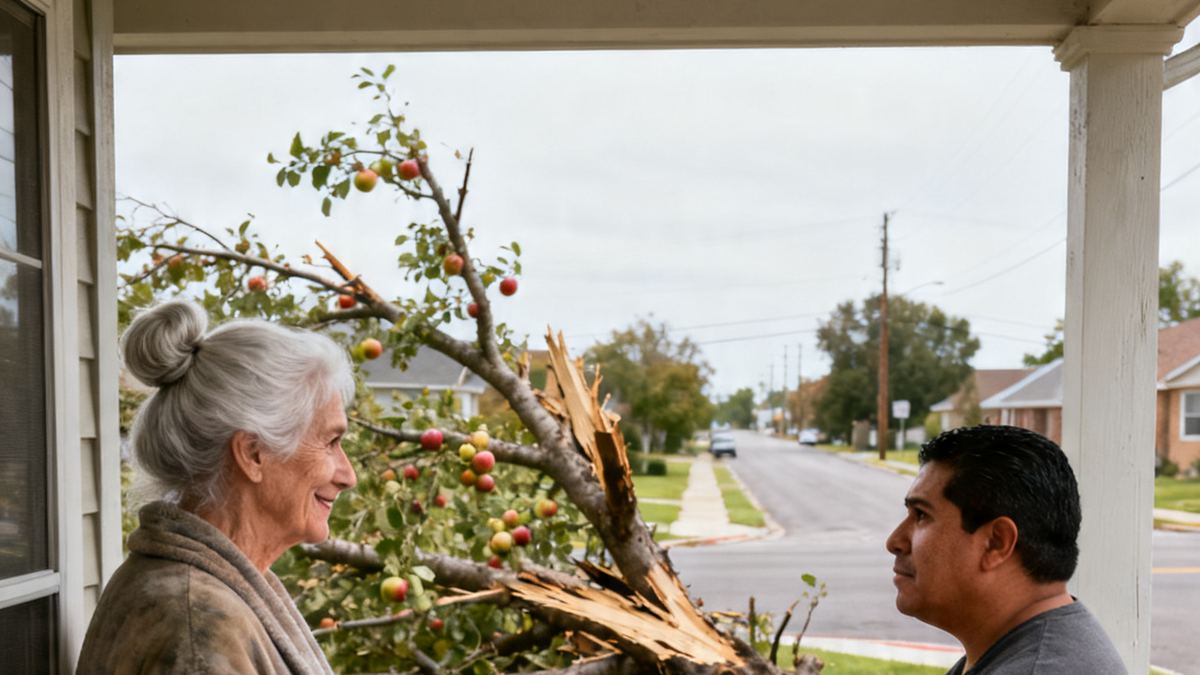
The morning I found my front yard buried in apples, I didn’t scream, didn’t storm across the lawn, didn’t even call the police — not yet. I just stood on my back stoop in my bathrobe, coffee mug warming my hands, staring at the carnage. Fuji apples by the dozen, split and bruised, scattered all over the grass, the stone path, the daylilies. Entire branches dangled from the trunk like broken arms. And the top of the tree, Ben’s tree, looked stripped bare.
I smiled.
Then I went inside, poured a fresh cup, and pulled the memory card from the little trail camera I’d wedged into the rhododendron bush six weeks earlier. That camera had cost me a hundred and forty-nine dollars at the hunting supply place over in Fletcher. At the time I felt ridiculous. But Ben always said a woman living alone ought to trust the feeling that makes her double-check the back door.
The feeling had a name: Kyle Weston, my next-door neighbor.
—
To understand why I was so calm, you have to go back eleven years, to a September afternoon when Ben dragged a skinny little sapling home from the farmers’ market. He was already sick then, though neither of us would say it out loud unless we had to. He’d been diagnosed with ALS the previous spring, and by fall his left hand was starting to betray him. But that day he came through the gate with the tree in a five-gallon bucket, a goofy grin on his face, and announced he was planting an orchard.
“This is a Fuji,” he said. “In five years we’ll be drowning in apples.”
“In five years you’ll be annoying me with apples,” I told him. I grabbed a shovel before he could try to do it himself. He directed from a lawn chair, drinking iced tea and telling me I wasn’t digging the hole deep enough. When we finally set the roots in the ground, he knelt — slowly, hands shaking — and pressed the soil down with his palms. “Give it time,” he said. “One day it’ll surprise you.”
Ben died that January. For the first two years after, the tree gave me nothing — not a single blossom. I almost took a chainsaw to it more than once because every time I looked at it, I felt that hollow ache in my chest all over again. But I let it stand.
Then year three came. A warm April, a froth of pink-white blooms. That fall I picked seven apples. By year six, I couldn’t give them away fast enough. The tree became a neighborhood fixture. Kids rang the bell to ask if they could grab a snack. I donated boxes to the elementary school bake sale. I learned to make butter, sauce, cider. And every time I bit into one of those crisp, sweet apples, I tasted the stubbornness of a man who refused to let his body stop him from leaving something good behind.
—
Kyle Weston moved into the bungalow next door two springs ago. He arrived in a glossy black Escalade that looked ridiculous on our gravel lane, wearing mirrored sunglasses even when the sky was overcast. Within a week he’d ripped out a fifty-year-old rhododendron hedge and replaced it with those fussy little boxwoods and a river of white rock. Within two weeks he’d filed three noise complaints about a family of woodpeckers.
The first time he spoke to me, I was repainting the porch swing. He didn’t introduce himself properly — just walked up, pointed over the fence, and said, “That tree is a problem.”
I blinked. “The apple tree?”
“It drops leaves. It drops fruit. The branches hang over my property line. I had to sweep my patio three times last October.”
“I can trim the branches,” I said. “I do it every year anyway.”
“I want the whole thing gone.”
I set down my paintbrush. “This tree was planted by my late husband. It’s not going anywhere.”
His jaw tightened. He had that look — the one that says, *I’m used to getting what I want right now.* “I’m trying to be civil. That tree is an eyesore, and it’s dragging down property values. Do you understand how much a house on this street could sell for if the curb appeal were right?”
“I’m not selling.”
“Then I’ll make this official.”
He did. A week later I got a letter from the Woodside Hills community compliance board — a volunteer group that enforces our neighborhood covenants. The complaint was full of exaggerations: the tree was a “hazard,” its roots were destroying his driveway, the fruit attracted wasps and rodents. A woman named Dorothy Haskins came out to inspect. She was around seventy, sharp as a tack, and had lived in the neighborhood since before they paved the main road. She circled the tree twice, took a few photos, then turned to Kyle, who was hovering near the fence.
“There’s no violation here,” she said. “That’s one of the healthiest fruit trees I’ve seen in years. And Mr. Weston, I noticed your driveway — the nearest crack is twenty-two feet from the trunk. Roots don’t leapfrog.”
Kyle’s face went dark. He didn’t say another word to me after that day, but I felt his eyes on me every time I stepped outside. The kitchen window facing my yard never had the blinds open, but I knew he was there. I started double-checking the gate latch at night. I bought the trail camera.
—
The night it happened, I slept straight through. The camera didn’t miss a frame.
At 2:18 a.m., the motion sensor tripped. The video showed a figure in dark clothes coming through the side gate from the direction of Kyle’s yard. He was wearing work gloves and carrying a pole pruner with an orange handle — one of those tree-trimming tools with a rope and a curved blade. And a five-gallon bucket. I recognized the hunched, angry way he moved.
He didn’t pick the apples. He punished the tree. He hooked branches and yanked them down until they cracked. He stripped clusters of fruit with his bare hands and tossed them into my yard like garbage. He kicked fallen apples into the flower beds. At one point he dragged a broken limb across the lawn and hurled it back over the fence onto his own property, as if rehearsing an alibi. He was out there for forty-one minutes.
When he was done, the tree looked like it had survived a tornado. The whole time, my camera recorded in crisp 1080p, every frame time-stamped and lit by the neighbor’s motion floodlight that he’d installed to “improve security.”
I sat at my kitchen table that morning and watched the footage twice. Then I called the non-emergency sheriff’s line and told the dispatcher I had evidence of criminal trespass and property damage. The deputy said they could send someone by ten. I told her that would be perfect.
After I hung up, I drove to Walgreens and printed six 8×10 photos — clear stills of Kyle’s face, the pruner, the snapped branches. I wrote a single sentence in thick black marker on a piece of poster board: *Wondering who trashed a widow’s apple tree at 2:18 a.m.? Meet my neighbor.* I taped the photos beneath the words and set the sign at the end of my driveway, facing the road, at 7:30.
—
By eight o’clock, people had started stopping. Joggers. Dog walkers. The woman from across the street who’d baked my apples into her famous galette. A couple of men from the compliance board came by, phones out, taking pictures of the pictures. Our little mountain community is friendly, but it has a long memory, and people had already heard about the feud.
Kyle came barreling out of his house around nine-thirty. He was still in his slippers, unshaven, his face flushed. When he saw the sign, he nearly tore it off the post.
“You can’t do this!” he shouted, jabbing a finger at me. “This is defamation. I’ll sue you for everything you own.”
I didn’t raise my voice. I pulled out my phone, tapped the screen, and turned it toward the dozen or so people gathered on the sidewalk. The video started playing immediately — the dark figure, the pole pruner, the unmistakable scowl caught in the floodlight. I’d muted the sound, but the images said everything. Kyle’s jaw went slack. The crowd went quiet.
When the deputy pulled up three minutes later, I was still holding my phone. I handed over the memory card, gave a statement, and two neighbors stepped forward to say they’d heard him threaten to “take care of that damn tree” weeks earlier. By noon, the whole town of Hendersonville seemed to know what had happened.
—
The legal process took a few months. Kyle was charged with criminal mischief and trespassing. In lieu of jail time, he was ordered to pay for a certified arborist to assess and treat the tree, cover all my court costs, and — as a community restitution — plant five native fruit trees in Millbrook Park with his own hands, on a Saturday morning, supervised by the town gardening club. Dorothy Haskins made sure the local paper covered it.
The apple tree had a rough year. The arborist had to prune away some jagged breaks, and the following spring it bloomed late, sparser. But it bloomed. By September, I counted eleven apples, and I swear they were the sweetest ones yet. Kyle put his house on the market in October and was gone by Thanksgiving. A young couple with twin toddlers bought the place, and the first thing they asked was whether they could pick a few apples come autumn.
Last week I walked out at sunrise and saw a brand-new branch sprouting from an old wound, covered in tiny green buds. I thought of Ben leaning over that sapling in his lawn chair, grinning like he’d just planted the whole world. I think he would’ve liked the way it all turned out — not the meanness, but the stubborn, quiet growing back. The kind of thing that happens when the roots run deep and you just refuse to quit.