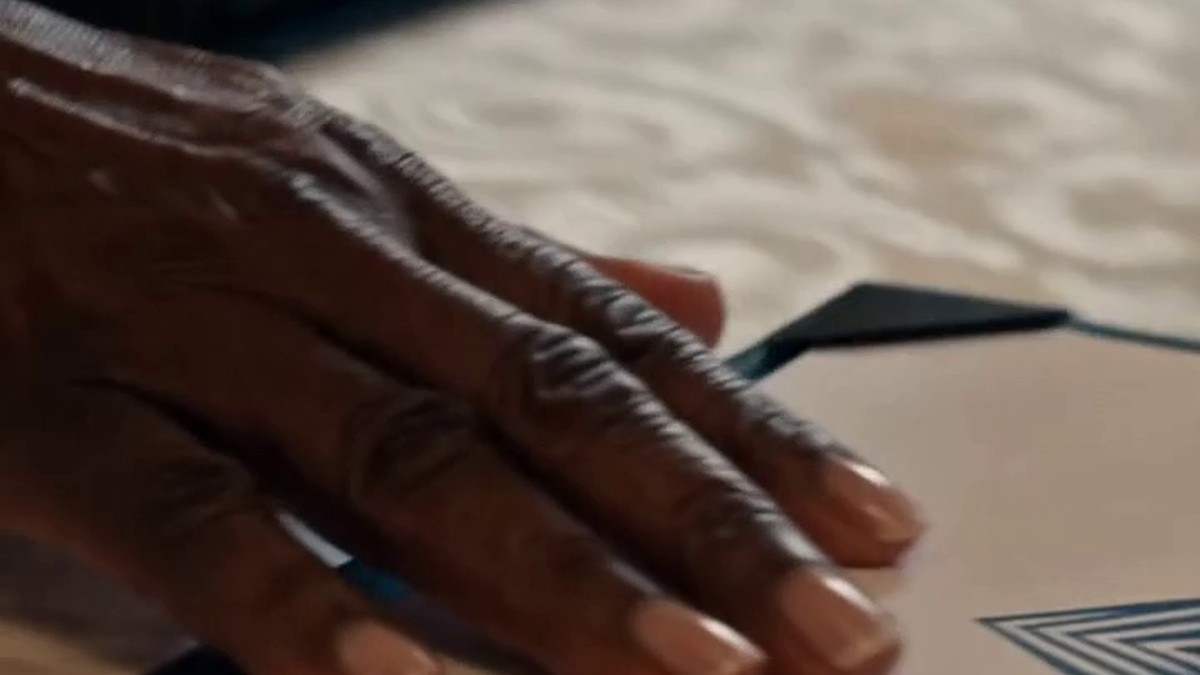
She walked in wearing a simple navy dress, her hands wrapped around that worn leather purse as if it held her whole world. Her smile was quiet, untroubled—the same smile that tucked me in as a child, the same smile that stretched a dollar into miracles and never once asked for applause. She didn’t look rich. She didn’t look powerful. She looked exactly like the woman who had raised me on tired hands, silent sacrifices, and a love that needed no spotlight. But I noticed a stillness in her that evening, a glint in her hazel eyes I’d glimpsed only a handful of times before—when life had cornered us and she’d somehow found a door that no one else could see.
My mother-in-law saw only the dress.
At the reception, Victoria swept toward our table with a champagne flute in her diamond-crusted grip. She ran her gaze over my mother as though she were a stain on the tablecloth, her features twisting into a mask of cold contempt. “Get her out of the photographs,” she announced, her voice pitched to carry. “I will not have my family’s legacy framed beside a charity case.”
My mother met her stare without flinching. “I’m here for my daughter. No photograph requires my permission.”
Before I could draw another breath, Victoria’s open palm cracked across my mother’s cheek.
The room froze. Crystal seemed to stop vibrating. Every guest at our wedding turned into a statue.
“You don’t belong at this table,” Victoria said, breathing hard now, her fury feeding on the silence. “My son did not marry poverty.”
My hands began to tremble so hard I thought the champagne glass might shatter.
“She’s my mother,” I whispered, the words scraping out of a throat gone dry.
Victoria laughed—a bright, tinny thing that splintered the silence. She called my mother a peasant, a stain on the family name, someone with no class, no standing, no right to breathe the same air as important people. Her friends tittered behind their gloved hands. My husband, Daniel, told her to stop, but even his voice sounded thin, swallowed by the weight of a lifetime of obedience.
My mother didn’t cry.
She didn’t scream.
She just stood there, a bright red mark blooming on her cheek, radiating a calm so deep it made the air crush my lungs. Then, slowly, she straightened up.
She set that old purse on the tablecloth, unhooked the brass clasp, and drew out a slim folder. Victoria’s laugh came again at first—a nervous, dismissive giggle, like this was part of some tasteless joke. But then my mother laid the top page in front of her.
The moment Victoria’s eyes landed on the embossed logo at the top, the smile died on her lips. Her face drained of color so fast it looked like a trick of the light. I saw her manicured fingers begin to shake.
And before she could speak, my mother’s voice cut through the ballroom, strong and soft all at once, a single sentence that made every guest whip their heads toward my mother-in-law as if they’d been slapped themselves.
“I’m the woman who holds the note on your family’s company, Victoria—and this morning, my board voted to call in the full balance.”
The words landed like a thunderclap. Daniel’s father, Jonathan, dropped his fork. Victoria’s mouth opened and closed, a fish gasping on dry land. I could see the calculations shattering behind her eyes: the endless social climb, the charity galas she’d banked her reputation on, the penthouse and the summer house and the private club memberships—all of it resting on a mountain of debt that had been quietly crushing them for years. A debt that my mother’s holding company had acquired, piece by piece, until the Prescotts were dancing on her string.
My mother didn’t raise her voice. She slid a second page across the linen. It was a forbearance agreement, already prepared, bearing the seal of Fairchild Holdings—a name I’d only ever seen in the business section of newspapers. A blank line waited for a signature.
“For three years your family has been coming to my board begging for extensions,” she said. “I gave them to you, because I wanted my daughter to meet your son without your shadow hanging over her. But tonight you struck my child’s mother. So now the extensions end. By noon tomorrow, every asset you’ve ever flaunted will be seized to satisfy a debt you didn’t even know you owed. Unless…”
Victoria’s breath hitched. “Unless what?”
My mother reached into the purse one more time and pulled out a single sheet of paper—a promissory note, already prepared, leaving a space for a signature. She placed it beside the stack, then looked directly at my mother-in-law, and her calm was no longer soft. It was granite.
“Unless you kneel right here, in front of every guest you wanted to impress, and apologize. Not to me. To my daughter. Then I’ll sign this note forgiving the balance in full, and you can keep your dignity and a roof over your head.”
The room was so quiet I could hear the distant clink of spoons in the kitchen. Daniel moved to my side and I felt his hand slide into mine, warm and solid—and for the first time that day, I saw his jaw set with something that looked like freedom.
Victoria’s eyes darted around. Her society friends averted their gazes. Her son stood beside me, not her. The power she’d wielded her whole life had simply evaporated, exposed for what it really was: a mountain of borrowed air.
Her knees hit the marble floor with a dull thud. The sound was answered by a collective gasp, then nothing. She forced the words through clenched teeth, one by one, her voice slick with humiliation.
“I am sorry. I was cruel. I was wrong.”
My mother let the silence stretch until it was unbearable. Then she lifted the promissory note, picked up a pen, and scribbled her signature across the blank line. She folded the paper once, pressed it into Victoria’s trembling hand, and raised her to her feet with a gentleness that only made the moment cut deeper.
“You’ll have what you need,” my mother said quietly, the words meant for Victoria alone. “Don’t make me come back.”
She picked up her old purse and turned to me. I threw my arms around her, finally letting the tears come, and I felt her heartbeat steady against my chest—the same heartbeat that had carried me through every storm of my childhood.
The wedding reception ended early. Daniel and I left together, hand in hand, his mother’s hysterics fading behind us like static on a radio. In the car, I sat beside my mother, the red mark on her cheek already fading, and asked the question that burned in my throat.
“Why didn’t you tell me? All these years… you let me believe we were barely getting by, that you were just—”
Her eyes softened. “Because I wanted you to marry for love, not leverage. I knew who Daniel’s family was long before you met him. I watched you fall for the man, not the name, and I wasn’t going to let my money speak before you did. I’m sorry I had to deceive you. I hope you can forgive me.”
I heard the apology, but a small, hurt part of me asked if I’d ever truly known my own mother. The woman who’d signed permission slips with the same careful hand that had just rewritten a family’s fate. The answer didn’t come easily. It lodged in my chest, a splinter I’d carry for a long time.
The next morning, the papers ran a small notice about a major corporate restructuring. But the story that mattered was already written on my heart—a story with more questions than answers. My mother, the woman they called poor, had given me a wedding gift no registry could ever list: the truth that strength wears quiet dresses, and true power never needs to shout. And yet, in the quiet hours that followed, I learned that even love built on sacrifice can leave a faint bruise, a reminder that the hands that lift you sometimes keep secrets of their own.